

Many Melbourne small business owners feel overwhelmed by website analytics dashboards filled with confusing metrics and charts. 68% of small business owners hesitate to use analytics because they perceive it as too complex. This guide removes that confusion by showing you exactly how to use analytics to improve your website performance, strengthen local SEO, and drive real business growth through data-driven decisions.
Table of Contents
- Understanding Website Analytics For Small Businesses
- Benefits Of Analytics For Small Business Websites
- Leveraging Analytics For Local Seo
- Common Misconceptions About Website Analytics
- Framework For Effective Analytics Use In Small Business Websites
- Selecting The Right Analytics Tools For Small Businesses
- Using Analytics To Improve Website Performance
- Tracking Marketing Effectiveness With Analytics
- Bridging Analytics And Local Seo Strategy
- Boost Your Melbourne Small Business With Expert Analytics And Seo
Key Takeaways
| Point | Details |
|---|---|
| Analytics drives informed decisions | Understanding user behavior through data increases conversions and business growth. |
| Productivity gains are substantial | Small businesses see 63% productivity improvements by leveraging analytics effectively. |
| Local SEO benefits significantly | Analytics-driven local SEO optimizations can deliver 70% more local traffic to your website. |
| Tools are now accessible | Modern analytics platforms remove technical barriers that previously held back small business adoption. |
| Framework ensures success | A decision-driven approach aligns analytics initiatives with clear business goals for measurable results. |
Understanding Website Analytics for Small Businesses
Website analytics tracks how visitors interact with your site, revealing patterns in their behavior, preferences, and actions. For Melbourne trades and professional services, this means understanding which pages attract enquiries, where visitors drop off, and which marketing channels deliver qualified leads.
The foundation of website design and local SEO success lies in understanding your audience. Companies that use web analytics effectively are 2.8× more likely to achieve their marketing goals. Data-driven decision making replaces guesswork with evidence, allowing you to invest time and money where they actually work.
Core analytics metrics matter most for local businesses:
- Visitor source shows whether customers find you through Google search, social media, or direct visits
- Bounce rate reveals if landing pages meet visitor expectations or drive them away immediately
- Conversion tracking measures how many visitors become enquiries, calls, or form submissions
- Page engagement identifies which content resonates with your Melbourne audience
- Device usage shows mobile versus desktop traffic patterns for optimization priorities
Melbourne small businesses benefit uniquely from analytics because local competition demands precision. Understanding web analytics basics helps you identify exactly what local customers want when they visit your site. You can then adjust your website, content, and offers to match those needs, turning more visitors into paying customers.
Pro Tip: Start by tracking just three metrics that directly relate to your business goals. Too much data creates paralysis, while focused metrics drive action.
Benefits of Analytics for Small Business Websites
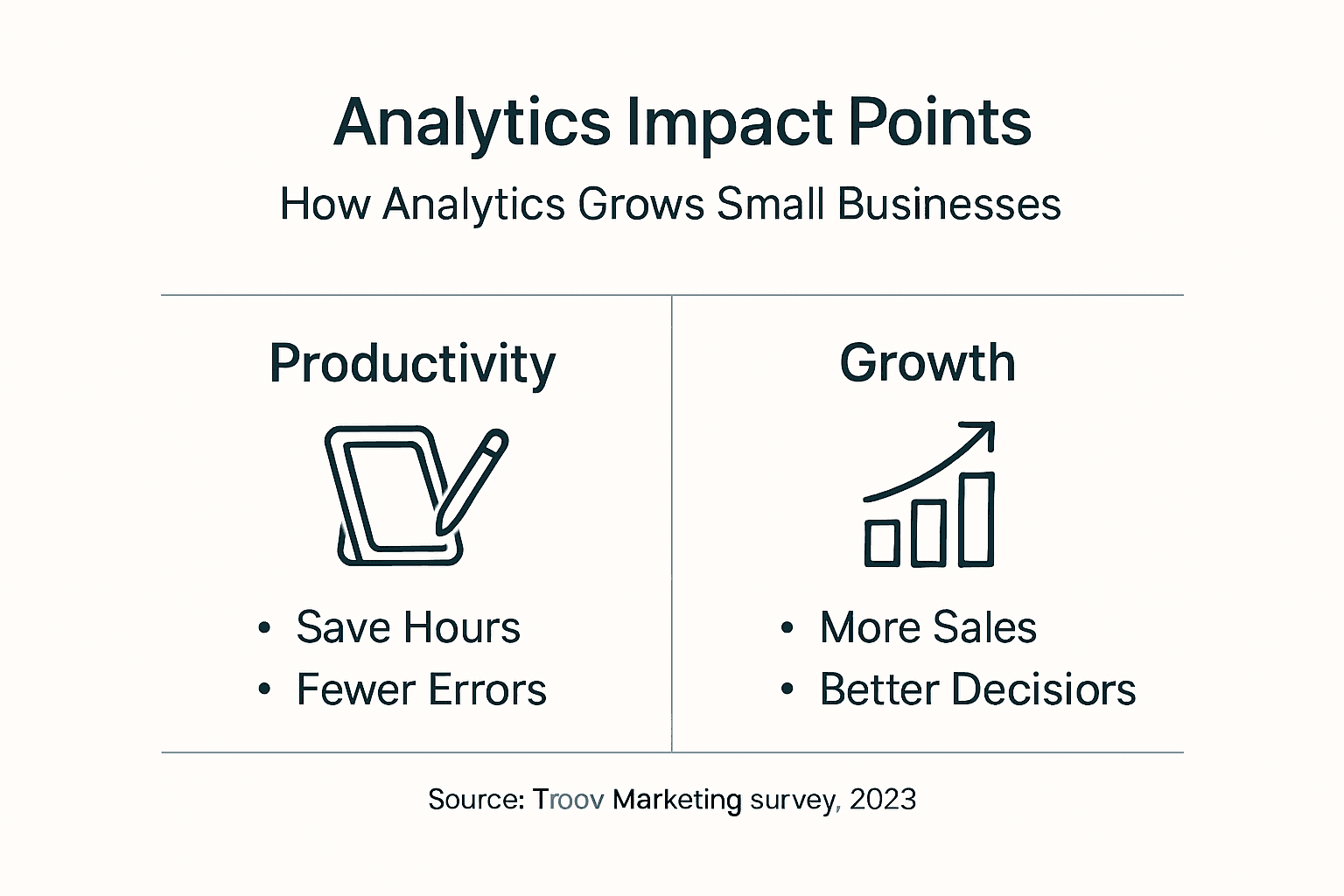
Small businesses leveraging analytics see productivity gains of 63% by using data to reduce costs and optimize operations. This productivity boost comes from eliminating wasted marketing spend, focusing on high-performing channels, and making faster decisions based on evidence rather than intuition.

User experience improvements emerge directly from behavior insights. When analytics shows visitors abandoning your contact form at a specific field, you know exactly what to fix. When data reveals customers prefer certain service pages over others, you can restructure navigation to highlight those offerings. These targeted improvements increase satisfaction and conversions simultaneously.
Marketing ROI increases dramatically when you identify which campaigns actually generate enquiries. Analytics reveals whether your Google Ads, social media posts, or local directory listings deliver qualified traffic. You can then shift budget toward winners and eliminate losers, maximizing return on every marketing dollar.
Key benefits for Melbourne small businesses:
- Cost reduction by stopping ineffective marketing campaigns early
- Conversion optimization through identifying and removing friction points in customer journeys
- Marketing efficiency by doubling down on channels that deliver qualified local leads
- Competitive advantage by understanding your audience better than competitors who rely on guesswork
- Growth acceleration through rapid testing and iteration based on real user feedback
Understanding local SEO benefits from analytics transforms your website from a static brochure into a dynamic growth engine. Regular data reviews reveal emerging opportunities before competitors spot them.
Pro Tip: Schedule a monthly 30-minute analytics review to spot trends and opportunities. Consistent monitoring beats sporadic deep dives for identifying growth patterns early.
The productivity gains through analytics compound over time as you build a library of insights about what works for your specific Melbourne market and customer base.
Leveraging Analytics for Local SEO
Analytics reveals exactly how Melbourne customers search for and interact with local businesses like yours. You can identify which suburbs generate the most enquiries, what search terms bring qualified visitors, and which pages need optimization to capture more local traffic.
Local businesses with optimized analytics and local SEO see up to 70% more local traffic by understanding and responding to search behavior patterns. This traffic increase translates directly to more enquiries when your website converts effectively.
| Metric | Before Analytics | After Analytics Optimization |
|---|---|---|
| Local search traffic | 500 monthly visits | 850 monthly visits (70% increase) |
| Bounce rate | 68% | 42% (38% improvement) |
| Enquiry conversion | 2.1% | 4.8% (129% increase) |
| Average session duration | 1:24 | 2:47 (97% increase) |
Integration with Google Business Profile optimization creates powerful synergy. Analytics data shows which services generate the most interest, allowing you to feature those prominently in your profile. You can see whether profile visitors actually visit your website and what they do when they arrive.
Actionable analytics insights that improve local rankings:
- Geographic data reveals which Melbourne suburbs to target in content and meta descriptions
- Search query reports identify local keywords you should optimize for but currently miss
- Landing page performance shows which service pages need better local targeting
- Referral traffic exposes which local directories and websites send qualified visitors
- Mobile usage patterns guide responsive design priorities for local searchers
Melbourne trades and professional services benefit particularly from location-specific insights. A plumber might discover that Preston generates twice as many enquiries as Footscray, justifying focused SEO for small businesses in Melbourne efforts in high-performing suburbs. Understanding the analytics impact on local traffic allows precise resource allocation.
The relationship between website design and local SEO becomes clear when analytics shows how design changes affect local search performance and enquiry rates.
Common Misconceptions About Website Analytics
68% of small business owners hesitate to use analytics due to perceived complexity, but these misconceptions prevent massive competitive advantages. Clearing up myths removes barriers to adoption and unlocks growth.
-
Analytics requires technical expertise: Modern platforms like Google Analytics and MonsterInsights feature intuitive dashboards designed for non-technical users. You do not need coding skills or statistical knowledge to extract valuable insights. Most platforms explain metrics in plain language with helpful tooltips.
-
Analytics is only for large companies: Small businesses actually benefit more from analytics because resources are tighter. Every marketing dollar must work harder, making data-driven decisions critical. Local focus means smaller data sets that are easier to understand and act upon quickly.
-
More data equals better decisions: Data hoarding creates confusion and paralysis. Focus on metrics directly tied to business goals like enquiry rate, cost per lead, and revenue per customer. Three relevant metrics beat thirty irrelevant ones every time.
-
Analytics setup takes too long: Basic tracking installs in minutes using plugins or simple code snippets. You can start collecting data today and learn the platform as you go. Waiting for perfect setup means losing months of valuable insights.
Accessible analytics tools for small businesses now exist at every price point, including free options that deliver professional insights. The barrier to entry has never been lower for Melbourne trades and services.
Pro Tip: Choose beginner-friendly tools with built-in tutorials and strong support communities. Google Analytics paired with MonsterInsights WordPress plugin offers the easiest entry point for most small businesses.
Understanding analytics misconceptions and corrections helps you overcome hesitation and start benefiting from data insights immediately. The learning curve is gentler than you expect, and early wins build confidence quickly.
Framework for Effective Analytics Use in Small Business Websites
Decision-driven analytics practices show up to 40% higher project success rates compared to data-first approaches. Start with business questions, then find data to answer them, rather than drowning in metrics hoping insights emerge.
-
Define specific business questions: What do you need to know to grow? Examples include which marketing channels deliver qualified leads, what prevents visitors from submitting enquiries, or which services interest Melbourne customers most. Clear questions focus data collection and analysis.
-
Identify required data points: Determine which metrics answer your questions. If you want to know why visitors abandon your contact form, you need form analytics and exit page tracking. Match data collection precisely to business questions.
-
Set up tracking and baselines: Implement tracking for identified metrics and establish current performance baselines. You cannot measure improvement without knowing starting points. Document baseline metrics for future comparison.
-
Analyze and extract insights: Review data regularly to identify patterns, anomalies, and opportunities. Look for trends over time rather than single-day fluctuations. Focus on actionable insights rather than interesting but useless observations.
-
Act on insights and measure results: Implement changes based on insights, then measure whether they improve target metrics. This closes the loop and validates whether insights actually drive business improvements. Iterate based on results.
| Framework Step | Business Question Example | Expected Outcome |
|---|---|---|
| 1. Define Questions | Why do visitors leave without enquiring? | Focus on conversion barriers |
| 2. Identify Data | Track bounce rate, exit pages, form abandonment | Pinpoint friction points |
| 3. Set Up Tracking | Install form analytics and heat mapping | Establish performance baseline |
| 4. Analyze Insights | Discover 60% abandon at phone number field | Understand specific problem |
| 5. Act and Measure | Make phone optional, add email alternative | Increase form completions 35% |
This framework aligns analytics with growth priorities rather than creating busywork. Effective analytics tools and strategies work best within a structured decision-making process.
Pro Tip: Revisit your business questions quarterly as priorities shift. Analytics needs evolve as your business grows and market conditions change.
The decision-driven analytics framework prevents common pitfalls like analysis paralysis and vanity metrics obsession. You stay focused on data that actually drives business decisions and growth.
Selecting the Right Analytics Tools for Small Businesses
Google Analytics and MonsterInsights serve different but complementary roles for Melbourne small businesses. MonsterInsights installs Google Analytics reports with a few clicks, simplifying data access for non-technical users through an intuitive WordPress dashboard interface.
| Feature | Google Analytics | MonsterInsights |
|---|---|---|
| Cost | Free | Free and paid tiers |
| Setup complexity | Moderate (code installation) | Simple (plugin install) |
| WordPress integration | Manual | Native and seamless |
| Dashboard location | Separate platform | Inside WordPress |
| Reporting clarity | Detailed but technical | Simplified and visual |
| Local SEO features | Available with configuration | Built-in tracking |
| Learning curve | Steeper | Gentler |
Key considerations when choosing analytics tools:
- Ease of use matters most for busy small business owners with limited technical skills
- Cost must align with budget, though free tiers often suffice for starting out
- Local SEO integration helps track geographic performance and suburb-level insights
- Reporting clarity determines whether you actually use the tool or ignore it | Setup speed affects how quickly you start collecting valuable data
Melbourne small businesses with WordPress sites benefit most from MonsterInsights because it removes technical barriers while preserving powerful tracking capabilities. You see reports directly in your familiar WordPress dashboard rather than switching to a separate platform.
Accessible analytics tools democratize data insights that were previously available only to enterprises with dedicated analysts. The combination approach using both Google Analytics for depth and MonsterInsights for simplicity gives you the best of both worlds.
MonsterInsights and Google Analytics benefits include quick setup, actionable insights, and the ability to track what matters most to local businesses: enquiries, phone calls, and form submissions from Melbourne customers.
Using Analytics to Improve Website Performance
Visitor behavior metrics reveal exactly where your website succeeds and fails at engaging Melbourne customers. Time on page, scroll depth, and click patterns show whether content resonates or bores visitors. Exit pages identify where you lose potential enquiries.
Page speed improvements reduce bounce rates by up to 30%, positively impacting SEO and conversions simultaneously. Analytics shows which pages load slowly, allowing you to prioritize optimization efforts where they matter most. Fast pages rank better and convert better.
Best practices for improving performance based on analytics:
- Identify and fix pages with above-average bounce rates first for quick wins
- Optimize images on pages with slow load times shown in speed reports
- Restructure navigation when analytics reveals visitors struggle to find key pages
- Add internal links to high-performing content to distribute engagement
- Simplify forms that show high abandonment rates in funnel analysis
- Improve mobile experience on device types showing poor engagement metrics
The connection between analytics insights and SEO ranking improvements becomes clear when you track changes over time. Better engagement metrics signal quality to search engines, improving rankings organically. Higher rankings bring more traffic, creating a virtuous cycle.
Pro Tip: Prioritize high-impact fixes first based on data rather than fixing everything at once. Focus on pages that get the most traffic or are closest to converting visitors into enquiries.
Regular reviews of website performance analytics reveal new opportunities as your site evolves and search algorithms change. What worked last quarter might need adjustment now. Continuous improvement beats one-time optimization projects.
Implementing insights from your website performance checklist becomes easier when analytics shows exactly which items deliver the biggest impact on engagement and conversions for your specific Melbourne audience.
Tracking Marketing Effectiveness with Analytics
Analytics dashboards transform marketing from guesswork into science by showing exactly which campaigns generate enquiries and revenue. Regular use of analytics dashboards leads to 25% higher marketing ROI because you can quickly stop underperforming campaigns and scale winners.
Key marketing metrics to monitor weekly:
- Conversion rate by traffic source reveals which channels deliver qualified visitors
- Cost per lead shows whether you spend efficiently across different marketing tactics
- Channel effectiveness compares Google Ads, organic search, social media, and referrals
- Campaign performance tracks specific promotions or seasonal offers
- Geographic data identifies which Melbourne suburbs respond best to marketing
Adjusting marketing tactics based on data feedback creates rapid improvement cycles. When analytics shows Facebook ads generate clicks but no enquiries, you know the targeting or landing page needs work. When organic search delivers high-quality leads, you can justify investing more in content and SEO.
Melbourne-based businesses see increased enquiries when they focus marketing spend on proven channels rather than spreading budgets thin across every platform. Analytics provides the evidence needed to make these allocation decisions confidently.
Local market focus matters because customer behavior varies by location and industry. What works for a Sydney business might not work in Melbourne. What works for professional services might not work for trades. Your specific analytics data guides decisions better than general marketing advice.
Using analytics dashboards for marketing ROI means knowing within days whether a new campaign succeeds or fails, allowing quick pivots that save money and time. Testing becomes affordable when you can measure results precisely.
Combining insights with effective marketing call-to-actions improves conversion rates by guiding visitors toward desired actions based on proven patterns in your analytics data.
Bridging Analytics and Local SEO Strategy
Analytics data directly informs Google Business Profile improvements by showing which services generate interest and enquiries. You can feature high-performing services prominently, add photos of popular offerings, and write descriptions that match actual search behavior patterns.
Local SEO improvements combined with analytics increase local enquiries by up to 50% because you optimize based on evidence rather than assumptions. The synergy between website data and local SEO tactics creates compound effects that individual efforts cannot match.
Integration benefits for Melbourne small businesses:
- Search visibility improves when you optimize for terms analytics shows customers actually use
- Engagement increases when content addresses topics that data proves interest your audience
- Enquiries grow when you remove friction points that analytics identifies in conversion funnels
- Reviews accumulate faster when you request them from customers analytics shows are most satisfied
- Profile performance accelerates when you align profile content with website analytics insights
Melbourne plumbers, electricians, and professional services see particularly strong results from this integration. Analytics might reveal that emergency services generate three times more enquiries than scheduled work, justifying emphasis on rapid response messaging in both website content and Google Business Profile.
Iterative refinement of local SEO for small business based on analytics creates continuous improvement. Each cycle of data analysis and optimization builds on previous wins, compounding results over time. Patient consistency beats sporadic bursts of activity.
Understanding analytics and local SEO synergy transforms both practices from separate tactics into an integrated growth system. The whole becomes greater than the sum of its parts when data insights guide SEO decisions and SEO improvements generate more data for analysis.
Boost Your Melbourne Small Business with Expert Analytics and SEO
Troov Marketing helps Melbourne small businesses implement analytics and SEO strategies that drive measurable enquiry growth. Our small business web design services build websites structured from day one to capture valuable analytics insights. We integrate tracking that matters for local businesses, not vanity metrics that waste time.
Our SEO services for Melbourne small businesses use analytics data to identify exactly what your customers search for and how they interact with your website. We optimize based on evidence, not generic best practices that might not apply to your specific market. Combined with expert Google Business Profile optimization services, we create integrated local visibility that turns searches into enquiries. Let us help you move from confusion to clarity and start your data-driven growth journey today.
Frequently Asked Questions
What is website analytics and why is it important for small businesses?
Website analytics tracks how visitors interact with your site, revealing which pages they view, how long they stay, and whether they become enquiries. Small businesses benefit because analytics replaces guesswork with evidence, allowing you to invest marketing budget where it actually works. Companies using analytics effectively are 2.8 times more likely to achieve marketing goals.
How can I start using analytics if I am not tech savvy?
Start with user-friendly platforms like MonsterInsights that install with a few clicks and display reports inside your WordPress dashboard. Focus initially on just three metrics tied to business goals rather than trying to understand everything at once. Many analytics tools guidance resources exist specifically for non-technical small business owners.
What analytics tools do you recommend for Melbourne small businesses?
Google Analytics paired with MonsterInsights offers the best combination of power and simplicity for most Melbourne small businesses. Google Analytics is free and comprehensive, while MonsterInsights simplifies the interface and integrates seamlessly with WordPress sites. This combination provides professional insights without requiring technical expertise or large budgets.
How does analytics improve my local SEO?
Analytics reveals which suburbs generate enquiries, what local search terms bring qualified traffic, and which service pages perform best. You can then optimize content, meta descriptions, and Google Business Profile information to match proven patterns rather than guessing what might work. Local businesses using analytics for SEO see up to 70% more local traffic.
Can analytics help me measure marketing campaign success?
Yes, analytics dashboards show exactly which marketing channels and campaigns generate enquiries versus which waste budget. You can track conversion rate, cost per lead, and ROI by traffic source to identify winners and losers quickly. Regular dashboard use increases marketing ROI by 25% because you can rapidly adjust tactics based on performance data.