

Most Melbourne small business owners think branding means just a logo and colour scheme. In reality, 86% of organic clicks go to first-page Google results, proving that integrated online branding paired with SEO drives the visibility and trust your business needs to grow locally. This guide shows how branding, web design, and SEO work together to transform your online presence.
Table of Contents
- Why Online Branding Matters For Small Businesses
- How Branding And Seo Interact To Boost Visibility
- The Role Of Branding Consistency In Building Trust And Recognition
- Enhancing Branding Through Web Design
- Integrating Branding And Web Design: Case Studies And Practical Tips
- Common Misconceptions About Online Branding And Seo
- Measuring And Growing Your Brand's Online Impact
- Boost Your Melbourne Small Business With Expert Web Design And Seo
Key Takeaways
| Point | Details |
|---|---|
| Branding builds trust | Effective online branding increases local visibility and customer confidence in your business. |
| SEO amplifies brand exposure | SEO delivers 86% of organic clicks, making your brand visible where customers search. |
| Consistency drives revenue | Consistent branding across platforms can increase revenue by 23%. |
| Design reflects identity | Web design that mirrors brand identity improves engagement and conversions. |
| Analytics refine strategy | Measuring impact through data helps continuously improve branding and SEO efforts. |
Why Online Branding Matters for Small Businesses
Establishing a strong online brand is no longer optional for Melbourne small businesses. 73% of small businesses now have websites, setting a baseline credibility expectation among local customers. Without an online presence, you risk invisibility in a market where competitors are actively building digital authority.
Search engines drive brand discovery for 30.6% of consumers, surpassing traditional advertising and word of mouth. This shift means your website and online branding are often the first touchpoints potential customers encounter. If your branding is weak or inconsistent, you lose trust before the first conversation begins.
Small business marketing budgets reflect this digital shift. 44% of small businesses allocate 6-10% of budgets to marketing, with growing investment in digital branding and SEO. Melbourne businesses that integrate website design and local SEO position themselves ahead of competitors still relying on outdated tactics.
Here's why online branding directly affects your local success:
- Customers research online before visiting or calling, making your website the deciding factor.
- Consistent branding signals professionalism and reliability, reducing friction in the buying journey.
- Local SEO depends on recognizable brand signals to rank your business in Melbourne searches.
- Digital branding supports all other marketing efforts, from social media to paid ads.
Before investing deeply in SEO tactics, establish your brand foundation. Work with a small business web designer in Melbourne to create a site that reflects your brand and supports SEO for small businesses from day one.
Pro Tip: Audit your current online presence by searching your business name and services in Google. If your website doesn't reflect your brand consistently or rank well locally, prioritize fixing branding and SEO together.
How Branding and SEO Interact to Boost Visibility
Branding and SEO are not separate strategies. They feed each other, creating a compounding effect that amplifies your Melbourne business's visibility and credibility online. When integrated properly, they transform casual searchers into loyal customers.
First-page Google results capture 86% of organic clicks, meaning SEO places your brand in front of nearly every potential customer searching for your services. Without strong branding, those clicks lead to a forgettable website that fails to convert. Without SEO, your beautiful brand sits invisible, buried on page five.
Strong SEO efforts boost brand recognition over time. Each appearance in search results reinforces your name, messaging, and authority in your industry. SEO-driven brand awareness builds long-term customer loyalty because repeated exposure creates familiarity and trust, making customers more likely to choose you over competitors.
Here's how branding and SEO work together:
- SEO keywords should align with your brand messaging so search intent matches your value proposition.
- Consistent branding across your website improves user engagement metrics, which signal quality to Google.
- Brand mentions and backlinks from local sources strengthen both brand authority and SEO rankings.
- Clear brand identity helps you create focused content that ranks and resonates with your target audience.
Integrated branding and SEO improve marketing ROI by ensuring every dollar spent on visibility also strengthens recognition. Melbourne businesses that treat these as one strategy see faster growth and better returns than those siloing efforts.
Pro Tip: Use your brand voice consistently in all content, from service pages to blog posts. Google rewards authentic, cohesive content that matches user intent. For conversion-focused pages, apply call to action examples that convert to turn visibility into enquiries.
The Role of Branding Consistency in Building Trust and Recognition
Consistency is the glue that holds your online branding together. Without it, customers see fragmented messages that erode trust and make your business forgettable. Consistent branding can increase revenue by up to 23%, proving that uniformity across touchpoints directly impacts your bottom line.
Consumers need 5 to 7 consistent brand impressions before recalling your business. Each interaction, whether on your website, social media, or Google Business Profile, must reinforce the same visuals, messaging, and experience. Inconsistency confuses potential customers and weakens the trust you've worked to build.
Brand authenticity strengthens customer loyalty. When your messaging matches your actions and your visual identity reflects your values, customers feel confident choosing you. This trust translates to repeat business and referrals, which are critical for Melbourne's competitive local markets.
Here's why consistency matters:
- Uniform colours, fonts, and imagery make your brand instantly recognizable across platforms.
- Consistent tone and messaging build a clear expectation of what customers will experience.
- Aligned online and offline branding (like matching your website to your shopfront) reinforces credibility.
- Repeated exposure through consistent branding supports SEO by increasing branded search volume.
Neglecting consistency erodes brand credibility and weakens SEO impact. If your website looks different from your social profiles, customers question your professionalism. If your messaging shifts between pages, search engines struggle to understand what you offer, hurting rankings.
Stat: Businesses that maintain consistent branding see up to 23% revenue growth because customers trust and remember them more easily.
Enhancing Branding Through Web Design
Your website is the digital storefront of your brand. Thoughtful web design amplifies your branding by creating an immersive experience that engages visitors and reinforces your identity at every touchpoint.

By 2025, 82% of internet traffic will be video, showcasing the rising importance of multimedia in brand storytelling. Melbourne small businesses that incorporate video, images, and interactive elements create richer experiences that hold attention and communicate brand personality more effectively than text alone.
Responsive design ensures your brand looks and functions perfectly across devices. Mobile users now dominate web traffic, and a clunky mobile experience damages brand perception instantly. Fast loading speeds, intuitive navigation, and mobile-first layouts signal professionalism and respect for your customers' time.
Consistent aesthetics between your website and brand messaging reinforce recognition. When your site's colours, fonts, and imagery match your logo and marketing materials, visitors immediately connect your online presence to your broader brand. This alignment builds trust and makes your business memorable.
Here's how web design enhances branding:
- Visual hierarchy guides visitors' eyes to key brand messages and calls to action.
- Whitespace and clean layouts communicate clarity and confidence, reflecting brand values.
- Branded photography and custom graphics differentiate you from competitors using stock images.
- Accessible design shows your brand cares about all customers, strengthening reputation.
Good design improves user trust and conversion rates. When visitors land on a polished, cohesive website, they perceive your business as credible and established. This trust makes them more likely to enquire, book, or buy.
Pro Tip: Start with mobile design first. Most Melbourne customers will find you on their phones, so prioritize mobile experience. Check out small business web design tips to ensure your site performs well on every device. For deeper integration, learn about combining website design with local SEO.
Integrating Branding and Web Design: Case Studies and Practical Tips
Real Melbourne businesses prove that integrating branding, web design, and SEO delivers measurable results. Case studies show local businesses improving rankings and conversions by treating these elements as one cohesive strategy rather than isolated tasks.
One Melbourne trades business revamped its website to reflect a professional, trustworthy brand. By aligning visuals with clear messaging and optimizing for local search terms, they jumped from page three to the top five results within four months. Enquiries doubled as customers encountered a brand they could trust.
A professional services firm integrated branded video testimonials and client case studies into their site design. This multimedia approach increased time on site by 40% and improved conversion rates by 18%. The consistent brand voice across all content reinforced their authority and expertise.
Here's a comparison of different approaches:
| Approach | Visibility | Conversions | Long-Term Growth |
|---|---|---|---|
| Branding Only | Moderate | Low | Limited without traffic |
| SEO Only | High | Moderate | Stalls without trust signals |
| Integrated | High | High | Sustained and scalable |
Follow these steps to integrate branding and web design effectively:
- Define your brand identity first. Clarify your mission, values, and unique selling points before designing.
- Develop a style guide covering colours, fonts, imagery, and tone to ensure consistency.
- Design your website to reflect your brand identity visually and functionally.
- Optimize every page for local SEO while maintaining brand voice and messaging.
- Test and refine based on user feedback and analytics to continuously improve.
Pro Tip: Begin with brand identity definition before developing design and SEO. Skipping this step leads to disjointed efforts that waste time and money. For Melbourne businesses, explore combining website design and local SEO and review SEO strategies tailored to local markets.
Common Misconceptions about Online Branding and SEO
Many small business owners operate under misconceptions that limit their online growth. Clearing these myths helps you build a strategy that actually works.
Branding is not just logos. It includes messaging, customer experience, emotional connection, and every interaction customers have with your business. A beautiful logo means nothing if your website, service, and communications fail to deliver a consistent brand promise.
SEO and branding are deeply connected, not separate strategies. Some believe SEO is purely technical while branding is purely creative. In reality, SEO amplifies your brand's reach, and strong branding improves SEO performance through better engagement and trust signals.
Branding consistency directly influences local search rankings. Google evaluates user behavior like time on site and bounce rate. Consistent, trustworthy branding keeps visitors engaged, signaling quality to search engines and improving your rankings.
Here are common misconceptions to avoid:
- Thinking branding is a one-time project rather than an ongoing commitment.
- Believing SEO is just about keywords without considering user experience and brand perception.
- Assuming you need a huge budget to compete, when strategic branding and SEO deliver results at any scale.
- Separating online branding from offline branding, creating disconnected customer experiences.
Misconceptions hinder integrated strategy development and business growth. Educating yourself on how branding and SEO truly interact empowers you to make smarter investments and achieve faster results in Melbourne's competitive market.
Measuring and Growing Your Brand's Online Impact
Tracking the right metrics ensures your branding and SEO efforts translate to real business growth. Without measurement, you're guessing whether your strategy works.
Use analytics tools like Google Analytics to monitor website traffic, engagement, and visitor behavior. Track metrics like pages per session, average session duration, and bounce rate to understand how users interact with your brand online. Improving these signals strengthens both brand perception and SEO rankings.
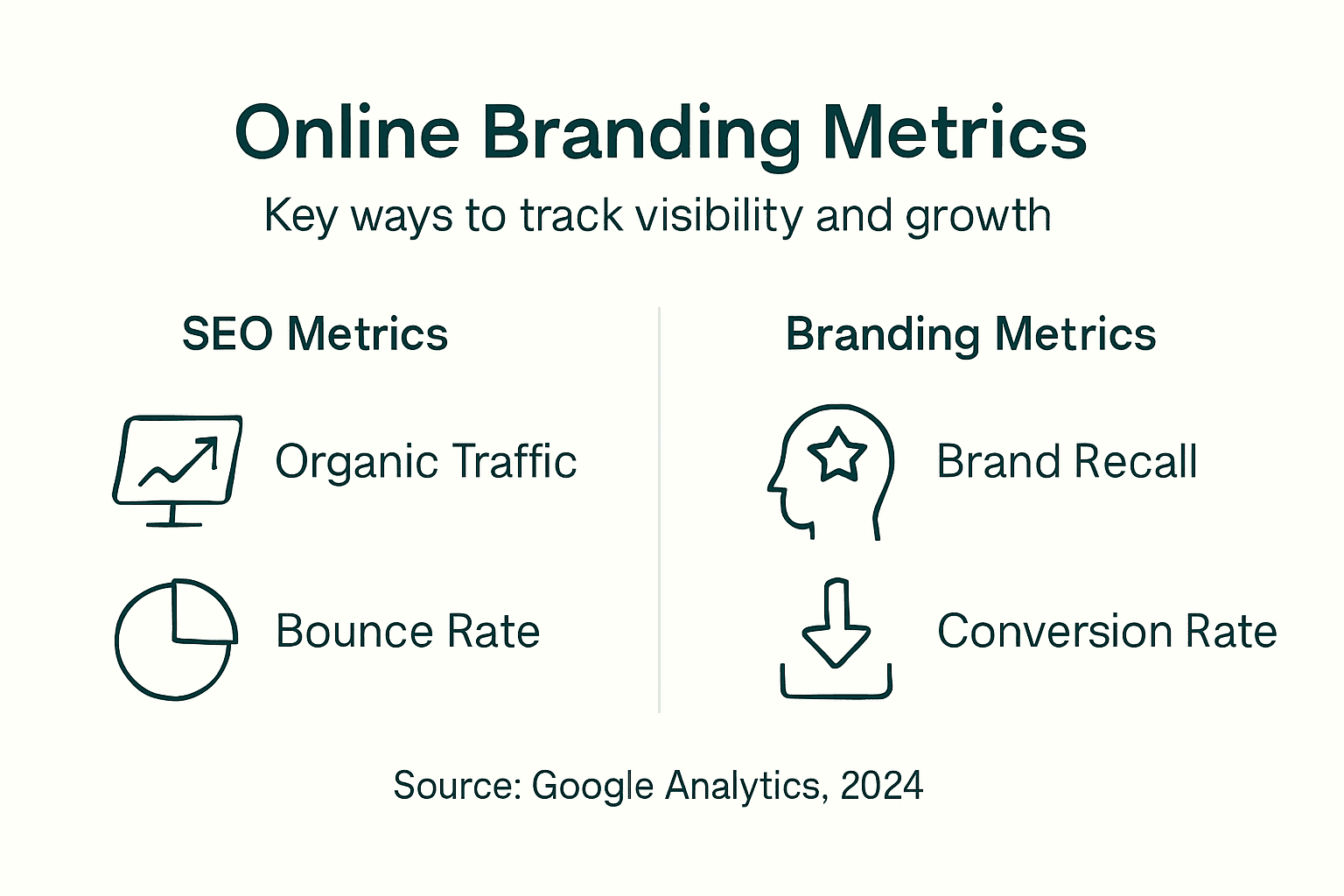
Evaluate brand recall through surveys and local search ranking reports. Ask new customers how they found you and what stood out. Monitor your rankings for branded and non-branded keywords to see if brand awareness is growing.
Track conversion rates from visits to enquiries or sales as key success indicators. A high-traffic website means nothing if visitors don't take action. Analyze conversion funnels to identify where branding or design improvements could remove friction.
Here's a simple data tracking table:
| Metric | What It Measures | Target |
|---|---|---|
| Organic Traffic | SEO visibility and brand reach | Consistent monthly growth |
| Bounce Rate | Brand relevance and engagement | Below 50% |
| Conversion Rate | Branding effectiveness | 3-5% for service businesses |
| Branded Searches | Brand awareness growth | Increasing trend |
Adjust branding and SEO strategies based on data trends and feedback. If certain pages have high bounce rates, revise messaging or design to better align with visitor expectations. If conversions lag, test stronger calls to action or clearer value propositions.
Pro Tip: Regular audits ensure consistent brand messaging and identify growth opportunities. Schedule quarterly reviews of your website, SEO performance, and brand consistency across all platforms. Small tweaks compound into significant improvements over time.
Boost Your Melbourne Small Business with Expert Web Design and SEO
You've learned how branding, web design, and SEO work together to grow your Melbourne business. Now it's time to put that knowledge into action with expert support. Troov Marketing specializes in small business web design that reflects your brand identity while delivering the performance and structure needed for local SEO success.
We offer SEO strategies tailored to Melbourne small businesses that boost local search visibility and drive qualified leads. From Google Business Profile optimization to search-friendly site structure, we build strong foundations so your website grows with your business over time. Use our website checklist to ensure your site meets modern standards for branding, usability, and SEO. Partner with experts who understand Melbourne's local market and transform your website into a powerful branding and sales asset.
FAQ
What is the difference between branding and SEO?
Branding defines who you are, your values, and how customers perceive you. SEO is the process of making your brand visible in search engines. Branding creates the message; SEO delivers it to the right audience at the right time.
How often should I update my website to maintain branding consistency?
Review your website quarterly to ensure visuals, messaging, and content align with your current brand identity. Update key pages whenever your services, values, or positioning evolve to keep branding consistent.
Which metrics best indicate my online branding success?
Track branded search volume, conversion rates, returning visitor percentage, and engagement metrics like time on site. Growing branded searches and higher conversions signal that your branding resonates and builds trust.
Can I improve local SEO without a big marketing budget?
Yes. Focus on Google Business Profile optimization, consistent NAP details, local content, and earning reviews. Small businesses can compete effectively by prioritizing strong foundations over expensive campaigns.
What is the first step to improve my small business online branding?
Define your brand identity clearly. Establish your mission, values, target audience, and unique selling points before investing in design or SEO. A strong foundation ensures all efforts align and amplify each other.