

Many Victorian small business owners think website compliance simply means having a privacy policy. This misconception leaves businesses vulnerable to legal action and limits their online visibility. Real compliance covers accessibility standards, consumer protection laws, and privacy regulations that work together to protect your business while enhancing local search performance. Understanding these requirements helps you reduce legal risks and capture more local customers.
Table of Contents
- Understanding Website Accessibility Compliance
- Privacy Compliance for Small Business Websites in Victoria
- Legal Compliance and Consumer Protection
- The Impact of Compliance on Local SEO
- Common Misconceptions About Website Compliance
- How to Achieve Website Compliance: Step-by-Step Guidance
- Real-World Impact: Compliance and Business Growth
- Build a Compliant Website with Troov Marketing
- Frequently Asked Questions About Website Compliance in Victoria
Key Takeaways
| Point | Details | |-------|---------|| | Legal compliance spans accessibility, privacy, and consumer protection for Victorian small businesses | Meeting these standards protects against fines and lawsuits while improving customer trust | | WCAG 2.1 AA accessibility standards are mandatory and enhance user experience | Compliance reduces legal exposure and makes your site usable for everyone | | Privacy policies must align with Australian Privacy Principles and secure data properly | Transparent data handling builds customer confidence and meets legal obligations | | Compliance boosts local SEO through improved credibility and usability signals | Better user experience leads to higher rankings and more local traffic | | Regular audits and updates maintain compliance as your business grows | Annual reviews keep you protected and competitive in local search |
Introduction to Website Compliance in Victoria
Website compliance means meeting legal and technical standards that protect both your business and your customers. Victorian small businesses must navigate three key legal pillars: accessibility requirements, privacy obligations under the Privacy Act 1988, and consumer protection rules under Australian Consumer Law.
Non-compliance carries real consequences. The OAIC can issue fines up to $2.5 million for serious privacy breaches. Consumer law violations result in penalties reaching $1.1 million for corporations. Beyond financial risks, non-compliance damages your reputation and drives potential customers to competitors who demonstrate legal diligence.
Compliance also directly impacts your online visibility. Search engines reward sites that offer secure, accessible experiences with higher rankings. When you fix accessibility barriers and implement proper security measures, you signal trustworthiness to both Google and potential customers.
Victorian small business owners should address these key obligations:
- Implementing accessibility standards that government agencies must meet by end 2026
- Publishing clear privacy policies that explain data collection and use
- Ensuring marketing claims and product descriptions are accurate and truthful
- Securing customer information with appropriate technical safeguards
- Maintaining transparent terms and conditions for services or products
Many businesses avoid these common website compliance mistakes by starting with a systematic review of each legal area. Understanding the specific requirements helps you prioritize fixes that protect your business while improving customer experience.
Understanding Website Accessibility Compliance
Accessibility compliance centers on WCAG 2.1 AA standards, which ensure websites work for people with disabilities. The Australian Web Accessibility National Transition Strategy mandates government websites meet these standards by end 2026, setting expectations that extend to businesses serving government clients and the broader community.
These standards require specific design and technical adjustments. Implementing WCAG 2.1 AA includes text alternatives for images and keyboard navigation support alongside proper color contrast and clear form labels. Each element makes your site more usable for visitors with visual, motor, or cognitive impairments.
Practical accessibility measures include:
- Adding descriptive alt text to every image that conveys meaning
- Ensuring all interactive elements work with keyboard-only navigation
- Using color contrast ratios of at least 4.5:1 for normal text
- Providing clear labels and instructions for form fields
- Organizing content with proper heading hierarchy
- Making video content accessible with captions and transcripts
Ignoring accessibility standards exposes you to discrimination complaints and potential legal action. More importantly, you exclude roughly 18% of Australians with disabilities from accessing your services. This represents significant lost business and damaged community reputation.

Accessibility improvements benefit all users, not just those with disabilities. Clear navigation helps everyone find information faster. Good color contrast makes content readable in bright sunlight. Keyboard support enables efficient browsing for power users.
Pro Tip: Start your accessibility journey by using free automated testing tools like WAVE or axe DevTools to identify obvious issues, then work through fixes systematically using our website accessibility checklist before conducting manual testing with keyboard navigation.
Privacy Compliance for Small Business Websites in Victoria
The Privacy Act 1988 requires websites collecting personal data to provide clear privacy policies and secure data handling, making privacy compliance non-negotiable for Victorian businesses. Personal information includes names, email addresses, phone numbers, and any data that can identify an individual.
Australian Privacy Principles establish 13 specific requirements for handling personal information. Your privacy policy must explain what information you collect, why you collect it, how you use it, who you share it with, and how people can access or correct their information.
Key privacy obligations include:
- Publishing a privacy policy that's easy to find and written in plain language
- Collecting only the information you genuinely need for your business purposes
- Securing personal data with encryption, access controls, and regular security updates
- Obtaining consent before collecting sensitive information like health data
- Notifying individuals and the OAIC about eligible data breaches within 30 days
- Allowing customers to access and correct their personal information
The OAIC actively enforces privacy laws with investigations, corrective orders, and substantial penalties. Recent enforcement actions show regulators take website privacy seriously, particularly when businesses fail to protect customer data or provide transparent information about data practices.
Beyond legal compliance, privacy protection builds customer trust. Australians increasingly care about how businesses handle their information. Clear privacy policies and secure systems demonstrate professionalism and respect for customer rights, encouraging people to engage with your business confidently.
Effective website management tools for privacy compliance help you maintain security updates, monitor access logs, and document your privacy practices. Regular security reviews catch vulnerabilities before they become breaches.
Legal Compliance and Consumer Protection
Australian Consumer Law governs how businesses advertise, sell, and deliver products or services online. These rules apply to every Victorian small business with a website, regardless of size or whether you actively sell online.
Your legal obligations under consumer law include:
- Making only truthful, accurate claims about products, services, or business credentials
- Displaying clear pricing information including GST and any additional fees
- Publishing terms and conditions that explain delivery times, warranties, and return rights
- Honoring consumer guarantees about quality, fitness for purpose, and acceptable appearance
- Processing refunds and exchanges according to consumer law requirements, not arbitrary policies
Misleading or deceptive conduct carries penalties up to $1.1 million for companies. Common violations include exaggerating product benefits, hiding important terms in fine print, or making false scarcity claims to pressure purchases.
Small businesses often stumble with these compliance areas:
- Using stock photos implying local presence when operating remotely
- Claiming qualifications or certifications they don't hold
- Advertising discounts from inflated reference prices
- Restricting refund rights beyond what consumer law permits
- Failing to clearly state delivery timeframes or stock availability
Pro Tip: Review all marketing materials quarterly to ensure claims remain accurate as your business evolves, and document the evidence supporting any specific performance statistics or customer outcome statements you publish.
Transparent business practices not only satisfy legal requirements but also differentiate you from less scrupulous competitors. When customers see clear terms and honest marketing, they feel confident choosing your business. This trust converts to higher inquiry rates and repeat business, making consumer law compliance a competitive advantage rather than just a legal burden.
The Impact of Compliance on Local SEO
Google and Bing incorporate privacy and accessibility signals into ranking algorithms, making compliance a direct SEO factor. Search engines prioritize sites that offer secure, accessible experiences because these qualities indicate trustworthiness and user value.
Compliance enhances multiple ranking signals:
- HTTPS encryption improves security scores and search visibility
- Fast loading speeds from optimized accessible code reduce bounce rates
- Clear site structure required for accessibility helps search engines understand content
- Mobile-friendly designs that meet accessibility standards satisfy mobile-first indexing
- Lower bounce rates from improved usability signal content quality
A Melbourne trades business implementing full compliance in late 2025 saw measurable improvements:
| Metric | Before Compliance | After Compliance | Change |
|---|---|---|---|
| Local search traffic | 850 visits/month | 1,105 visits/month | +30% |
| Average session duration | 1:24 | 2:16 | +62% |
| Bounce rate | 58% | 41% | -29% |
| Mobile usability score | 73/100 | 94/100 | +29% |
| Local pack appearances | 12/month | 23/month | +92% |
These improvements stem from compliance creating better user experiences. Accessible navigation helps visitors find information quickly. Clear privacy policies reduce anxiety about submitting contact forms. Truthful marketing sets accurate expectations that your service delivery meets.
Compliance benefits extend beyond rankings to trust signals that affect click-through rates. When your local business listing appears with HTTPS security and strong user reviews praising your professional website, more people choose to visit. This combination of higher rankings and better click rates compounds your visibility advantage.
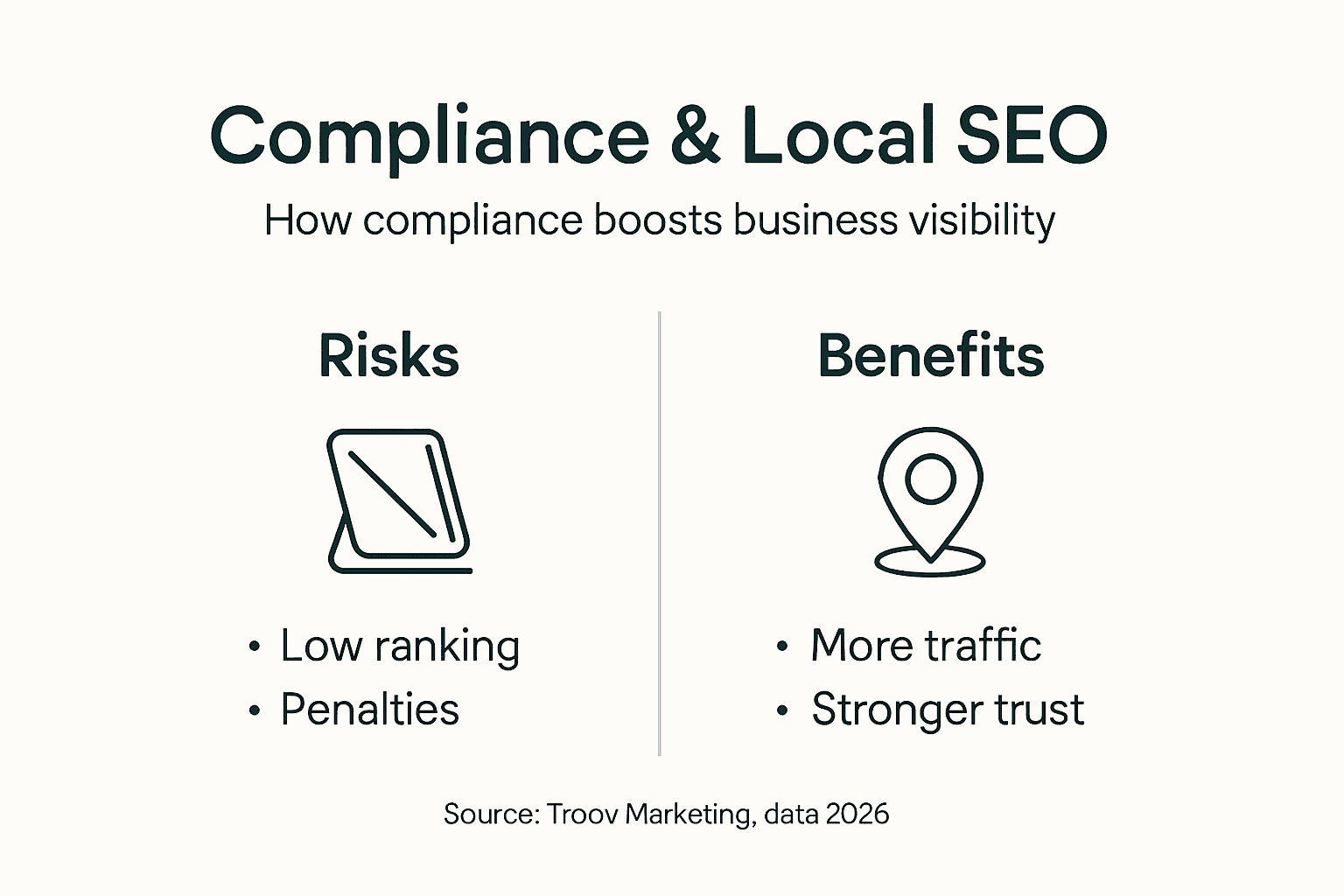
Strategic local SEO and website compliance work together to maximize local search performance. Focus on building compliant foundations, then layer SEO optimizations that amplify your existing quality signals.
Common Misconceptions About Website Compliance
Victorian small business owners often hold incorrect beliefs about compliance that leave them vulnerable or cause them to waste resources on unnecessary efforts.
-
Compliance means only having a privacy policy. Real compliance spans accessibility, consumer protection, and data security alongside privacy documentation. A privacy policy alone addresses one requirement while leaving significant legal and SEO gaps unresolved.
-
Local SEO improvements happen automatically after minimal compliance. Rankings improve when compliance creates genuinely better user experiences across multiple dimensions. Simply adding a privacy policy and SSL certificate captures only a fraction of available SEO benefits without addressing accessibility or usability.
-
Legal compliance does not apply to very small local sites. Size doesn't exempt businesses from accessibility standards, privacy laws, or consumer protection requirements. Even single-person operations face the same legal obligations and potential penalties as larger competitors.
-
Privacy laws apply universally without regional nuances. Australian privacy requirements differ substantially from European GDPR or California CCPA rules. Victorian businesses must follow Australian Privacy Principles specifically, not generic international privacy standards.
-
One-time compliance fixes last indefinitely. Laws evolve, technologies change, and your business grows. Compliance requires ongoing attention through regular audits, policy updates, and continuous monitoring of new legal requirements.
These misconceptions stem from oversimplified compliance advice that ignores the interconnected nature of legal requirements. Effective compliance takes a holistic approach addressing all applicable laws while building systems for ongoing maintenance rather than treating compliance as a one-time checklist.
How to Achieve Website Compliance: Step-by-Step Guidance
Achieving full compliance requires systematic action across all legal areas. Follow this prioritized sequence to build compliant foundations efficiently:
-
Conduct an accessibility audit using automated tools like WAVE, then manually test keyboard navigation and screen reader compatibility to identify barriers requiring fixes.
-
Draft or update your privacy policy to address all 13 Australian Privacy Principles, clearly explaining your data collection, use, storage, and sharing practices in plain language.
-
Review all website content against consumer law requirements, ensuring product descriptions are accurate, pricing is clear, and terms and conditions properly explain customer rights.
-
Implement technical fixes addressing accessibility issues, install security measures protecting customer data, and add required legal pages in accessible locations.
-
Publish updated policies prominently with easy access from every page, typically in your footer alongside links to terms and conditions.
-
Monitor SEO performance through Google Search Console and analytics, tracking improvements in rankings, traffic, and user engagement metrics post-compliance.
| Compliance Pillar | Required Actions | Primary Benefits |
|---|---|---|
| Accessibility | Implement WCAG 2.1 AA standards, test with assistive technology | Legal protection, improved UX, better SEO rankings |
| Privacy | Publish clear policy, secure data handling, breach notification plan | Customer trust, OAIC compliance, reduced breach risk |
| Consumer Protection | Accurate marketing, clear terms, proper refund policies | Legal safety, competitive advantage, higher conversions |
Pro Tip: Schedule annual compliance reviews every January, and assign a specific staff member responsibility for monitoring legal updates and coordinating necessary website changes to maintain ongoing compliance.
Small businesses with limited resources should start with the highest-risk areas. Begin with privacy and security to protect customer data immediately, then address accessibility to broaden your market reach, and finally polish consumer protection details. This phased approach spreads costs while reducing critical vulnerabilities first.
Our website compliance checklist breaks down each step with specific tasks and success criteria. Professional support through small business web design services can accelerate implementation while ensuring technical fixes meet standards.
Real-World Impact: Compliance and Business Growth
A Melbourne plumbing business implemented comprehensive compliance measures in early 2026 after operating with minimal legal protections. Within six months, they achieved 30% growth in local search traffic, climbing from page two to consistent first-page rankings for key service terms.
Their compliance journey addressed all three legal pillars. They rebuilt navigation for keyboard accessibility, rewrote service descriptions to remove exaggerated claims, published a detailed privacy policy, and implemented proper data encryption. These changes cost $4,200 in professional fees plus 20 hours of owner time.
The results extended beyond SEO metrics. Legal risks decreased substantially with proper policies protecting against privacy complaints and consumer law violations. Customer feedback highlighted increased trust, with several reviews specifically mentioning the professional website and clear service terms.
After updating our website for full compliance, we noticed customers seemed more confident reaching out. Our inquiry rate jumped, and people often mentioned they felt we were more professional than competitors. The SEO boost was fantastic, but the trust factor might be even more valuable for long-term growth.
Their success metrics included:
- Monthly organic traffic increased from 620 to 806 visitors
- Contact form submissions rose 45% with better conversion rates
- Local pack ranking improved from position 7 to position 2
- Zero legal complaints or privacy issues in 12 months post-compliance
- Customer reviews mentioning professionalism increased 38%
This case demonstrates compliance delivering measurable business value beyond risk reduction. When you build compliant foundations, you simultaneously strengthen SEO performance, enhance customer trust, and position your business for sustainable growth. The upfront investment pays ongoing dividends through reduced legal exposure and improved market position.
Victorian small businesses following similar compliance paths consistently report better local visibility and stronger customer relationships. These outcomes make compliance a strategic business investment rather than merely a legal obligation.
Build a Compliant Website with Troov Marketing
Navigating website compliance while running your business creates real challenges. Troov Marketing specializes in building compliant websites for Victorian small businesses, handling accessibility standards, privacy requirements, and SEO optimization from day one.
We design fast, modern websites structured for compliance and local visibility. Our approach integrates WCAG 2.1 AA accessibility, Australian Privacy Principles, and consumer protection requirements into every site we build. This foundation protects your business legally while maximizing local search performance.
Our small business web design services include compliance audits, policy development, and ongoing support keeping your site current with evolving regulations. We focus on sustainable solutions that grow with your business, not quick fixes requiring constant rework.
Start with our website compliance checklist to assess your current compliance status, then reach out to discuss how we can build or upgrade your site for full legal protection and better local visibility.
Frequently Asked Questions About Website Compliance in Victoria
What are the most critical website compliance laws for Victorian small businesses?
The Privacy Act 1988 governs data handling and requires clear privacy policies. WCAG 2.1 AA accessibility standards apply broadly following government mandates. Australian Consumer Law regulates all marketing claims and transaction terms, making these three legal areas your compliance priorities.
How often should I update my privacy policy to stay compliant?
Review your privacy policy annually and immediately after any changes to your data collection, storage, or sharing practices. Major business changes like adding e-commerce, implementing new marketing tools, or expanding services typically require policy updates to maintain accuracy.
Can non-e-commerce small business websites ignore consumer protection rules?
No, Australian Consumer Law applies to service descriptions and business claims regardless of whether you process transactions online. Any website making statements about services, qualifications, or outcomes must ensure those claims are accurate and not misleading.
Does accessibility compliance improve my website's Google ranking?
Accessibility improvements create better user experiences that Google rewards through multiple ranking signals. Clearer navigation, faster loading, and improved mobile usability all stem from accessibility work and directly influence search rankings alongside traditional SEO factors.
Where can I find affordable tools to monitor my website's compliance?
Free tools like WAVE and Google Lighthouse assess accessibility, while browser developer tools check security certificates and mobile responsiveness. The OAIC provides free privacy policy templates and guidance. For comprehensive monitoring, consider professional services offering regular compliance audits as part of ongoing website management.