

You've got a great website, but your phone isn't ringing. Many Melbourne small businesses face this exact challenge. Without a clear content creation framework, you're invisible to local customers searching online. Local businesses can increase qualified leads by over 90% after optimising website content in 5 months. This guide shows you a proven step by step process tailored for Melbourne trades and service businesses.
Table of Contents
- Prerequisites For Website Content Creation
- Step By Step Website Content Creation Process
- Local SEO Specific Content Optimisation
- Common Mistakes And Solutions In Content Creation
- Expected Results And Measurable Outcomes
- Boost Your Melbourne Business With Expert Web Content Services
- Frequently Asked Questions
Key takeaways
| Point | Details | |-------|---------|| | Strong foundations matter | Site speed under 3 seconds and mobile optimisation establish your content base | | Structured workflow wins | Following keyword research through to publishing increases traffic and leads systematically | | Local focus delivers results | Melbourne specific keywords and Google Business Profile integration drive qualified enquiries | | Common pitfalls hurt growth | Keyword stuffing and neglecting updates kill your search visibility fast | | Results take time | Expect 300% traffic growth and 90% more qualified leads within 6 months |
Prerequisites for website content creation
Before you write a single word, your technical foundation must be solid. A website loading in under 3 seconds improves SEO and user experience, so check your site speed first. Mobile responsiveness matters just as much because most Melbourne customers search on phones during their commute or lunch break.
Your website technical readiness checklist should include structured data markup. Schema helps search engines understand your business details, services, and location. This technical layer makes your content work harder without adding extra text.
Choose website management tools that match your skill level. You don't need complex systems. A simple content management platform lets you update pages, add blog posts, and track performance without calling a developer every time.
Understanding local SEO basics for small businesses gives you context for why certain content decisions matter. Local keyword research differs from generic SEO because you're targeting customers in specific Melbourne suburbs, not competing nationally.
Get familiar with Google Business Profile basics too. Your website content and GBP listing work together. When they tell the same story with consistent information, Google trusts you more and ranks you higher in local searches.
Pro Tip: Run your website through Google PageSpeed Insights before starting content work. Fix critical speed and mobile issues first, then build content on a solid technical base.
Essential prerequisites checklist:
- Site speed optimised to load in under 3 seconds
- Mobile responsive design tested on multiple devices
- Schema markup implemented for local business details
- Content management system selected and configured
- Google Business Profile claimed and basic info added
- Basic local SEO principles understood
Your blogging guide for Melbourne businesses provides deeper detail on platform setup. The site speed and mobile optimisation essentials resource walks through technical fixes step by step.
Step by step website content creation process
Start with thorough local keyword research. You're not chasing generic terms like "plumber" or "electrician". Focus on Melbourne specific phrases like "emergency plumber Collingwood" or "commercial electrician Hawthorn". These location modifiers filter out irrelevant searchers and attract ready to buy customers.
Structured keyword research and content mapping reduce keyword cannibalisation and boost rankings. Create a simple spreadsheet mapping each keyword to a specific page. One keyword per page prevents your own pages from competing against each other in search results.
Plan your content structure before writing. Service pages target commercial intent keywords. Blog posts answer questions and target informational searches. This step by step content workflow prevents random content creation that doesn't support business goals.
Write naturally with your local keywords woven into useful content. Your reader wants solutions, not keyword stuffed nonsense. Answer their questions thoroughly, mention Melbourne suburbs where relevant, and write like you're explaining your service to a neighbour.

Optimise every page using your SEO optimisation checklist. Meta titles need your keyword and location within 60 characters. Meta descriptions summarise page value in 155 characters. Headings structure content logically while including relevant keywords.
Internal linking connects related pages and distributes authority across your site. Link from blog posts to service pages naturally. Connect related service pages together. Your content management tools should make adding these links straightforward.
Publish and track performance immediately. Set up Google Search Console and Google Analytics before you publish. These free tools show which keywords drive traffic, where visitors drop off, and which pages convert best.
Pro Tip: Create a content calendar planning 3 months ahead. Consistency matters more than perfection. Publishing one quality page every two weeks beats publishing nothing for months then rushing five pages at once.
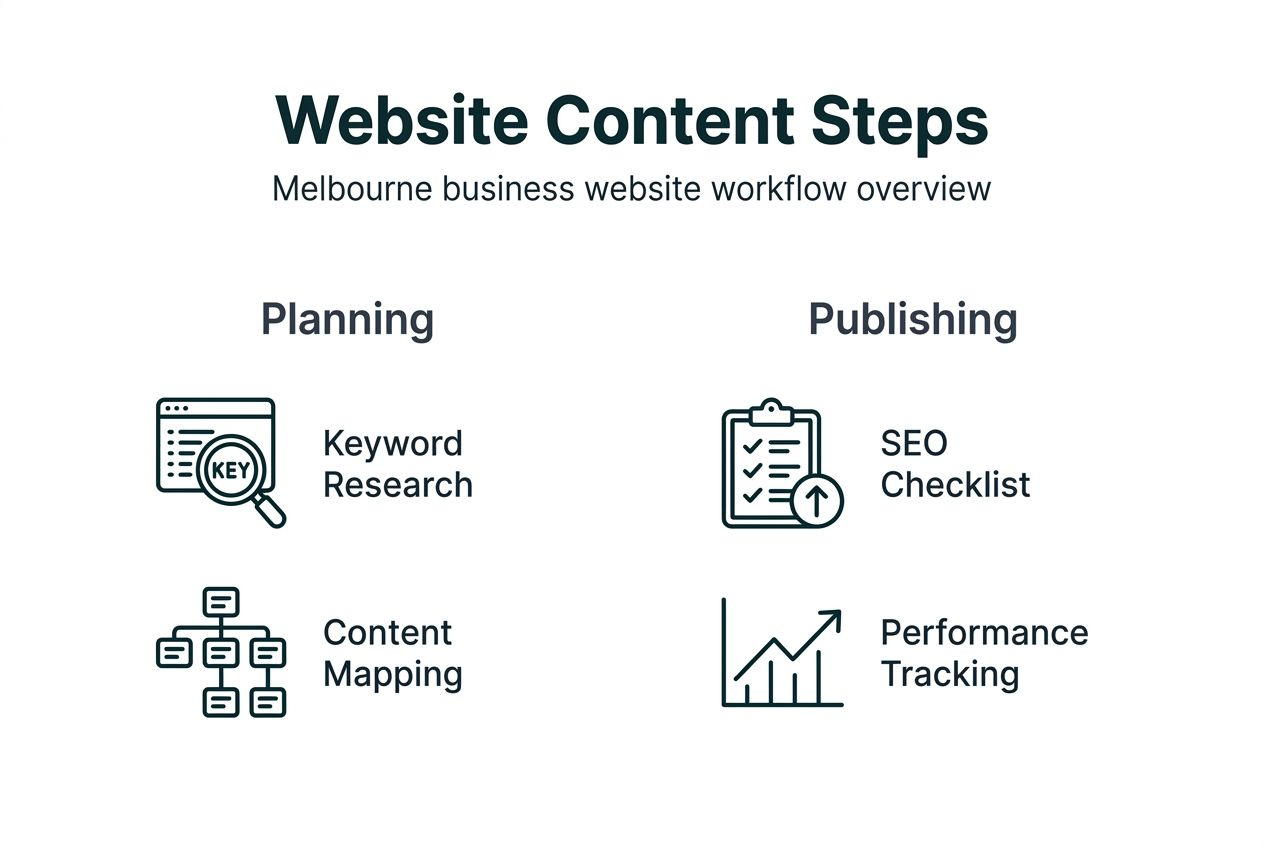
Your content creation workflow:
- Research Melbourne specific keywords for your industry
- Map each keyword to a unique page or blog post
- Write content naturally addressing customer questions
- Optimise meta titles, descriptions, and headings
- Add internal links connecting related pages
- Publish and begin tracking performance metrics
| Content Type | Primary Goal | Keyword Focus | Update Frequency |
|---|---|---|---|
| Service Pages | Convert visitors | Commercial intent | Every 6 months |
| Blog Posts | Attract traffic | Informational | Monthly additions |
| Location Pages | Local visibility | Suburb specific | Quarterly review |
| Case Studies | Build trust | Mixed intent | As completed |
Your local SEO keyword research tips resource provides Melbourne suburb keyword lists to jumpstart research. Follow the workflow methodically instead of jumping around randomly.
Local SEO specific content optimisation
Melbourne suburbs aren't just geographic markers. They're search qualifiers that connect you with nearby customers. Mention specific suburbs naturally when describing your service area. "We service Preston, Reservoir, and Thornbury" works better than vague "northern suburbs" references.
Your content must support Google Maps visibility. Adding location specific keywords and schema markup improves Melbourne local search rankings. Include your full business address, phone number, and service areas in footer content and contact pages.
Schema markup highlights your local business details for search engines. LocalBusiness schema tells Google your address, hours, service area, and business type. Review schema adds star ratings to search results. This structured data creates rich snippets that increase click through rates.
Keep your Google Business Profile integration and website content perfectly aligned. If your GBP lists Fitzroy as a service area, your website should mention Fitzroy too. Consistency builds authority and prevents Google from doubting your information.
Your Melbourne small business digital presence relies on multiple local signals working together. Citations in local directories, Google reviews, and website content all reinforce your location. When they match perfectly, your rankings improve.
Pro Tip: Create a dedicated service area page listing every Melbourne suburb you cover. Write a sentence about each suburb mentioning a landmark or local detail. This page becomes a ranking asset for multiple location searches.
Local SEO content essentials:
- Mention specific Melbourne suburbs in service descriptions
- Include full business address and phone in footer
- Add LocalBusiness schema markup to homepage
- Create dedicated location pages for key suburbs
- Align website content with Google Business Profile data
- Reference local landmarks and community details naturally
| Feature | Generic SEO Content | Local SEO Content |
|---|---|---|
| Keywords | Broad industry terms | Suburb specific phrases |
| Location mentions | Vague or absent | Specific suburbs and streets |
| Schema markup | Basic or none | LocalBusiness and Service Area |
| Contact details | Contact page only | Footer, headers, and pages |
| Service area | Generic regions | Named Melbourne suburbs |
Follow these local SEO content optimisation tips to maximise visibility. The local search optimisation techniques guide provides advanced strategies once you've mastered basics.
Common mistakes and solutions in content creation
Publishing content once then forgetting it guarantees failure. Neglecting regular content updates causes over 70% of small business SEO failures. Set quarterly reviews to refresh statistics, update outdated information, and add new insights to existing pages.
Keyword stuffing destroys readability and rankings. Repeating "plumber Melbourne" fifteen times per page makes Google suspicious and readers leave fast. Write naturally, use synonyms, and focus on answering questions thoroughly instead of hitting arbitrary keyword density targets.
Mismatched user intent kills conversion rates. Someone searching "how to fix a leaking tap" wants information, not a sales pitch. Someone searching "emergency plumber near me" wants to call immediately. Match your content format and call to action to search intent.
Ignoring mobile users means losing most potential customers. Short paragraphs, clear headings, and fast load times matter more on mobile. Test every page on your phone before publishing.
Weak or missing calls to action leave money on the table. Every page needs a clear next step. Service pages need phone numbers and contact forms prominently displayed. Blog posts should link to relevant service pages naturally.
Pro Tip: Set a recurring calendar reminder to review your top 10 performing pages every 3 months. Refresh one statistic, add one new paragraph, or update one outdated reference. Small consistent updates maintain rankings better than occasional massive rewrites.
Mistakes to avoid:
- Publishing content then never updating it again
- Stuffing keywords unnaturally throughout text
- Writing generic content that ignores user intent
- Creating mobile unfriendly walls of text
- Forgetting clear calls to action on every page
- Copying competitor content instead of adding unique value
Your common content mistakes and fixes resource explains each pitfall in detail. Learn from these avoiding SEO pitfalls examples before they cost you traffic. Master writing effective calls to action to convert more visitors into customers.
Expected results and measurable outcomes
Realistic expectations prevent frustration and keep you committed. Proper website content creation can increase organic traffic by over 300% within 6 months. This growth compounds monthly as you add more optimised content and existing pages gain authority.
Qualified lead growth matters more than raw traffic numbers. You want customers ready to buy, not random browsers. Proper local SEO content can increase qualified leads by over 90% within 5 months by attracting searches with commercial intent.
Google Maps visibility often improves fastest. Local searches have less competition than national keywords. Many Melbourne trades businesses see 180% increases in Maps impressions and profile views within 3 months of optimising website content and Google Business Profile together.
Track these key performance indicators monthly. Organic search traffic shows overall visibility growth. Conversion rate measures how well your content turns visitors into leads. Average position in search results indicates ranking improvements. Time on page reveals content quality and relevance.
Maintain consistent content creation for sustained results. Adding one quality blog post every two weeks beats publishing ten posts then going silent for months. Search engines reward consistent activity with better rankings over time.
Pro Tip: Screenshot your Google Search Console performance today. Check total clicks, impressions, and average position. Review these same metrics every month to track progress and prove ROI to yourself.
Measurable outcomes to expect:
- 300%+ organic traffic increase within 6 months
- 90%+ qualified lead growth within 5 months
- 180%+ Google Maps visibility improvement within 3 months
- Steady ranking improvements for target keywords
- Increased conversion rates from optimised calls to action
- Lower bounce rates from improved content relevance
Use measuring content success dashboards to track progress weekly. Follow these SEO performance tracking tips to identify winning content patterns and double down on what works.
Boost your Melbourne business with expert web content services
Implementing this content creation process takes time and expertise. Troov Marketing specialises in small business web design services that combine fast, mobile friendly websites with search optimised content from day one. We build websites structured to support your growth, not hold you back.
Our local SEO services help Melbourne trades and professional services dominate local search results. We handle keyword research, content creation, Google Business Profile optimisation, and ongoing performance tracking so you can focus on running your business.
You get clear, reliable websites that turn visitors into enquiries. We provide the tools and guidance to manage updates yourself or handle everything for you. Our website checklist for SEO ensures nothing gets missed from technical setup through content optimisation.
Frequently asked questions
What is the website content creation process?
The website content creation process follows a structured workflow from keyword research through publishing and maintenance. It involves researching local Melbourne keywords, mapping them to specific pages, writing optimised content, and tracking performance. This systematic approach improves search rankings and visitor engagement consistently.
How often should I update my website content?
Review and update key website content at least every 3 to 6 months to maintain SEO performance. Regular updates prevent rankings from declining as information becomes outdated. Focus on refreshing statistics, adding new insights, and ensuring all details remain accurate and relevant to current Melbourne market conditions.
What tools can help with local keyword research?
Google Keyword Planner, Moz Local, and SEMrush assist with Melbourne specific keyword research effectively. Many offer free basic plans suitable for small business budgets. These tools reveal search volumes, competition levels, and related keywords that help you target the right local customers efficiently.
Why is Google Business Profile important for local SEO?
Google Business Profile increases your visibility in Google Maps and local search results where most Melbourne customers find trades and services. It displays accurate business information, photos, reviews, and contact details directly in search results. A well optimised Google Business Profile enhances customer trust and generates more qualified enquiries consistently.
How long before I see results from optimised website content?
Significant traffic and lead improvements typically appear within 5 to 6 months of consistent content optimisation. Early wins like improved Google Maps visibility may show within 2 to 3 months. Consistent updates, quality content creation, and proper local SEO practices influence how quickly you see measurable results and ROI.