

Many Victorian small business owners wrongly believe they must register copyright to protect their website content. Australian copyright law automatically protects your original website content, including text, images, and code, without any registration needed. This guide explains what copyright protects, debunks common myths, outlines your legal rights, and provides practical steps to safeguard your online content and respond to infringement.
Table of Contents
- Understanding Copyright For Your Website In Australia
- Duration And Legal Rights Under Australian Copyright Law
- Common Misconceptions About Website Copyright
- How To Protect Your Website Content And Respond To Infringement
- Managing Third-Party Content And Permissions On Your Website
- Distinguishing Copyright From Trademark For Brand Protection
- Summary And Practical Takeaways For Small Business Owners
- How Troov Marketing Supports Your Website Success
Key takeaways
| Point | Details |
|---|---|
| Automatic protection | Copyright protects original website content automatically without registration in Australia. |
| Long duration | Protection lasts 70 years after the creator's death for literary and artistic works. |
| Exclusive rights | Owners have exclusive rights to copy, publish, and communicate their content online. |
| Infringement risks | Misusing others' online content without permission infringes copyright laws. |
| Practical steps | Clear terms, monitoring, and responding to infringement protect your content. |
Understanding copyright for your website in Australia
Copyright is an intangible intellectual property right that protects original works from unauthorised use. Australian copyright law provides automatic protection to original website content, including text, images, code, and multimedia, without any registration requirement. This protection applies the moment you create original content and fix it in a tangible form, whether that's publishing a blog post, uploading an image, or launching your site.
Website content covered by copyright includes:
- Written text like blog posts, product descriptions, and page copy
- Visual elements including photos, graphics, and illustrations
- Source code and software powering your site
- Videos, audio files, and multimedia components
Copyright protects the expression of ideas, not the ideas themselves. You can't copyright a business concept, but the specific words, images, and design elements you create to express that concept receive protection. When you build your dream small business website, every original element becomes protected intellectual property from the moment of creation.
Understanding this automatic protection helps you recognise the value of your online content. Your website represents significant creative investment, and Australian law safeguards that investment without requiring formal steps or fees. This protection extends across all formats and platforms, giving Victorian small businesses robust legal backing for their digital presence.
Duration and legal rights under Australian copyright law
Copyright duration in Australia is typically 70 years after the death of the author for literary and artistic works like website content. This extended protection period ensures your creative work remains safeguarded well into the future, potentially benefiting your estate or successors. For works created by businesses or organisations, different rules may apply, but the principle of long protection holds.
Website owners in Australia hold exclusive economic rights to copy, publish, communicate, and licence their original content. These rights include:
- Reproduction right: controlling who can copy your content
- Publication right: deciding where and when your work appears publicly
- Communication right: managing online distribution and display
- Licensing right: granting permissions and setting terms for use
Moral rights operate separately from economic rights, protecting attribution and integrity of your work. These ensure you receive credit as the creator and prevent others from distorting or misrepresenting your content in ways that damage your reputation. Even if you sell or licence your copyright, moral rights typically remain with you as the original author.
Pro Tip: Document your content creation dates and processes to establish clear ownership records if disputes arise.
Understanding these rights helps you control how your content appears online and enables strategic decisions about licensing or partnerships. These protections prevent competitors from simply copying your carefully crafted website text or unique images. Recognising website mistakes costing your small business money includes understanding how failing to exercise these rights can undermine your competitive advantage.
Common misconceptions about website copyright
Myth 1: You must register copyright or use the © symbol for protection. This is incorrect. Protection is automatic in Australia from the moment you create original content. While displaying the © symbol can serve as a reminder to others, it's not legally required for protection. Registration systems don't exist for copyright in Australian law, unlike patents or trademarks.
Myth 2: Online content can be freely used without permission. Using content found online without permission often infringes copyright, even if the source appears free; Australian law protects website content equally strongly as physical formats. The ease of copying digital content doesn't diminish legal protections. Just because you can technically download an image doesn't mean you have the legal right to use it on your site.
Myth 3: Attribution alone permits use of others' content. Giving credit is courteous, but consent is also required by law. Simply linking back to the source or naming the creator doesn't grant you permission to reproduce their work. You need explicit authorisation, typically through a licence agreement, to legally use copyrighted material.
Pro Tip: When you build your dream small business website, invest in original content or properly licensed assets from the start to avoid legal complications later.
Confusing trademark with copyright can lead to incomplete brand protection. Copyright protects creative expression like your website text and images. Trademarks protect brand identifiers like your business name and logo. You need both for comprehensive protection. Understanding these distinctions prevents costly errors and ensures you don't overlook critical protections. Many website mistakes costing your small business money stem from these fundamental misunderstandings about intellectual property rights.
How to protect your website content and respond to infringement
Keep detailed records of your original website content as proof of ownership. Save dated versions of your work, including drafts, revision histories, and publication timestamps. These records become invaluable evidence if you need to prove you created content first. Cloud storage with automatic versioning provides convenient documentation.
Monitor the internet for unauthorised copies of your content:
- Set up Google Alerts for unique phrases from your website
- Use reverse image search tools to find where your photos appear
- Regularly search for your distinctive content manually
- Consider monitoring services for comprehensive coverage
Recording evidence of infringement and contacting infringers directly helps resolve copyright violations efficiently. When you discover unauthorised use, follow these steps:
- Document the infringement with screenshots, URLs, and dates
- Contact the infringer informally, explaining your copyright and requesting removal
- Send a formal cease and desist notice if informal contact fails
- Notify hosting providers to remove infringing content where possible
- Consider legal action as a last resort for serious or persistent violations
Most infringements resolve through direct communication. Many people genuinely don't understand copyright law and will remove content promptly when informed. A professional, factual approach works better than aggressive threats. Clearly state your ownership, provide evidence, and specify what action you want taken.
Start by assuming good faith. Many infringers simply don't realise they've done anything wrong. Education often works better than escalation.
Maintain clear website terms that define copyright permissions. Your terms of use should explicitly state that all content is protected by copyright and outline any permissions you grant to visitors. When you combine website design and local SEO, include legal protections in your foundational structure. Clear terms protect your rights while setting expectations for users.

Effective website management includes regular monitoring and swift responses to infringement. Making protection part of your routine prevents small issues from becoming major problems.
Managing third-party content and permissions on your website
Website terms and conditions are critical for defining copyright permissions especially for user-generated content. If your website accepts comments, reviews, testimonials, or other user submissions, your terms must clearly state what rights users grant you when they post. Without explicit terms, you may lack legal permission to display or use that content.
Respect moral rights by providing proper attribution and avoiding derogatory treatment of others' works:
- Always credit creators when using licensed content
- Don't modify works in ways that misrepresent the creator's intent
- Obtain permission before making substantial alterations
- Maintain the integrity of original works as intended by their authors
Get explicit licences or permissions before hosting third-party content to avoid infringement. Written agreements should specify:
- What content is covered
- How you can use it
- Duration of the permission
- Any attribution requirements
- Whether you can modify the content
Clear policies protect both your business and contributors. When users understand what happens to their content, trust increases. When you have proper permissions documented, legal risks decrease. This clarity benefits everyone involved and demonstrates professional standards.
Proper website management includes systems for tracking permissions and ensuring compliance with licensing terms. Maintain a register of where each piece of third-party content came from, what permissions you have, and when those permissions expire. This organisation prevents accidental infringement and simplifies renewals.
Distinguishing copyright from trademark for brand protection
Copyright protects original creative works like website text, images, and code. It covers the expression of ideas in fixed form, giving you exclusive rights to reproduce, publish, and communicate your creative content. Copyright arises automatically and doesn't require registration, though keeping records of creation strengthens your position.
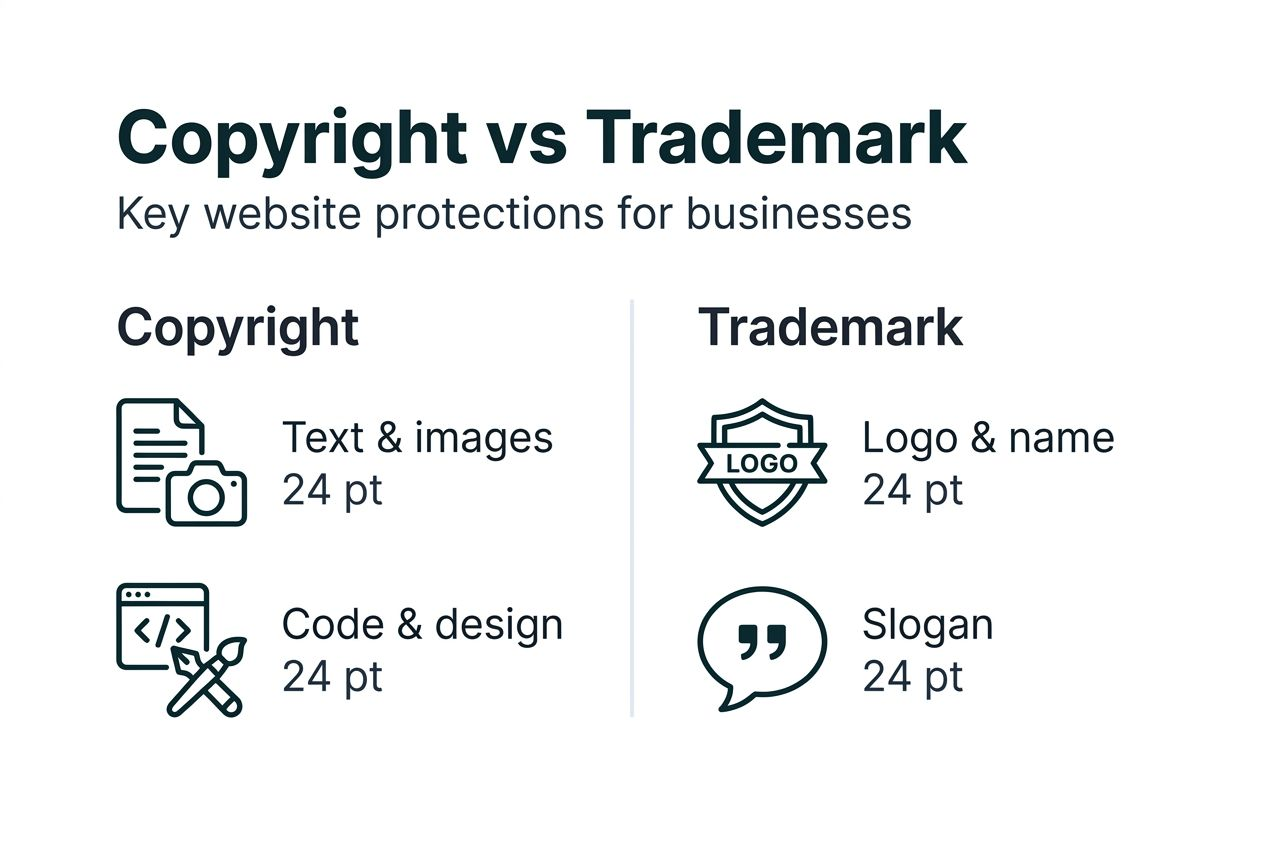
Trademark protects brand identifiers such as business names, logos, and slogans. It covers distinctive signs that identify your business and distinguish it from competitors. Unlike copyright, trademark protection in Australia typically requires registration with IP Australia for full legal protection, though some common law rights exist for unregistered marks.
| Aspect | Copyright | Trademark |
|---|---|---|
| Protects | Creative expression like text, images, code | Brand identifiers like names, logos, slogans |
| Registration | Automatic, no registration needed | Registration recommended for full protection |
| Duration | 70 years after creator's death | Renewable indefinitely every 10 years |
| Purpose | Prevents copying of creative works | Prevents confusion about business identity |
Both protections are important and complement each other for comprehensive online safeguarding. Your website needs copyright to protect the content you create and trademark to protect the brand identity you build. A competitor can't copy your website text due to copyright, and they can't use a confusingly similar business name or logo due to trademark.
Understanding the difference helps avoid legal gaps and strengthens your brand's legal foundation. When you build your dream small business website, consider both types of protection from the outset. Invest in original content that copyright automatically protects, and register trademarks for your key brand elements to maximise legal safeguards.
Summary and practical takeaways for small business owners
Your original website content is automatically protected without registration. From the moment you create text, images, or code, Australian copyright law gives you exclusive rights over that work. You don't need to display copyright notices or take formal steps, though documentation helps if disputes arise.
Know your legal rights and enforce them to control your content:
- You decide who can copy, publish, and communicate your work
- You control licensing and commercial use
- You maintain moral rights to attribution and integrity
- You can take action against unauthorised use
Keep records and monitor for infringement regularly. Documentation strengthens your position, while monitoring catches problems early when they're easier to resolve. Set up simple alerts and make checking part of your routine.
Use website terms of use to manage third-party content and permissions. Clear terms protect you legally and set expectations for users. They're especially critical if you accept user-generated content like reviews or comments.
Seek legal advice if infringement persists or is serious. Most issues resolve informally, but professional guidance helps with complex situations or valuable content. A lawyer can advise on formal notices, negotiations, or court action if needed.
Pro Tip: Make copyright protection part of your launch checklist when creating a new website, not an afterthought once problems emerge.
Confident copyright management protects your business investment and maintains your competitive edge. Understanding these basics empowers you to safeguard your digital assets effectively while focusing on growing your Victoria-based business.
How Troov Marketing supports your website success
Troov Marketing offers expert web design services tailored to Victorian small businesses, building fast, modern websites that perform well and support your business goals. We understand the importance of original content and proper copyright practices in creating sustainable online presence.
Our ultimate website checklist ensures your site covers essential elements including legal protections, performance optimisation, and user experience. We help you build strong foundations that support growth over time, not quick fixes that create future problems.
We provide essential website management tools and ongoing support for compliance and effectiveness. Whether you need help structuring your site, protecting your content, or managing ongoing updates, Troov Marketing delivers clear, reliable solutions that help turn visitors into enquiries.
What is copyright registration and do I need it for my website?
What is copyright registration and do I need it for my website?
Copyright registration is not required in Australia. Your website content is protected automatically upon creation under Australian law. Unlike patents or trademarks, registering copyright is not available in the Australian system. Protection begins the moment you create original work and fix it in tangible form, with no paperwork, fees, or formal processes needed.
How long does copyright protection last for my website content in Australia?
How long does copyright protection last for my website content in Australia?
Copyright lasts 70 years after the author's death for literary and artistic works. This long duration helps protect your creative work well beyond its initial publication, potentially benefiting your estate. For business-created works, specific rules may vary, but the principle of extended protection remains consistent.
Can I use images or text from other websites on my site legally?
Can I use images or text from other websites on my site legally?
No, you must obtain permission or a licence to legally use images or text from other websites. Using online content without permission often infringes copyright, even if it's freely accessible. Attribution alone does not grant you the right to use copyrighted content; you need explicit authorisation from the copyright owner.
What steps should I take if someone copies my website content?
What steps should I take if someone copies my website content?
Start by collecting evidence and contacting the infringer; escalate to formal notices or hosting provider alerts if needed. Document the infringement with screenshots and URLs, then try resolving directly. If unsuccessful, send formal legal notices and notify the hosting provider. Seek legal advice if the issue escalates or involves significant commercial harm.
Recommended
- Website Design & Local SEO | Troov Marketing | Melb.
- Small Business Web Design | Troov Marketing | Melb.
- Small Business Blogging Guide | Troov Marketing | Melb.
- Website Mistakes Guide | Troov Marketing | Melb.
- Why DIY Website Builders Can Hurt Your Business Long-Term - City Web Company | Digital Marketing Agency