

Your website is the digital storefront for your Melbourne business, yet 53% of users abandon a website if it takes longer than 3 seconds to load, costing you valuable local leads. In 2026, combining fast, mobile responsive design with strong local SEO is no longer optional for trades and professional services. This guide walks you through practical website design strategies that attract Melbourne customers and turn visits into enquiries.
Table of Contents
- Why Modern Website Design Matters in 2026
- Prerequisites: What You Need Before Starting Your Website Design
- Core Website Design Best Practices for 2026
- Local SEO Fundamentals for Small Business Websites
- Common Website Design and SEO Mistakes to Avoid
- Project Timeline, Costs, and Alternative Solutions
- Measuring Success: Expected Outcomes and Key Metrics
- Summary and Next Steps for Small Business Owners
- Boost Your Melbourne Business with Expert Website Design
- Frequently Asked Questions
Key Takeaways
| Point | Details |
|---|---|
| Speed and mobile design are critical | Fast loading sites reduce bounce rates and meet Google's mobile-first indexing requirements for better rankings. |
| Local SEO drives nearby customers | Consistent NAP citations and geo-targeted content help Melbourne businesses appear in local search and map results. |
| Avoid common design mistakes | Stock photos and inconsistent business information harm trust and SEO performance. |
| Plan realistic timelines and budgets | Website projects typically take 4 to 12 weeks with costs ranging from $500 to $5000+ depending on complexity. |
| Track performance metrics regularly | Monitor traffic, rankings, and conversions to measure ROI and identify areas for improvement. |
Why Modern Website Design Matters in 2026
User expectations have evolved dramatically. People expect websites to load instantly and work seamlessly on their phones. When your site fails to meet these standards, potential customers simply move to your competitor.
Google's mobile-first indexing rules mean the search engine prioritizes the mobile version of your website when determining rankings. If your site isn't mobile responsive, you're fighting an uphill battle for visibility. For Melbourne small businesses competing in local search, this creates a significant disadvantage.
Page speed directly impacts both user experience and SEO performance. 53% of users abandon a website if it takes longer than 3 seconds to load, and Google considers speed a ranking factor. Every second of delay costs you leads.
Local SEO has become essential for attracting nearby customers. When someone in Melbourne searches for a tradie or professional service, Google prioritizes businesses with strong local signals. Your website must clearly communicate your Melbourne location and service areas to capture this traffic.
Key factors driving modern website requirements in 2026:
- User abandonment increases dramatically with slow loading times
- Mobile-first indexing makes responsive design mandatory for rankings
- Local search queries demand geo-targeted content and clear location signals
- Authentic local content builds trust faster than generic stock photos
- Clear calls to action convert visitors into enquiries
Pro Tip: Test your current website on multiple devices and use Google's PageSpeed Insights to identify performance bottlenecks before starting a redesign.
Prerequisites: What You Need Before Starting Your Website Design
Successful website projects start with proper preparation. Rushing into design without foundation work leads to costly revisions and missed opportunities for local visibility.
Before you begin, gather information about your target customers. Understanding their search behavior, pain points, and preferred communication methods helps you design a site that resonates. For Melbourne trades and professional services, this means knowing which suburbs you serve and what specific problems customers need solved.
Your business information must be accurate and consistent. Compile your complete NAP details: business name, physical address, and phone number exactly as they appear on official documents. Inconsistent information across your website and other platforms confuses search engines and damages local rankings.
Google Business Profile setup is crucial for local visibility. If you haven't already, claim your profile and verify ownership. This free tool connects directly to local search results and Google Maps, making it essential for Melbourne businesses wanting to appear in the local map pack.
Choosing the right web platform matters. WordPress offers flexibility and SEO capabilities but requires ongoing maintenance. AI builders provide speed but may limit customization. Many Melbourne businesses benefit from working with web design expertise in Melbourne that understands local market requirements.
Steps to prepare for your website project:
- Document your target customer demographics and search behavior patterns
- Compile accurate NAP information and ensure consistency across all platforms
- Claim and verify your Google Business Profile with complete details
- Research local keywords your Melbourne customers use when searching
- Gather authentic photos of your team, work, and Melbourne locations
- List your core services and unique value propositions clearly
- Collect existing customer testimonials and reviews to showcase
Core Website Design Best Practices for 2026
Modern website design balances aesthetics with performance. Pretty designs mean nothing if your site loads slowly or confuses visitors trying to contact you.

Page speed optimization starts with technical foundations. Compress images without sacrificing quality, enable browser caching, and minimize unnecessary code. Your goal is to achieve load times under three seconds across all devices. Every millisecond counts for both user experience and search rankings.
Mobile responsiveness goes beyond fitting content to smaller screens. Navigation must be thumb friendly, text must be readable without zooming, and forms must be easy to complete on phones. Test your design on multiple devices before launching.
Clear site structure reduces friction. Visitors should find what they need within two clicks. Simple navigation menus, prominent service descriptions, and obvious contact buttons keep people engaged. Complex layouts increase bounce rates and hurt conversions.
Authentic local content builds trust faster than generic stock photos. Using authentic local photos and geo-tagged images increases trust signals and demonstrates real business presence in Melbourne. Show your actual team, completed projects, and recognizable Melbourne landmarks.
Calls to action must be tailored to your business type. Trades need prominent phone buttons for mobile users. Professional services benefit from booking forms. Every page should guide visitors toward the next logical step.
Essential design elements for 2026:
- Image compression and lazy loading for fast performance
- Responsive layouts tested across phones, tablets, and desktops
- Maximum three-level navigation hierarchy for simplicity
- Authentic photos of your Melbourne team and completed work
- Multiple contact options positioned prominently on every page
- Trust signals like certifications and customer testimonials
Pro Tip: Review expert mobile design tips to ensure your responsive design meets 2026 standards for small business websites.
Local SEO Fundamentals for Small Business Websites
Local SEO turns your website into a customer magnet for Melbourne searches. When someone nearby needs your services, proper optimization ensures you appear in their results.
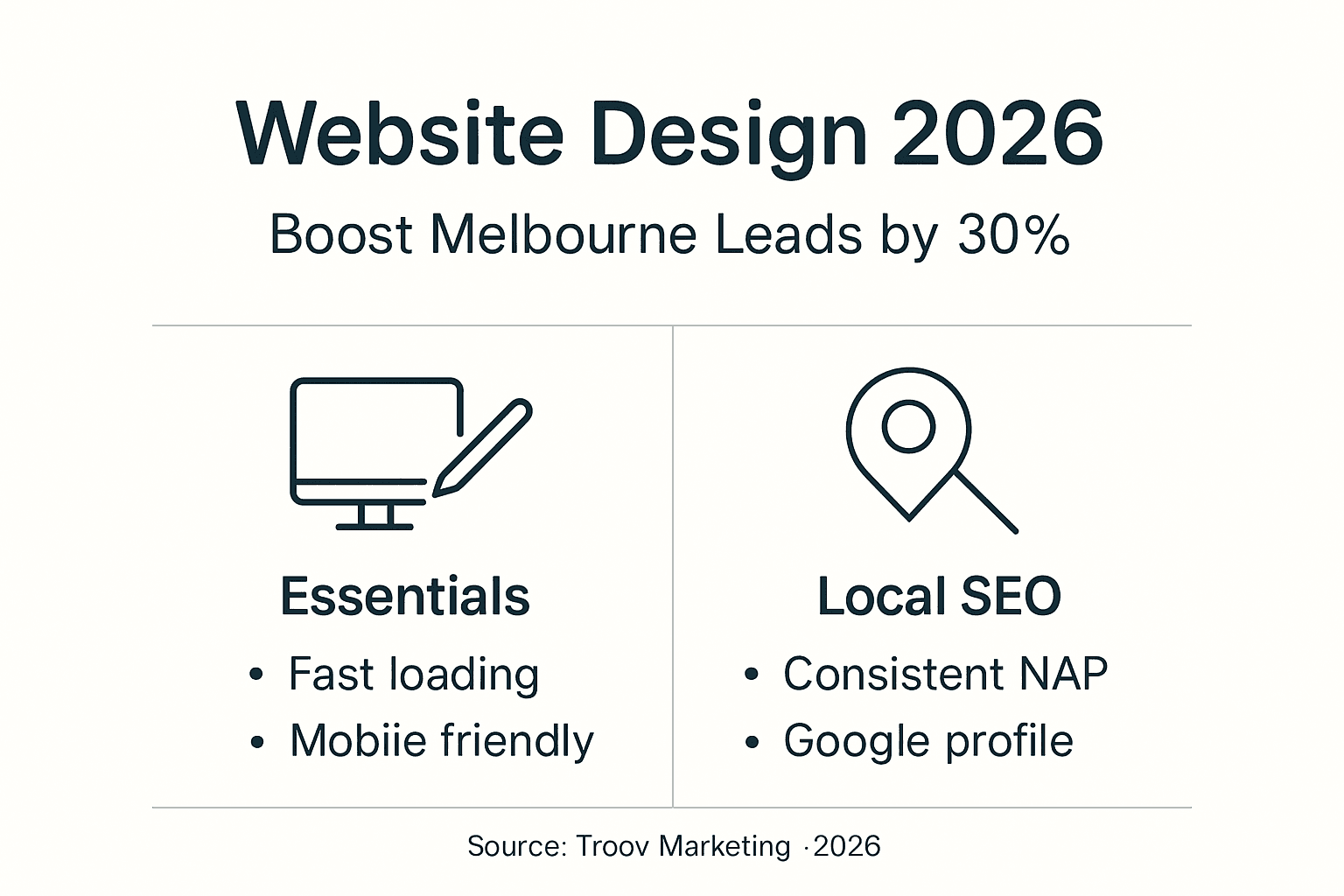
Consistent NAP citations across your website and online platforms form the foundation. Consistent NAP citations and use of local keywords improve local rankings by helping Google verify your business location. Every mention of your business must match exactly, including punctuation and abbreviation choices.
Google Business Profile integration extends beyond just linking to your profile. Embed your profile reviews widget, display your business hours, and showcase your service areas prominently. Encourage satisfied customers to leave reviews and respond to all feedback promptly.
Geo-targeted keywords throughout your content signal relevance to Melbourne searches. Include suburb names, landmarks, and local terminology naturally in page titles, headings, and body content. Avoid keyword stuffing, focus instead on answering local customer questions.
The impact of local optimization is significant. 76% of consumers who search with 'near me' intent visit a business within a day, highlighting the importance of appearing in local results. Melbourne businesses that neglect local SEO miss this high-intent traffic.
Key local SEO strategies:
- Embed complete NAP information in footer and contact pages
- Create dedicated service area pages for Melbourne suburbs you serve
- Use schema markup to help search engines understand your business details
- Publish blog content addressing local customer questions and concerns
- Build citations on relevant Melbourne business directories
- Generate and showcase authentic customer reviews regularly
| SEO Tactic | Expected Result | Timeline |
|---|---|---|
| Consistent NAP citations | Improved local pack rankings | 2 to 4 weeks |
| Google Business Profile optimization | Increased map visibility | 1 to 3 weeks |
| Local keyword content | Higher organic rankings | 6 to 12 weeks |
| Customer review generation | Enhanced trust and CTR | Ongoing |
Integrating website design with local SEO creates compound benefits. Learn more about combining website design and local SEO or explore our Google Business Profile optimization guide. For comprehensive local strategies, visit our SEO for small Melbourne businesses resource.
Understanding the complete local SEO checklist and following a detailed local SEO guide helps Melbourne businesses maximize their local visibility.
Common Website Design and SEO Mistakes to Avoid
Many Melbourne small businesses unknowingly sabotage their website performance through common mistakes. Recognizing these errors helps you avoid costly setbacks.
Stock photos destroy credibility faster than poor design. Visitors immediately recognize generic imagery and question whether your business is legitimate. Use real photos of your Melbourne team, actual projects, and genuine customer interactions. This authenticity builds trust and improves engagement.
Inconsistent NAP information creates confusion for both search engines and customers. When your address differs between your website, Google Business Profile, and directories, Google struggles to verify your location. This inconsistency directly harms local rankings and leads to lost customers who can't find you.
Poor site structure frustrates visitors and increases bounce rates. Complex navigation, buried contact information, and unclear service descriptions send people to competitors. Every page should have a clear purpose and obvious next step.
Neglecting mobile optimization remains surprisingly common. Some businesses still design primarily for desktop, treating mobile as an afterthought. This approach fails in 2026 when most local searches happen on phones.
Critical mistakes to avoid:
- Using stock photos instead of authentic Melbourne business images
- Maintaining inconsistent business information across platforms
- Creating complex navigation that requires multiple clicks to reach key pages
- Ignoring mobile user experience and touch-friendly design
- Publishing thin content that fails to answer customer questions
- Forgetting to update outdated information like old phone numbers or closed locations
Pro Tip: Schedule quarterly website audits to catch inconsistencies, broken links, and outdated content before they damage your rankings and credibility.
Many of these issues are preventable with proper planning. Review our guide on common website mistakes and solutions to identify problems in your current site. Understanding website design mistakes to avoid helps Melbourne businesses maintain competitive websites.
Project Timeline, Costs, and Alternative Solutions
Understanding realistic timelines and costs prevents frustration and helps you budget appropriately for your website project.
Project timelines vary from 4 to 12 weeks depending on complexity and features. A basic five-page site with simple design launches faster than a custom platform with advanced functionality. Trades businesses with straightforward needs typically complete projects in four to six weeks, while professional services requiring booking systems or client portals need longer.
Costs range from $500 for DIY platforms to $5000 plus for custom professional designs. Your investment depends on platform choice, customization level, content volume, and ongoing maintenance requirements. AI-enhanced design tools enable faster launches but may lack personalized customization that helps you stand out in Melbourne's competitive market.
| Solution Type | Cost Range | Timeline | Best For |
|---|---|---|---|
| DIY AI Builder | $500 to $1500 | 1 to 2 weeks | Very small businesses, tight budgets |
| Template WordPress | $1500 to $3000 | 3 to 6 weeks | Standard business needs, some customization |
| Custom WordPress | $3000 to $6000 | 6 to 10 weeks | Unique branding, specific functionality |
| CRM Platform | $2000 to $8000 | 8 to 12 weeks | Service businesses needing client management |
Factors influencing project scope and cost:
- Number of pages and content volume required
- Custom design versus template-based approach
- E-commerce or booking system integration needs
- Photography and content creation requirements
- Ongoing maintenance and SEO support plans
- Training needs for your team to manage updates
Choosing between approaches involves trade-offs. DIY platforms offer speed and low initial cost but require your time and may limit growth. Custom builds provide exactly what you need but cost more upfront. Many Melbourne businesses find middle ground with expert website design services that balance quality and budget.
Understanding SEO and website project costs helps you budget for both initial build and ongoing optimization. Review detailed information about small business website project timelines and options to plan your project realistically.
Measuring Success: Expected Outcomes and Key Metrics
Tracking the right metrics shows whether your website investment delivers results and identifies areas needing improvement.
Website speed improvements should be measurable immediately after launch. Use Google PageSpeed Insights to track your scores over time. Mobile usability scores from Google Search Console reveal how well your responsive design performs in real-world conditions.
Local search rankings require consistent monitoring. Track your positions for key Melbourne-focused keywords using SEO tools or Google Search Console. Map pack inclusion is particularly valuable, focus on earning and maintaining a spot in the local three-pack for your primary services.
Organic traffic volume indicates growing visibility. Compare month-over-month local traffic from Melbourne and surrounding suburbs. Seasonal businesses should track year-over-year trends to account for natural fluctuations.
User engagement metrics reveal whether visitors find your content valuable. Bounce rate, average session duration, and pages per session show how well your design guides people through your site. High bounce rates suggest navigation or content problems needing attention.
Lead generation and conversion improvements are the ultimate success measure. 28% higher conversion rates with local SEO demonstrate the compound effect of combining strong design with optimization. Track phone calls, form submissions, and email enquiries to measure ROI.
Key metrics to monitor:
- Page load speed and Core Web Vitals scores
- Mobile usability and mobile traffic percentage
- Local keyword rankings and map pack visibility
- Organic traffic volume from Melbourne areas
- Bounce rate and average session duration
- Conversion rate for calls, forms, and enquiries
- Google Business Profile views and actions
Set benchmarks before your redesign and track progress monthly. Small improvements compound over time, delivering increasingly better results. Explore small business growth analytics and tracking strategies to maximize your website's performance.
Summary and Next Steps for Small Business Owners
Modern website design combined with strong local SEO creates powerful results for Melbourne small businesses. Your website must load fast, work seamlessly on mobile devices, and clearly communicate your local presence to attract nearby customers.
Prioritize user experience above fancy features. Simple navigation, authentic local photos, and prominent calls to action convert better than complex designs. Speed and mobile responsiveness directly impact both rankings and conversions.
Local SEO amplifies your website's effectiveness. Consistent NAP citations, Google Business Profile optimization, and geo-targeted content help you dominate Melbourne local search results. Remember that 76% of consumers who search with 'near me' intent visit a business within a day, making local visibility crucial.
Plan your project realistically with appropriate timelines and budgets. Whether you choose DIY tools or professional design services, understanding trade-offs helps you make informed decisions. Most Melbourne businesses benefit from expert guidance that combines design and SEO from the start.
Track your results consistently. Monitor speed, rankings, traffic, and conversions to measure ROI and identify optimization opportunities. Continuous improvement based on data drives long-term growth.
Next steps to improve your website:
- Audit your current site speed and mobile performance
- Verify NAP consistency across all online platforms
- Claim and optimize your Google Business Profile completely
- Gather authentic photos of your Melbourne team and work
- Research local keywords your customers use when searching
- Plan your redesign timeline and budget realistically
Ready to start your website redesign with expert help that understands Melbourne small business needs?
Boost Your Melbourne Business with Expert Website Design
Troov Marketing specializes in building fast, mobile-responsive websites for Melbourne small businesses, particularly trades and professional services. We combine modern design with integrated local SEO strategy to help you attract nearby customers and turn website visits into enquiries.
Our approach focuses on strong foundations, not quick fixes. We design websites that load quickly, work seamlessly on all devices, and are structured to support your local SEO from day one. Every site we build includes proper NAP consistency, schema markup, and geo-targeted content that helps you rank in Melbourne local search.
We handle the complete project from planning through launch, making the process straightforward for busy business owners. Our team understands the specific challenges Melbourne trades and service businesses face online and builds solutions that address real customer needs.
Get started with our expert small business web design in Melbourne services. Discover how integrated website design and local SEO services work together for maximum impact. Download our free ultimate website checklist for small business to start planning your project today.
Frequently Asked Questions
What is the ideal website load time in 2026?
Your website should load in under three seconds to prevent user abandonment and maintain good search rankings. Compress images, enable caching, and minimize code to achieve fast performance across all devices.
How do I claim and optimize my Google Business Profile?
Search for your business on Google Maps, click "Claim this business," and verify ownership through phone or postcard. Complete every section with accurate NAP information, add photos, select categories, and encourage customer reviews. Learn detailed optimization strategies in our Google Business Profile optimization tips guide.
Can I use AI tools for my website and still rank well?
AI website builders can produce sites that rank well if you focus on content quality, proper local SEO implementation, and consistent NAP citations. The tool matters less than the strategy behind your site structure, keyword targeting, and ongoing optimization efforts.
What local SEO elements should trades businesses focus on?
Trades businesses should prioritize consistent NAP citations, service area pages for Melbourne suburbs, authentic project photos with geo-tags, customer reviews, and clear contact information on every page. Mobile optimization is critical since most trades searches happen on phones.
How often should I update my website content for SEO?
Publish new blog content monthly to target fresh keywords and answer customer questions. Update core service pages quarterly to keep information current. Review and refresh older content annually to maintain relevance and rankings.