

Mobile devices generate over half of all global website traffic, yet many Melbourne small business owners still treat mobile optimization as an afterthought. It's not just about making your site look good on a phone. Mobile optimization drives speed, usability, and local search rankings. This guide shows you exactly how to leverage mobile optimization to capture more traffic, engage visitors, and turn enquiries into revenue.
Table of Contents
- Understanding Mobile Optimization: Definition And Importance
- How Mobile Optimization Impacts Local SEO In Melbourne
- Key Technical Components Of Mobile Optimization
- Common Misconceptions About Mobile Optimization
- A Framework For Implementing Mobile Optimization On Small Business Websites
- Real-World Examples And Case Studies From Melbourne Businesses
- Practical Tips For Maintaining And Improving Mobile Optimization Over Time
- Discover Expert Mobile Web Design & SEO Services For Melbourne SMEs
- What Is Mobile Optimization? Frequently Asked Questions
Key Takeaways
| Point | Details |
|---|---|
| Mobile drives majority traffic | Over 55% of website visits now come from mobile devices globally. |
| Local SEO depends on mobile | Google prioritizes mobile-optimized sites in Melbourne local search results. |
| Speed impacts conversions directly | Even one-second delays can reduce conversions by 20%. |
| Practical framework delivers results | A 4-pillar approach can improve key metrics by 30-50%. |
| Regular updates maintain advantage | Quarterly reviews keep your mobile site competitive as technology evolves. |
Understanding Mobile Optimization: Definition and Importance
Mobile optimization means tailoring your website to perform exceptionally on smartphones and tablets. It goes beyond shrinking content to fit smaller screens. You're improving accessibility, navigation, and readability so visitors can find what they need quickly.
Mobile devices account for over 55% of global website traffic, making optimization critical to reach most users. For Melbourne small businesses, this shift is even more pronounced. Local customers search for services on their phones while on the go, comparing options, checking reviews, and making snap decisions.
Google treats mobile optimization as a ranking prerequisite, especially for local searches. If your site doesn't load quickly or display properly on mobile, you're invisible to half your potential customers. That's lost revenue.
Key benefits of mobile optimization for local business growth include:
- Higher search rankings in Melbourne local results
- Lower bounce rates and longer visitor engagement
- Increased conversion rates from mobile traffic
- Better user experience that builds trust
- Stronger competitive position against rivals who haven't optimized
Pro Tip: Start by testing your site on actual mobile devices, not just desktop browsers resized. Real-world testing reveals issues that simulators miss, particularly with touch interactions and load times on cellular networks.
Melbourne businesses that invest in expert mobile design tips see immediate improvements in visitor behavior. Users stay longer, explore more pages, and contact businesses at higher rates.
How Mobile Optimization Impacts Local SEO in Melbourne
Google prioritizes mobile-optimized websites for local search rankings through mobile-first indexing. This means Google primarily uses your mobile site version to determine where you rank. If your mobile experience is poor, your rankings drop across all devices.
For Melbourne small businesses, this creates both challenge and opportunity. Local searches like "plumber near me" or "Melbourne electrician" happen predominantly on mobile. When combined with an optimized Google Business Profile, mobile optimization can increase local traffic by up to 40%.
Compare the difference:
| Metric | Mobile-Optimized Site | Non-Optimized Site |
|---|---|---|
| Average Bounce Rate | 35-45% | 60-75% |
| Time on Site | 3-5 minutes | 45-90 seconds |
| Pages per Session | 3-4 pages | 1-2 pages |
| Local Search Visibility | Top 3-5 results | Page 2 or lower |
| Conversion Rate | 3-5% | 1-2% |
Melbourne's competitive local market makes mobile optimization non-negotiable. When potential customers search for your services, they compare multiple businesses in seconds. A slow, clunky mobile site sends them straight to competitors.
Mobile optimization factors Google evaluates include:
- Page load speed on 4G/5G networks
- Touch-friendly navigation and buttons
- Readable text without zooming
- Proper spacing between clickable elements
- Mobile-friendly pop-ups and forms
Pro Tip: Combine mobile optimization and local SEO strategies for maximum impact. Optimize your site structure for local keywords while ensuring fast mobile performance to dominate Melbourne search results.
Key Technical Components of Mobile Optimization
Google recommends responsive design over separate mobile sites. Responsive design uses flexible layouts that adapt automatically to any screen size. One website, one URL, consistent content across devices.
A one-second delay in mobile page load time can reduce conversions by up to 20%. Speed isn't just nice to have. It directly affects your bottom line. Users expect pages to load in under three seconds. Anything slower triggers immediate abandonment.
Poor mobile usability causes over 50% bounce rates. If visitors can't easily tap buttons, read text, or navigate your site, they leave. Simple as that.
Essential usability factors include:
- Navigation menus that work with thumbs, not cursors
- Buttons sized at least 44x44 pixels for easy tapping
- Forms simplified to essential fields only
- Text sized at minimum 16 pixels for readability
- Adequate white space preventing accidental clicks
| Approach | Pros | Cons | SEO Impact |
|---|---|---|---|
| Responsive Design | Single site to maintain, consistent URLs, Google-recommended | Requires careful planning for complex sites | Excellent |
| Separate Mobile Site | Can optimize specifically for mobile | Double maintenance, duplicate content risks, separate URLs | Moderate to Poor |
| Dynamic Serving | Server detects device and serves appropriate version | Complex setup, harder to debug issues | Good |
Pro Tip: Focus on responsive design advice and prioritize speed optimization first. Compress images, minimize code, and choose fast hosting. These foundational improvements deliver immediate results for small business sites without requiring expensive redesigns.
Common Misconceptions About Mobile Optimization
Many Melbourne business owners believe mobile optimization simply means shrinking desktop content to fit phones. That's wrong. Mobile optimization is not just visual design; speed and SEO impact are often underestimated.
Myth 1: Mobile optimization only affects appearance. Reality: Speed, navigation, and search rankings matter more than visuals. A beautiful mobile site that loads slowly loses customers.
Myth 2: Speed doesn't significantly impact mobile engagement. Reality: Conversion data proves speed is critical. Every second of delay costs you real money in lost sales and enquiries.
Myth 3: Mobile optimization is optional for local businesses. Reality: Google's mobile-first indexing makes it mandatory. Your desktop site performance no longer determines rankings.
Common oversights leading to lost traffic:
- Ignoring page speed testing and optimization
- Using desktop-sized images on mobile
- Implementing pop-ups that cover entire mobile screens
- Creating forms with excessive required fields
- Neglecting touch-friendly navigation design
- Failing to test on actual mobile devices
Small businesses often focus on quick fixes rather than sustainable foundations. They add plugins or tools without addressing core speed and usability issues. This creates temporary improvements that degrade over time.
A holistic approach addresses design, speed, navigation, and SEO simultaneously. You can't fix one element and ignore others. They work together to create the mobile experience that converts visitors into customers. Avoid common mobile optimization mistakes by treating optimization as an integrated system, not isolated tweaks.
A Framework for Implementing Mobile Optimization on Small Business Websites
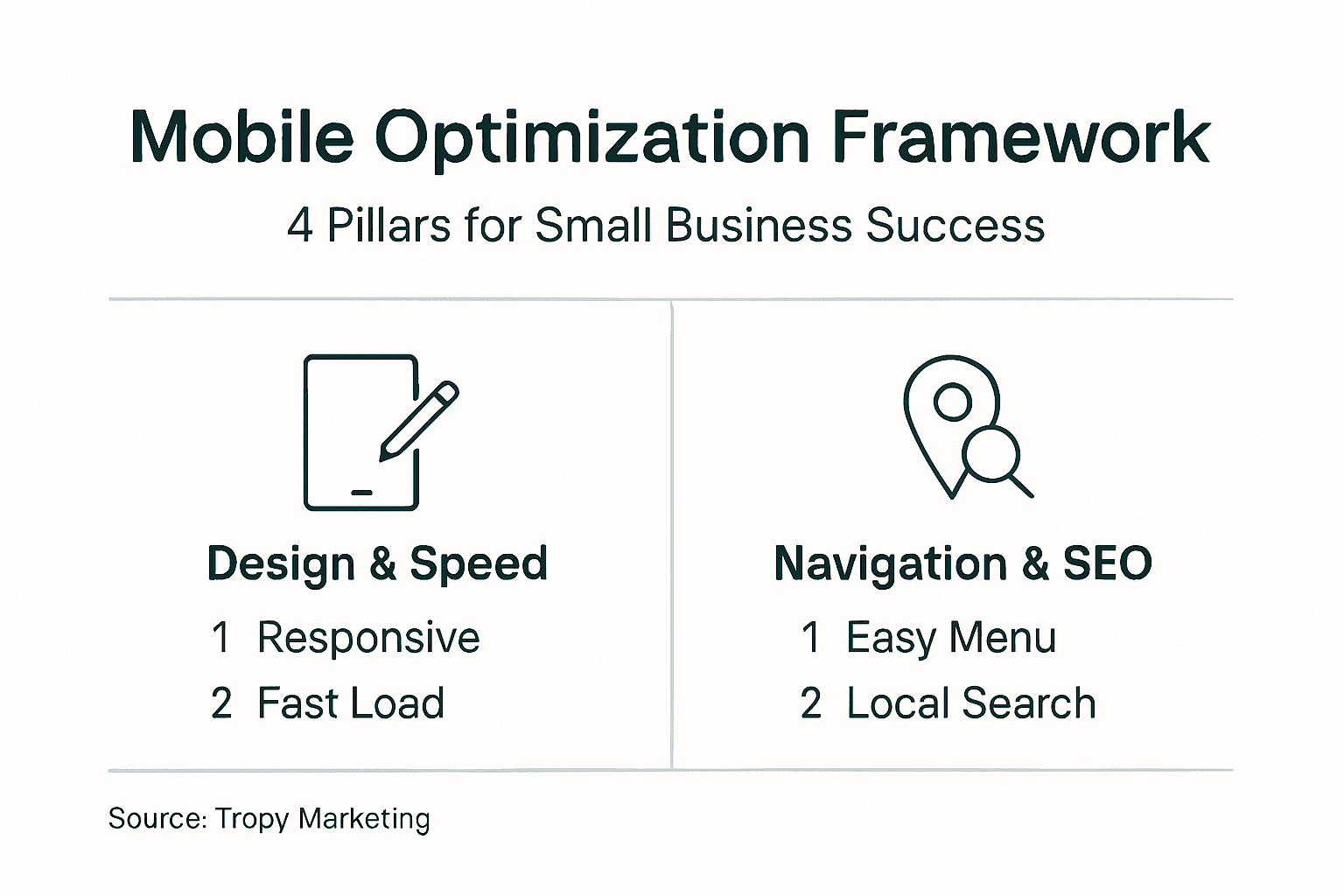
Use this 4-pillar framework: speed, responsive design, navigation, and local SEO. Each pillar supports the others, creating a foundation that improves key metrics by 30-50%.
Step 1: Audit current mobile performance. Test your site using Google's Mobile-Friendly Test and PageSpeed Insights. Identify specific issues affecting speed and usability.
Step 2: Implement responsive design. Ensure your site adapts seamlessly to all screen sizes. Check that content reflows properly without horizontal scrolling.
Step 3: Optimize page load speed through:
- Compressing images to web-optimized sizes
- Minimizing CSS and JavaScript code
- Enabling browser caching
- Choosing fast, reliable hosting
- Using lazy loading for images below the fold
Step 4: Simplify navigation and interface. Create thumb-friendly menus, enlarge tap targets, and remove unnecessary elements cluttering mobile screens.
Step 5: Enhance local SEO including:
- Optimizing Google Business Profile
- Adding location-specific keywords naturally
- Including Melbourne suburbs you serve
- Building local citations and backlinks
Step 6: Test and update regularly. Mobile technology and user expectations evolve constantly. Schedule quarterly reviews to maintain competitive advantage.
| Framework Step | Primary Focus | Expected KPI Improvement |
|---|---|---|
| Speed Optimization | Load time under 3 seconds | 30-40% conversion increase |
| Responsive Design | Seamless multi-device experience | 25-35% lower bounce rate |
| Navigation Simplification | Easy thumb-friendly interface | 40-50% longer sessions |
| Local SEO Enhancement | Melbourne search visibility | 35-45% more local traffic |
Pro Tip: Apply mobile SEO framework for small businesses principles focusing on sustainable foundational strategies. Quick fixes might boost metrics temporarily, but proper structure ensures long-term growth as your business expands.
Real-World Examples and Case Studies from Melbourne Businesses
A Melbourne trades business approached us with a slow, difficult-to-navigate mobile site. Their bounce rate exceeded 70%, and they received minimal enquiries from mobile visitors.
We implemented comprehensive mobile optimization focusing on speed and navigation. Load time dropped from 8 seconds to 2.5 seconds. We simplified the menu structure, enlarged contact buttons, and optimized images.

A Melbourne trades business saw a 35% increase in enquiries within 3 months after mobile optimization improvements focused on speed and navigation. Their bounce rate fell to 38%, and mobile visitors started converting at rates matching desktop users.
Key actions taken:
- Compressed all images without quality loss
- Redesigned navigation for thumb-friendly tapping
- Implemented click-to-call buttons prominently
- Optimized contact forms to three essential fields
- Added location-specific service pages
"We didn't realize how many potential customers we were losing to our slow mobile site. Within weeks of optimization, our phone started ringing more. The investment paid for itself in the first month."
This demonstrates the tangible impact proper mobile optimization delivers for small businesses. It's not theoretical. Real Melbourne businesses achieve measurable growth by prioritizing mobile experience. View more Melbourne business mobile optimization case studies showing similar results across different industries.
Practical Tips for Maintaining and Improving Mobile Optimization Over Time
Mobile optimization isn't a one-time project. Technology evolves, Google updates algorithms, and user expectations rise. Continuous improvement keeps you ahead of competitors.
Conduct regular speed and usability audits quarterly. Use free tools like Google PageSpeed Insights, Mobile-Friendly Test, and Search Console. Monitor metrics for degradation indicating new issues.
Stay informed about Google mobile ranking algorithm updates. Subscribe to Google Search Central blog and industry newsletters. Major updates can shift ranking factors, requiring adjustments.
Continuously optimize your Google Business Profile. Add fresh photos, respond to reviews, update business hours, and post regular updates. This supports mobile local search visibility.
Keep improving website navigation and content for mobile users:
- Test new features on actual mobile devices
- Simplify processes based on user feedback
- Update content to match current search intent
- Remove outdated or underperforming pages
- Monitor mobile-specific analytics metrics
Pro Tip: Schedule quarterly mobile performance reviews using tools for maintaining mobile optimization. Set specific metrics to track (load time, bounce rate, conversion rate) and commit to measurable improvements each quarter. This systematic approach prevents regression and maintains competitive advantage.
Discover Expert Mobile Web Design & SEO Services for Melbourne SMEs
Achieving and maintaining optimal mobile performance requires expertise and ongoing attention. Troov Marketing specializes in building mobile-optimized sites tailored for Melbourne small business owners. We design fast, modern websites structured for local SEO from day one.
Our approach focuses on strong foundations, not quick fixes. We provide small business web design services that combine responsive design, speed optimization, and local SEO strategies. Every site we build is tested thoroughly on mobile devices to ensure exceptional user experience.
We also offer tools and resources including a complete website checklist and ongoing support through our small business SEO solutions. Whether you need a new mobile-optimized site or improvements to your existing one, we deliver clear, reliable results that turn visitors into enquiries.
What Is Mobile Optimization? Frequently Asked Questions
What are the main benefits of mobile optimization for small businesses?
Mobile optimization increases search visibility, reduces bounce rates, and improves conversion rates. Melbourne businesses typically see 30-50% improvements in key metrics after proper optimization. You reach more local customers actively searching for your services on phones.
How quickly can I expect results after optimizing my mobile site?
Speed and usability improvements show immediate impact on bounce rates and session duration. SEO benefits take longer, typically 4-8 weeks as Google recrawls and re-evaluates your site. Most businesses notice increased enquiries within the first month.
Is mobile optimization expensive for small businesses?
Costs vary based on current site condition and desired improvements. Basic optimization (speed, responsive design) is affordable and delivers strong ROI. Consider it an investment that pays ongoing returns through increased traffic and conversions. Professional mobile web design tips help maximize value.
How does mobile optimization relate to Google Business Profile?
They work together synergistically. An optimized mobile site provides the destination for traffic your Google Business Profile generates. When local customers find you through Google Maps or local search, a fast mobile site converts that visibility into enquiries and sales.
What tools help track mobile site performance improvements?
Google Search Console shows mobile usability issues and performance metrics. Google Analytics tracks mobile-specific user behavior, bounce rates, and conversions. PageSpeed Insights measures load times and identifies optimization opportunities. These free tools provide essential data for ongoing improvements.