

If you're an electrician relying solely on word-of-mouth referrals, you might be surprised to learn that 79% of electricians across Australia and New Zealand already have websites. This isn't just a trend among larger companies. Solo operators and small teams are building online presences because they've recognised something critical: consistent lead generation requires more than hoping your last happy customer remembers to recommend you. The gap between electricians with websites and those without isn't just about being modern, it's about survival and growth in a competitive market where potential clients search online first.
Table of Contents
- Key takeaways
- The current landscape: why most electricians have websites
- Why relying on word-of-mouth alone can limit your business
- Key website features that attract and convert local clients
- How to integrate your website with local SEO and online marketing
- Get professional website design and SEO help for electricians
- Frequently asked questions
Key Takeaways
| Point | Details |
|---|---|
| Websites drive enquiries | Websites provide a steady flow of enquiries rather than relying on chance referrals. |
| Online presence boosts growth | A strong online presence helps electricians compete for higher value contracts and maintain work during slow periods. |
| 79 per cent online | Across Australia and New Zealand around 79 per cent of electricians have websites, underpinning reliable client access. |
| Websites run 24 7 | They capture enquiries while you are on site or resting, creating dependable lead flow. |
| ROI justifies web costs | A single residential rewiring job can cover a year's hosting and maintenance. |
The current landscape: why most electricians have websites
The data tells a compelling story about survival in the electrical trade. Out of 6,579 electricians surveyed across Australia and New Zealand, 5,192 have established websites, representing 79% of the industry. This isn't coincidental. Electricians who operate without websites rarely sustain their businesses beyond five years, struggling to maintain consistent work during slow periods when referrals dry up.
The correlation between website ownership and business longevity reveals something fundamental about modern client behaviour. When a homeowner's circuit breaker trips at 9pm or a business needs urgent electrical work, they don't flip through the Yellow Pages or wait for a friend's recommendation. They search Google on their phone, expecting to find contact details, service areas, and availability immediately.
| Business characteristic | With website | Without website |
|---|---|---|
| Average business age | 8+ years | 2-4 years |
| Lead consistency | Steady monthly flow | Highly variable |
| Geographic reach | Multiple suburbs | Limited to immediate area |
| Client trust signals | Reviews, portfolio, credentials | Word-of-mouth only |
Electricians choose websites for varied but interconnected reasons. Some prioritise local visibility, wanting to appear when potential clients search for "emergency electrician near me" or "commercial electrical services Melbourne". Others recognise that younger homeowners and business managers expect to research service providers online before making contact. A growing number understand that web design for electricians directly impacts their ability to compete for higher-value commercial contracts where decision-makers vet contractors thoroughly before engagement.
Conversely, electricians who avoid websites typically fall into predictable categories. Some believe their existing referral network is sufficient, not recognising how vulnerable this makes them to market shifts. Others worry about costs or technical complexity, unaware that modern website solutions are affordable and manageable. A smaller group simply hasn't prioritised digital presence, operating reactively rather than strategically about business growth.
Pro Tip: If you're hesitant about website costs, consider this: a single residential rewiring job typically covers an entire year of professional website hosting and maintenance. The return on investment becomes positive after just one additional monthly lead.
The electricians thriving beyond the five-year mark share a common trait: they've built systems for consistent lead generation rather than depending on unpredictable referrals. Their websites work as 24/7 sales representatives, answering common questions, showcasing credentials, and capturing enquiries while they're on job sites or sleeping. This systematic approach to client acquisition creates business stability that word-of-mouth alone cannot match.
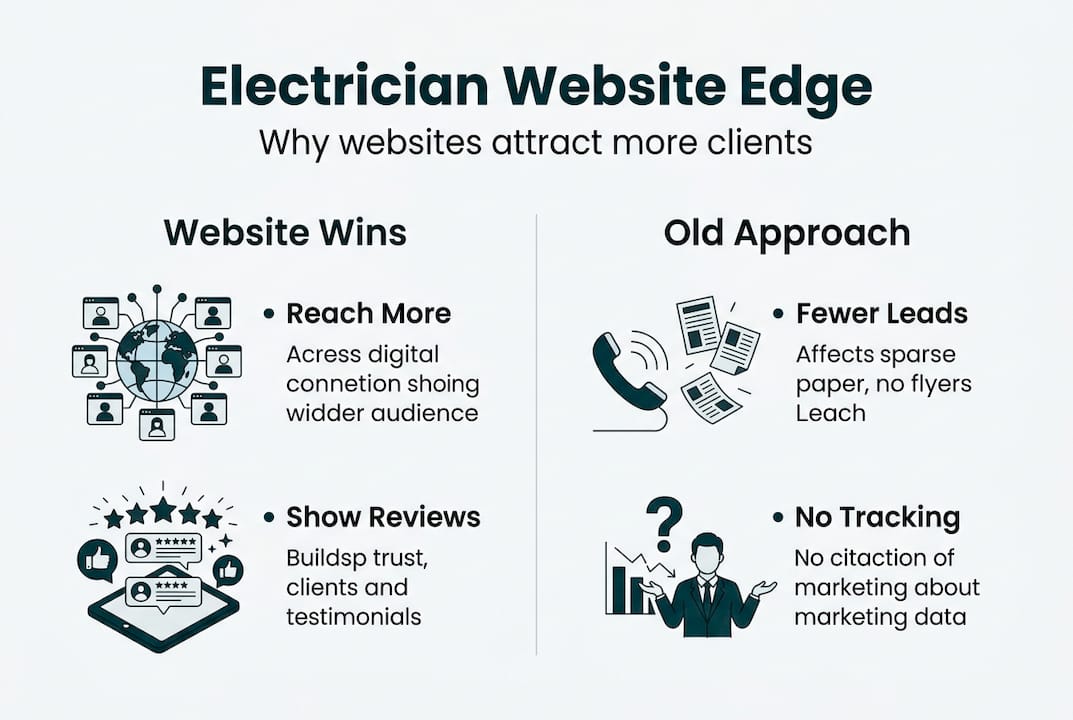
Why relying on word-of-mouth alone can limit your business
Word-of-mouth referrals feel reliable because they're personal and trusted. A satisfied customer recommends you to their neighbour, that neighbour calls, and the cycle continues. This model worked brilliantly for decades when communities were tighter and consumer behaviour was different. Today, this approach carries significant risks that many electricians don't recognise until they experience a prolonged dry spell.
The fundamental problem with word-of-mouth dependency is unpredictability. Your lead flow depends entirely on factors outside your control: whether past clients remember you when someone asks for recommendations, whether they're socially connected to people needing electrical work, and whether those potential clients act on casual suggestions. During economic downturns or seasonal slowdowns, referral networks contract sharply, leaving you scrambling for work.
Scaling presents another critical limitation. Word-of-mouth grows linearly at best. If you complete ten jobs this month and half those clients refer one person next month, you gain five potential leads. Compare this to a well-optimised website that appears in local search results for dozens of relevant queries, potentially reaching hundreds of searchers monthly. The mathematical ceiling on referral-based growth becomes obvious.
"I relied on referrals for three years and thought I was doing great until winter hit and nobody was renovating. Suddenly I had two weeks with zero calls. That's when I realised I needed something more predictable. Got a website up, started showing in Google Maps results, and now I get at least 3-4 enquiries weekly regardless of season." — Electrician sharing experience on industry forum
Common pitfalls from exclusive word-of-mouth reliance include:
- Revenue volatility making it impossible to plan investments in tools, vehicles, or staff
- Geographic limitations because referrals cluster in areas where you've previously worked
- Inability to target specific service types, forcing you to take whatever work comes rather than specialising profitably
- Lack of professional credibility with commercial clients who expect contractors to have established online presences
- Vulnerability to negative word-of-mouth, which spreads faster than positive recommendations but leaves no opportunity for public response
The contrast with website-generated leads is stark. Electrician SEO strategies allow you to target specific suburbs, service types, and client segments. You can optimise for emergency calls, commercial contracts, or residential renovations based on your business goals. This strategic control over lead sources enables sustainable growth and business planning.
Pro Tip: Track your lead sources meticulously for three months. You'll likely discover that word-of-mouth generates fewer leads than you assumed, and those leads often come in clusters followed by gaps. This visibility alone motivates most electricians to diversify their client acquisition channels.
Websites also provide something word-of-mouth cannot: data. You can see which services generate the most enquiries, which suburbs produce the best clients, and which marketing messages resonate. This intelligence allows continuous refinement of your positioning and service offerings, creating a compounding advantage over competitors who operate on assumptions and anecdotes.
Key website features that attract and convert local clients
Not all electrician websites perform equally. The difference between a site that generates consistent enquiries and one that sits idle comes down to specific features designed for local service businesses. Understanding these elements helps you invest wisely whether you're building a new site or improving an existing one.

| Feature category | Basic website | High-converting website |
|---|---|---|
| Mobile design | Desktop layout shrunk to fit phone | Purpose-built mobile interface with tap-to-call |
| Contact options | Email form only | Phone, SMS, email, live chat, booking system |
| Service pages | Single "Services" page listing everything | Dedicated pages per service with local keywords |
| Trust signals | Business name and licence number | Reviews, photos, certifications, insurance details |
| Load speed | 5-8 seconds | Under 2 seconds |
| Local SEO | Business address in footer | Structured data, suburb pages, Google Business integration |
The most critical website elements for electricians follow a clear hierarchy:
- Mobile-first design that loads instantly and makes calling effortless, because 73% of electrical service searches happen on smartphones
- Clear service descriptions using language clients actually search for, not industry jargon that confuses homeowners
- Prominent contact options above the fold on every page, eliminating any friction between interest and action
- Social proof through authentic reviews, project photos, and credentials that build immediate trust
- Local relevance signals including suburb-specific content and service area clarity that help both search engines and potential clients understand your coverage
Mobile optimisation deserves special emphasis because it directly impacts whether searchers become callers. When someone's power goes out or they need urgent electrical work, they're almost certainly searching on their phone. If your website takes five seconds to load or requires zooming and scrolling to find your phone number, they'll hit the back button and call your competitor instead. Local SEO website features like click-to-call buttons and simplified navigation specifically address this behaviour pattern.
Conversion optimisation extends beyond aesthetics into psychology. Electricians who showcase their work through before-and-after photos, explain their processes in plain language, and display relevant certifications convert significantly more visitors into enquiries. These trust signals matter especially for electrical work, where safety concerns and regulatory compliance create natural hesitation about hiring unknown contractors.
Pro Tip: Add a simple booking system or availability calendar to your website. Even if clients prefer calling, seeing your schedule transparency builds confidence that you're organised and professional. This small feature often differentiates you from competitors who seem less accessible or established.
The ultimate website checklist covers technical foundations like SSL certificates, fast hosting, and proper site structure that support these visible features. While clients don't consciously notice these elements, they create the reliable, professional experience that converts casual browsers into paying customers. Skipping technical fundamentals to save money typically backfires, producing a website that looks acceptable but performs poorly in search results and user experience.
How to integrate your website with local SEO and online marketing
A website alone won't transform your business. The real power emerges when you connect your site with local SEO tactics and digital marketing channels that drive targeted traffic. This integration creates a system where each component reinforces the others, multiplying your visibility and lead generation capacity.
Effective integration strategies include:
- Claiming and optimising your Google Business Profile with consistent information, regular posts, and review management that links back to your website
- Creating suburb-specific content pages that target local search queries while demonstrating your service area expertise
- Building citations across online directories with identical business information that reinforces your legitimacy to search engines
- Earning backlinks from local business associations, suppliers, and community organisations that signal authority in your geographic area
- Publishing helpful content that answers common electrical questions, positioning you as the trusted local expert
The impact of these tactics becomes measurable quickly. Electricians who implement comprehensive local SEO alongside their websites see dramatic shifts in lead volume and quality.
| Local SEO metric | Before optimisation | After 6 months optimisation |
|---|---|---|
| Monthly website visitors | 40-60 | 200-350 |
| Google Maps impressions | 500-800 | 3,000-5,000 |
| Enquiries per month | 2-4 | 12-18 |
| Average enquiry quality | Mixed | Highly targeted to services offered |
Combining website design and local SEO requires understanding how search engines evaluate local service providers. Google prioritises businesses that demonstrate relevance, proximity, and prominence. Your website provides the foundation for relevance through service descriptions and local content. Your Google Business Profile establishes proximity. Reviews, citations, and backlinks build prominence.
Content maintenance plays a crucial role that many electricians overlook. Search engines favour websites that regularly publish fresh, relevant content. This doesn't require daily blog posts, but quarterly updates about regulatory changes, seasonal electrical tips, or new services keep your site active in search algorithms. Electrician SEO Victoria 2026 strategies emphasise consistent content updates as a competitive differentiator in crowded markets.
Tracking performance through analytics transforms guesswork into strategy. Installing Google Analytics and Search Console on your website reveals which services generate the most interest, which suburbs produce the best leads, and which marketing channels drive the highest-quality traffic. This data allows you to double down on what works and abandon what doesn't, continuously improving your return on marketing investment.
Many electricians worry about the time commitment required for ongoing SEO and content management. The reality is less demanding than feared. Spending 2-3 hours monthly on Google Business Profile updates, review responses, and basic content additions typically suffices once your foundational optimisation is complete. This modest investment generates compounding returns as your search visibility strengthens and your lead flow stabilises.
Get professional website design and SEO help for electricians
Building an effective website and implementing local SEO might feel overwhelming when you're focused on running jobs and managing clients. That's exactly why Troov Marketing specialises in helping tradespeople like electricians establish strong online presences without the technical headaches. We've worked with electrical contractors across Melbourne to create websites that actually generate leads, not just look pretty.
Our approach focuses on practical foundations rather than flashy features that don't convert. We build fast, mobile-optimised sites structured for local search from day one, then integrate them with Google Business Profile optimisation and ongoing SEO support. This comprehensive strategy addresses the complete client journey from search to enquiry. Resources like our ultimate website checklist help you understand exactly what makes an electrician website effective.
Whether you're starting from scratch or improving an existing site that's not performing, small business web design expert tips and small business SEO services provide the clarity and support you need. The difference between struggling for leads and having consistent enquiries often comes down to professional implementation of proven strategies tailored specifically for trades businesses.
Frequently asked questions
What is the average cost of building a website for an electrician?
Website costs for electricians typically range from $2,000 to $6,000 depending on design complexity, number of pages, and included features like booking systems or chat functions. Most packages include mobile optimisation, basic SEO setup, and content management systems that let you update information yourself. Monthly hosting and maintenance usually add $50 to $150, making the total investment comparable to a single mid-sized residential job.
Can a website replace traditional referrals for electricians?
Websites complement rather than replace referrals by expanding your reach beyond existing networks and creating predictable lead flow. The most successful electricians maintain strong referral relationships while using their website to capture clients who search online first. This combination provides stability during slow referral periods and allows strategic growth into new service areas or client segments that referrals alone wouldn't reach.
How long does it take to see results from SEO on my electrician website?
Most electricians notice increased enquiries within 3 to 6 months of implementing comprehensive local SEO, though timeline varies based on competition intensity and optimisation quality. Early wins often come from Google Business Profile optimisation and basic on-page SEO, while broader organic search visibility builds gradually. Consistent effort compounds over time, with year two typically producing significantly better results than year one as authority accumulates.
What are the must-have pages for an electrician website?
Essential pages include a home page clearly stating your services and service area, individual service pages for key offerings like residential, commercial, and emergency work, an about page establishing credentials and experience, a testimonials or reviews page building trust, and a contact page with multiple communication options. Adding a blog or resources section helps with SEO by targeting question-based searches clients commonly use. Check the website checklist for complete page requirements and optimisation details.