

Your service pages are live, you've put in the effort, but the phone isn't ringing. Sound familiar? Many Melbourne small businesses have websites that look decent but quietly bleed potential customers because their service pages aren't built to convert or rank locally. A service page redesign can yield 45% more sales and 1,418% more form submissions, which means the gap between a mediocre page and a great one isn't small. This guide walks you through exactly what to fix, build, and measure so your service pages start working as hard as you do.
Table of Contents
- Why service page design matters for Melbourne businesses
- What you need before you start: essentials checklist
- How to design your service pages: a step-by-step process
- SEO and navigation structure for service pages in Melbourne
- Measuring results and refining your service pages
- How Troov Marketing helps Melbourne businesses build high-converting service pages
- Frequently asked questions
Key Takeaways
| Point | Details |
|---|---|
| Conversion-focused content | Your service page should lead with benefits, trust signals, and strong calls to action to boost leads and sales. |
| Local SEO essentials | Structure your pages for Melbourne search, using local keywords, suburb linking, and strategic headings. |
| Measure and optimise | Track conversions, adjust page elements, and iterate to continually lift results for your small business. |
| Protect against penalties | Make every service page unique and truly useful to avoid Google’s quality penalties. |
| Prepare before building | Start with a checklist of assets, reviews, photos, and content ideas for a smooth, conversion-optimised launch. |
Why service page design matters for Melbourne businesses
Most small business owners treat service pages as a formality. A paragraph about what you do, maybe a photo, and a contact button. But Google and your customers expect far more than that in 2026.
Conversion rates tell the real story. Well-designed service pages achieve conversion rates of 3 to 5% or higher, with dramatic improvements in leads and engagement compared to basic pages. For a Melbourne tradie or professional service getting 500 monthly visitors, the difference between a 1% and a 4% conversion rate is roughly 15 extra enquiries every month.
There's also a serious SEO risk hiding in plain sight. Google actively penalises what it calls "doorway pages," which are thin, duplicated service pages stuffed with suburb names but offering no real value. Prioritising usefulness and uniqueness is the only reliable way to avoid these penalties and keep your rankings intact.
"A service page isn't just a description of what you do. It's a sales conversation with someone who's already interested. Design it that way."
Melbourne customers also have specific habits worth noting. They search with suburb-level intent, compare multiple providers quickly, and make decisions fast on mobile. Your service page needs to answer their questions before they think to ask them. Understanding these local behaviours is central to improving local SEO and turning visitors into paying customers.
Here's what poor service page design typically costs you:
- High bounce rates from visitors who can't find what they need quickly
- Lost rankings from thin or duplicated content across suburb pages
- Missed enquiries from unclear or buried calls to action
- Damaged trust from outdated or generic page content
For anyone serious about local SEO for small businesses, the service page is ground zero. Get it right here, and everything else gets easier.
What you need before you start: essentials checklist
Rushing into building a service page without the right assets is one of the most common and costly mistakes. You end up reworking everything twice. A bit of preparation now saves hours later.
Start by gathering your core content ingredients. Every effective service page needs a clear value proposition, a simple explanation of your process, some form of pricing guidance, a list of benefits (not just features), and trust signals like reviews or certifications. Including trust signals above the fold, such as reviews and certifications, increases credibility and engagement from the moment someone lands on your page.
| Asset | Why it matters | Where to get it |
|---|---|---|
| Customer testimonials | Builds immediate trust | Ask recent clients directly |
| Before/after images | Shows real results | Your own job photos |
| Process steps | Reduces anxiety about hiring | Write from your workflow |
| Pricing guidance | Filters serious enquiries | Research local competitors |
| Certifications/licences | Validates credibility | Your existing documents |
| Local suburb references | Signals Melbourne relevance | Your service area list |
Before writing a single word, also check what your Melbourne competitors are doing. Look at the top three results for your main service keyword in your suburb. Note what they include, what they're missing, and where you can genuinely do better. This isn't about copying; it's about understanding the baseline your customers are already comparing you against.
Pro Tip: The most powerful trust signal isn't a five-star rating. It's a specific customer story. "John from Fitzroy called us on a Tuesday morning with a blocked drain and we had it sorted by lunch" is worth ten generic reviews. Real stories stick.
Here's your pre-build checklist:
- Value proposition written in plain language (what you do, for whom, and why you're the right choice)
- At least three customer testimonials with first name and suburb
- Photos of your actual work, not stock images
- A simple 3 to 5 step process description
- Pricing range or starting-from figure
- List of suburbs you service in Melbourne
- Your Google Business Profile link
If you're unsure where to start with content planning, brushing up on SEO basics for page planning will give you a solid foundation. And if your current site has structural problems, reviewing common website mistakes before you build is time well spent.
How to design your service pages: a step-by-step process
With your assets ready, here's how to put the page together in a way that both Google and real humans will respond to.
- Write a headline that names the service and the location. "Plumbing repairs in Melbourne's inner north" is more powerful than "Our plumbing services." Be specific.
- Build your above-the-fold section carefully. This is everything visible before scrolling. Include your headline, a one-sentence value statement, your primary call to action, and at least one trust signal such as a review count or a certification badge.
- Add a process section. Three to five steps showing exactly what happens when someone hires you. This reduces hesitation and makes you feel approachable and professional.
- Include pricing guidance. You don't need to publish a full price list. A "starting from" figure or a typical range is enough to filter serious enquiries and build confidence.
- Write a benefits section. Focus on outcomes for the customer, not features of your service. "You'll have a functioning hot water system by end of day" beats "we carry all major brands."
- Add an FAQ section. Answer the three to five questions you get asked most often. This builds trust, reduces friction, and gives Google more indexable content.
- Finish with a strong call to action. One clear next step. Call, fill in a form, or book online. Don't offer three options and confuse people.
Page structure matters enormously for engagement. Redesigned pages can increase time on site by 2.4 times and cut bounce rates by 58%, which directly signals quality to Google and keeps more visitors moving toward an enquiry.

| Approach | Cost | SEO control | Conversion potential | Best for |
|---|---|---|---|---|
| DIY (page builder) | Low | Limited | Low to medium | Tight budgets, simple services |
| Template website | Low to medium | Moderate | Medium | Early-stage businesses |
| Custom professional | Medium to high | Full | High | Growth-focused businesses |
For guidance on structuring the top of your page effectively, homepage design best practices apply directly to service pages too. And if you want your calls to action to actually drive clicks, learning how to write calls to action that convert is worth your time.
Pro Tip: Link each service page to your most relevant suburb or location pages, and link those location pages back to your service pages. This bidirectional linking structure is one of the most underused local SEO tactics for Melbourne businesses.
SEO and navigation structure for service pages in Melbourne
Building a great page is only half the job. If Google can't understand what the page is about and where it fits in your site, it won't rank it well.
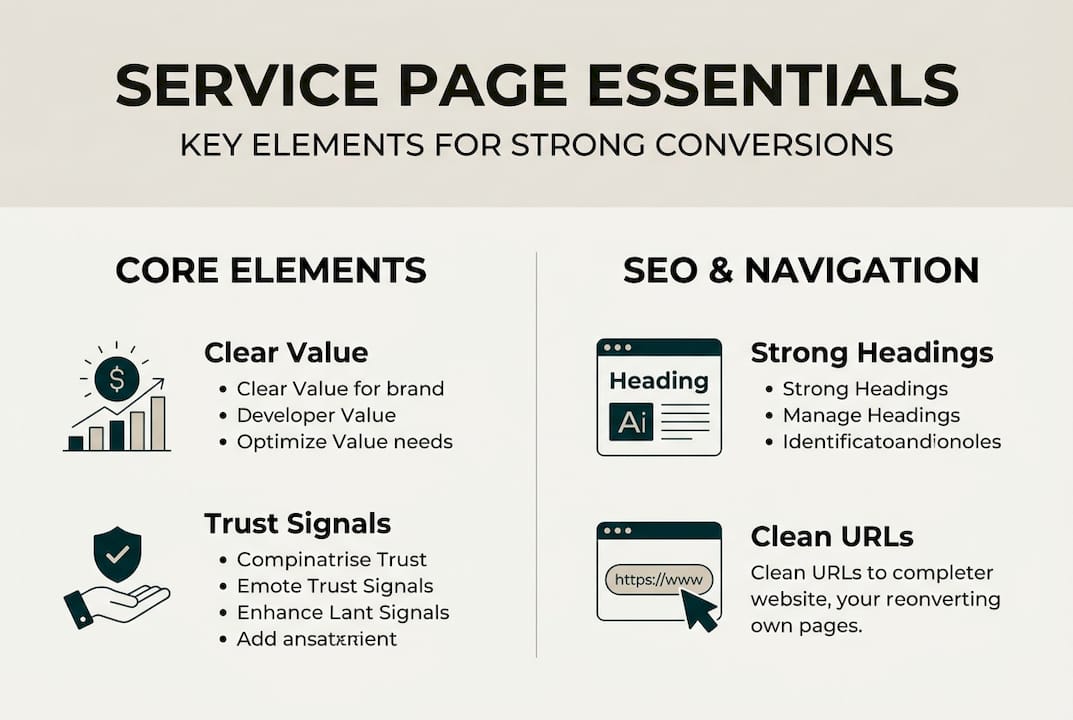
Start with your URL. Keep it clean and descriptive. Something like "/services/plumbing-fitzroytells both Google and users exactly what to expect. Avoid generic URLs like/page-3or/service1`.
Your heading structure matters too. Use your H1 for the main service and location. Use H2s for major sections like your process, benefits, and FAQs. Use H3s for individual steps or questions. This hierarchy helps Google understand the page's structure and improves your chances of appearing in featured snippets.
Bidirectional service and location links help maximise search ranking and prevent Google doorway penalties. In practice, this means your "plumbing repairs" page links to your "Fitzroy" location page, and your "Fitzroy" page links back to "plumbing repairs." Each page reinforces the other.
Here's what your SEO structure checklist should include:
- URL includes service name and Melbourne suburb or region
- H1 contains primary keyword with location
- Meta description is unique, under 160 characters, and includes a call to action
- Page links to at least two relevant suburb or location pages
- Those location pages link back to this service page
- Google Business Profile link included somewhere on the page
- Schema markup added for local business and service (if your platform supports it)
Pro Tip: Your FAQ and process sections are goldmines for Google. Write them in plain, question-and-answer format and Google may pull them directly into search results as featured snippets, giving you visibility even above the top organic result.
For a deeper look at how site structure and local visibility connect, the guide on website design and local SEO is worth reading alongside this one. And if you want to understand how professional site structure supports rankings, local SEO structure covers the technical side clearly.
Measuring results and refining your service pages
Once your page is live, the work isn't finished. The businesses that get the best results treat their service pages as living documents, not set-and-forget assets.
These are the metrics that matter most:
- Conversion rate: The percentage of visitors who submit a form, call, or book. Aim for 3 to 5% or higher.
- Time on page: Are people reading your content or leaving immediately?
- Bounce rate: A high bounce rate often signals a mismatch between what Google promised and what the page delivers.
- Form submissions and phone calls: Track these separately if you can. They tell you which call to action is working.
- Google Business Profile views: If your page links to your GBP, watch for increases in profile visits and direction requests.
The tools you need aren't complicated. Google Analytics 4 tracks visits, time on page, and conversions. Hotjar shows you heatmaps of where people click and how far they scroll. Google Business Profile Insights shows how customers find and interact with your listing.
Key stat: Redesigns boost sales by 45% and reduce bounce rates by 58%, but only when the changes are based on real data, not guesswork. Review your metrics monthly and make one change at a time so you know what's actually working.
When something isn't performing, start with the simplest fix first. Change your call to action wording. Add a new testimonial. Update a photo. Small changes often produce surprising results. For a structured approach to improvement, the website redesign benefits guide outlines what to prioritise. The website checklist is also a practical tool for auditing what might be holding your page back.
How Troov Marketing helps Melbourne businesses build high-converting service pages
If you've read this far, you know that a great service page isn't just about looking good. It's about structure, local SEO, trust signals, and a clear path to conversion. That's exactly what we focus on at Troov Marketing. We work with trades, professional services, and local businesses across Melbourne to build websites designed for local search and real enquiries, not just online presence. Our website and SEO packages are built around the foundations covered in this guide. If you'd like to talk through your service pages or get a second opinion on what's holding your site back, speak to our team and we'll point you in the right direction.
Frequently asked questions
What are the key elements to include on a great service page?
Every strong service page needs trust signals above the fold, a clear process section, pricing guidance, customer benefits, and specific local references. These elements work together to build confidence and drive enquiries.
How do I structure my service page for Melbourne SEO?
Use suburb-specific URLs and headings, include Melbourne location keywords naturally in your content, and link services to locations bidirectionally across your site.
How do I know if my new service page is working?
Track conversion rate, time on page, bounce rate, and direct leads. A well-built page should reach 3 to 5% conversion or higher within a few months of going live.
What makes a service page avoid Google penalties?
Google penalises thin, duplicated pages that exist only to target suburb keywords. Unique, useful content written for real users is the only reliable way to stay on the right side of these guidelines.
Should I list prices on my service page?
Yes, even a rough range helps. Pricing guidance filters out tyre-kickers, builds trust with serious buyers, and improves your overall conversion rate without requiring you to publish a full price list.