

TL;DR:
- A structured SEO workflow is essential for improving online visibility and attracting local clients.
- Preparing with a professional website, local keywords, and Google profile sets the foundation for success.
- Ongoing monitoring and adjustments ensure sustained growth and higher search rankings in Melbourne.
Running a garden business in Melbourne means competing with dozens of local operators for the same pool of clients. Most of them are searching online right now, typing phrases like "garden maintenance Fitzroy" or "landscaper near me" into Google. If your website does not appear in those results, you are missing real enquiries every single day. A structured SEO workflow changes that. It gives you a clear, repeatable process to improve your visibility, attract local leads, and build a stronger online presence over time. This guide walks you through each step so you can take action with confidence.
Table of Contents
- Prepare for SEO success: what you need before starting
- Step 1: Optimise your website structure and content
- Step 2: Local SEO essentials for garden businesses
- Step 3: Monitor, adjust, and grow your SEO results
- Why a consistent SEO workflow outperforms quick fixes
- Get expert help with your garden website SEO
- Frequently asked questions
Key Takeaways
| Point | Details |
|---|---|
| Start with the right setup | Make sure you have all the tools, access, and info you need before beginning SEO work. |
| Structure boosts visibility | A logical website structure and keyword-focused pages help attract Melbourne clients. |
| Local SEO is crucial | Building a strong Google Business Profile and using local signals can greatly improve your rankings. |
| Monitor and adjust | Track your SEO progress and regularly update your site for the best long-term growth. |
| Consistency wins | Following a workflow reliably outperforms shortcuts and delivers lasting results. |
Prepare for SEO success: what you need before starting
Now that you have seen why a workflow is essential, let's make sure you are set up for success. Jumping into SEO without the right foundations in place is like starting a landscaping job without your tools. You will waste time and get patchy results.
Garden businesses with a professional website are better positioned for local SEO from the start. Before you touch a single page, gather everything you need in one place. If you are still building your site or thinking about starting fresh, reviewing gardening website basics is a smart first move.
Here is a checklist of what to have ready:
- Website platform access: Log in to your CMS (WordPress, Wix, Squarespace, or similar) and confirm you can edit pages, titles, and content.
- Google Business Profile: If you have not claimed yours yet, do it now. It is free and essential for local search.
- Core keywords: Write down 5 to 10 phrases your ideal clients might search, combining your service type with your suburb or area (for example, "lawn mowing South Yarra").
- Google Analytics and Search Console: Connect both to your website so you can track what is working.
- Page inventory: List every page currently on your site and note what service or topic it covers.
- Branding assets: Have your logo, photos of your work, and service descriptions ready to use.
| Item | Why it matters |
|---|---|
| CMS login | Lets you edit pages and update content |
| Google Business Profile | Drives local map and search visibility |
| Target keywords | Guides all on-page content decisions |
| Analytics access | Shows where traffic comes from and what converts |
| Page inventory | Reveals gaps in your current content coverage |
| Branding images | Builds trust and supports gallery or project pages |
Pro Tip: Do not skip the page inventory step. Many garden business owners discover they have duplicate pages or missing service pages once they actually list everything out. Fixing these gaps early saves a lot of rework later.
Once you have all of this in order, you are ready to start making real improvements.
Step 1: Optimise your website structure and content
Once you are prepared, it is time to build a strong foundation with your website's structure and content. How your site is organised matters just as much as what is written on it.

Certain website types for gardeners attract more Melbourne leads based on their SEO setup. A site with clear, separate service pages will almost always outperform one with a single long page trying to cover everything. Good website design tips consistently point to structure as a key ranking factor.
Follow these steps to get your structure right:
- Plan your core pages. Every garden website should have a Home, About, Services, Gallery, and Contact page as a minimum. Each service you offer (lawn care, landscaping, pruning, irrigation) deserves its own page.
- Assign one main keyword per page. Do not try to rank a single page for ten different terms. Pick one primary phrase per page and build the content around it.
- Write locally focused content. Mention Melbourne suburbs, local landmarks, and seasonal conditions relevant to your work. This signals to Google that you serve a specific area.
- Use proper headings. Your page title should be an H1, and supporting sections should use H2 or H3 tags. This helps Google understand your page layout.
- Write clear meta descriptions. These short summaries appear in search results. Keep them under 160 characters and include your target keyword and a call to action.
| Weak page setup | Strong page setup |
|---|---|
| One page listing all services | Separate page per service |
| Generic titles like "Services" | Keyword titles like "Garden landscaping Melbourne" |
| No location mentions | Suburb names woven into content naturally |
| No calls to action | "Request a free quote" buttons on every page |
Pro Tip: Add a "Request a quote" button or contact form to every service page, not just your Contact page. Melbourne clients often decide quickly, so make it easy for them to reach you from wherever they land.
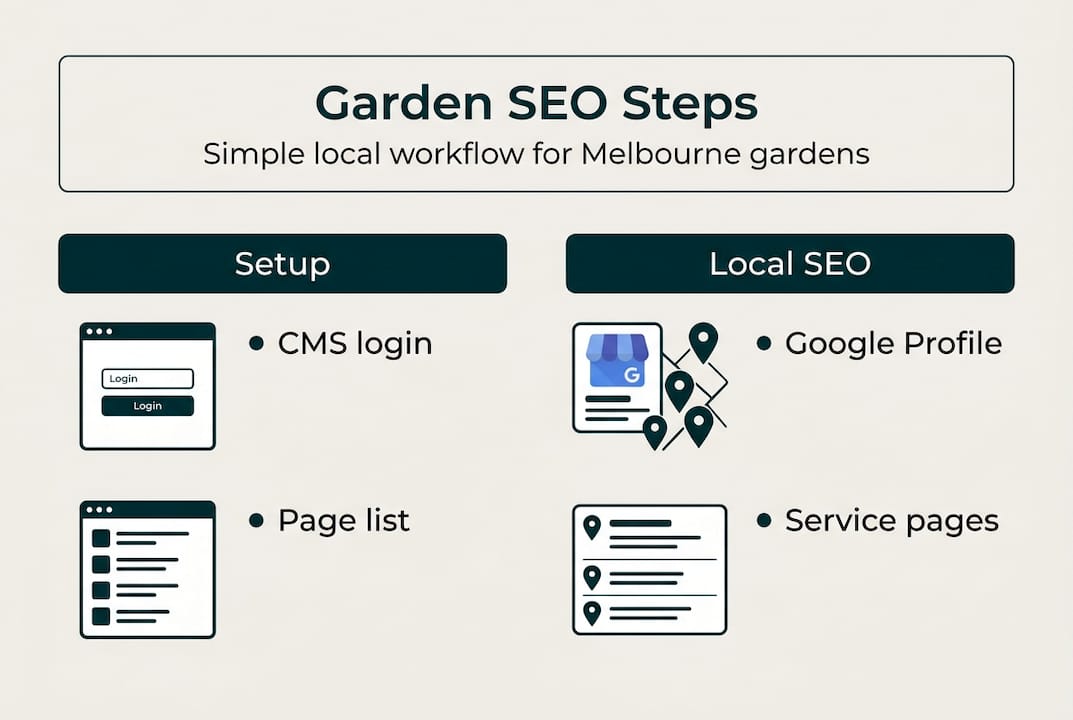
Step 2: Local SEO essentials for garden businesses
With your main site content sorted, let's make your garden website truly stand out in Melbourne's local search results. Local SEO is about telling Google exactly where you operate and who you serve.
Optimised Google profiles and local landing pages drive leads for Melbourne garden services consistently. Here is what to focus on:
- Complete your Google Business Profile fully. Add your business name, address, phone number, service areas, business hours, photos of your work, and a description that includes your main keywords.
- Keep your NAP consistent. NAP stands for Name, Address, and Phone number. Make sure these details are identical across your website, Google Business Profile, social media pages, and any local directories.
- Add location signals to your website. Include suburb names in your page headings, body text, image alt text, and meta descriptions. Do not force it. Write naturally but be specific.
- Collect and display reviews. Ask satisfied clients to leave a Google review after each job. Respond to every review, positive or negative. Reviews build trust and influence rankings.
- Build location-focused gallery pages. Create project pages that show your work in specific Melbourne suburbs. A page titled "Garden renovation in Hawthorn" is far more useful for local SEO than a generic gallery.
"Building local landing pages that speak directly to your suburb and service combination is one of the most effective ways to capture high-intent local search traffic in Melbourne."
The goal is to make it completely clear to Google, and to potential clients, that you are a local Melbourne business with real experience in their area. Specificity builds credibility.
Step 3: Monitor, adjust, and grow your SEO results
Once your site is optimised and live in Melbourne's local search, ongoing measurement and tweaks will help you stay ahead. SEO is not a set-and-forget task. It rewards consistency.
Continuous improvement with basic website management tools boosts local SEO by 45%. That is a significant gain from simply staying on top of your site's performance.
Here is what to monitor regularly:
- Google Search Console: Check which keywords your site ranks for, how many clicks you receive, and whether Google has flagged any errors or mobile usability issues.
- Page load speed: Use Google's PageSpeed Insights tool to test your site. Slow pages push visitors away and hurt rankings. Aim for a load time under three seconds.
- Traffic trends: Review your Google Analytics monthly. Look for pages that are gaining or losing visits and investigate why.
- Fresh content: Add a new blog post, project update, or seasonal tip at least once a month. Google favours sites that are regularly updated.
- Local link building: Reach out to local Melbourne directories, community groups, or complementary businesses (like hardware stores or nurseries) for a mention or link back to your site.
Pro Tip: Set a monthly reminder to check your Search Console for any new errors or manual actions. Catching a technical issue early can prevent a significant drop in rankings before it affects your enquiry volume.
If you notice a sudden drop in traffic, check whether Google released an algorithm update around the same time. Resources like website management tips can help you understand what changed and how to respond.
Why a consistent SEO workflow outperforms quick fixes
With the whole workflow laid out, it is worth stepping back and asking: why does this structured approach actually work better than one-off tweaks?
We have seen many garden businesses try a shortcut approach. They update their homepage title, add a few keywords, and wait for results. When nothing changes in a fortnight, they assume SEO does not work for them. The real issue is that SEO is cumulative. Each small improvement builds on the last.
Algorithm changes are constant. Tricks that worked in 2023 can actively hurt your rankings today. A repeatable workflow protects you from that because it is built on fundamentals: clear structure, quality content, consistent local signals, and regular monitoring. These things do not go out of date.
The website growth lessons that matter most are not about gaming the system. They are about showing up consistently, making your site genuinely useful for Melbourne clients, and fixing problems as they arise. Garden businesses that follow a steady process tend to outrank competitors who rely on occasional bursts of activity.
Patience is part of the strategy. But so is action. Start the workflow, track your progress, and keep improving.
Get expert help with your garden website SEO
If you have worked through this workflow but want faster results, or simply do not have the time to manage it all yourself, Troov Marketing is here to help. We specialise in website and local SEO for small and local businesses across Melbourne, including garden and trades businesses. Our team builds sites that are structured for search from day one, so you are not playing catch-up later. As Melbourne SEO specialists, we offer tailored strategies and affordable web design that delivers real, measurable growth. Book a call or visit our website to find out how we can support your garden business.
Frequently asked questions
How long does it take to see SEO results for a garden website?
You can usually see ranking improvements within 2 to 4 months, depending on local competition and how frequently you update your site. Regular updates and management lead to ongoing SEO growth over time.
What is the most important local SEO step for Melbourne garden services?
Claiming and fully completing your Google Business Profile is essential for appearing in local search results. Google Business Profile optimisation is one of the fastest ways to drive local leads.
Can I do SEO myself or should I hire an expert?
Many steps in this workflow are DIY-friendly, but working with a local expert can accelerate results and help you avoid costly mistakes. Professional web design and ongoing management significantly boost your SEO impact.
Do I need a different SEO approach if I specialise in landscaping vs. garden maintenance?
The core workflow is the same, but your page keywords, service descriptions, and photo galleries should reflect your specific service type for the best results. Tailoring content to service type improves both ranking relevance and lead quality.