

TL;DR:
- Ongoing local listing optimisation is essential for improved visibility and rankings in Melbourne.
- Consistent NAP details, fresh content, and active reviews build trust and search relevance.
- Genuine local knowledge and continuous management distinguish top-performing profiles from outdated ones.
Many Melbourne business owners set up a Google Business Profile, tick it off their list, and wonder why they still can't be found online. The truth is, simply creating a listing is not the same as optimising it. Local listing optimisation (LLO) is the ongoing process of managing and improving your business information across directories, maps, and platforms so that local customers can find you when it counts. This guide explains what LLO actually involves, why it's far more than a one-off task, and how you can apply it to grow your visibility in Melbourne's competitive local market.
Table of Contents
- Understanding local listing optimisation
- Core components: NAP, citations, and content
- What makes a winning local profile in Melbourne?
- Pitfalls and advanced strategies for Melbourne businesses
- Why most local listing optimisation advice misses the point
- Next steps: optimise your local presence
- Frequently asked questions
Key Takeaways
| Point | Details |
|---|---|
| Local listing optimisation explained | It means continually managing your business info across directories to boost Google rankings and local customer trust. |
| Consistency is crucial | Having the same name, address, and phone details everywhere is essential for better local visibility. |
| Ongoing effort, not one-off | Successful optimisation requires regular updates, review requests, and listing audits, not just a set-and-forget approach. |
| Local relevance wins | Profiles tailored to Melbourne’s market outperform generic or copy-pasted listings every time. |
| Monitor for issues | Check your map pin, reviews, and citations regularly to avoid ranking drops and missed leads. |
Understanding local listing optimisation
Local listing optimisation means actively managing how your business appears across online platforms. This includes Google Business Profile, Apple Maps, Bing Places, Yelp, and dozens of local directories. It's not just about being listed. It's about making sure every detail is accurate, complete, and consistent everywhere your business appears.
The most common misconception is that LLO is a one-time setup. You create a profile, add your address and phone number, and you're done. But this approach misses the point entirely. Local search marketing is a dynamic field, and Google rewards businesses that stay active and relevant over time.
Think of your listing like a shopfront. If the sign is faded, the hours are wrong, and there are no photos in the window, people walk past. The same happens online. A neglected listing signals to both Google and potential customers that your business may not be reliable.
A complete, well-maintained local listing includes:
- NAP details: Your Name, Address, and Phone number, consistent across every platform
- Business hours: Including holiday hours and any seasonal changes
- Map pin: Accurately placed at your physical or service location
- Photos: Fresh, relevant images that reflect your actual work
- Reviews: Recent feedback that builds trust with new customers
- Business description: Clear, locally relevant content that explains what you do
When any of these elements are missing or outdated, your ranking can drop. Worse, customers may arrive at the wrong address, call a disconnected number, or simply choose a competitor who looks more credible.
Many businesses treat their Google Business Profile as a one-time setup, but ongoing optimisation through monthly audits, posts, and review management is what separates visible businesses from those that stay buried in search results.
Experts consistently emphasise that LLO is an ongoing system, not a one-off checklist. Monthly audits, regular posts, and proactive review responses are what keep your listing performing well over time.
With the basics outlined, let's look at the core elements that make up a well-optimised listing.
Core components: NAP, citations, and content
Three things sit at the heart of every strong local listing: NAP consistency, citations, and locally relevant content. Get these right and you build a solid foundation for ranking in Melbourne searches.
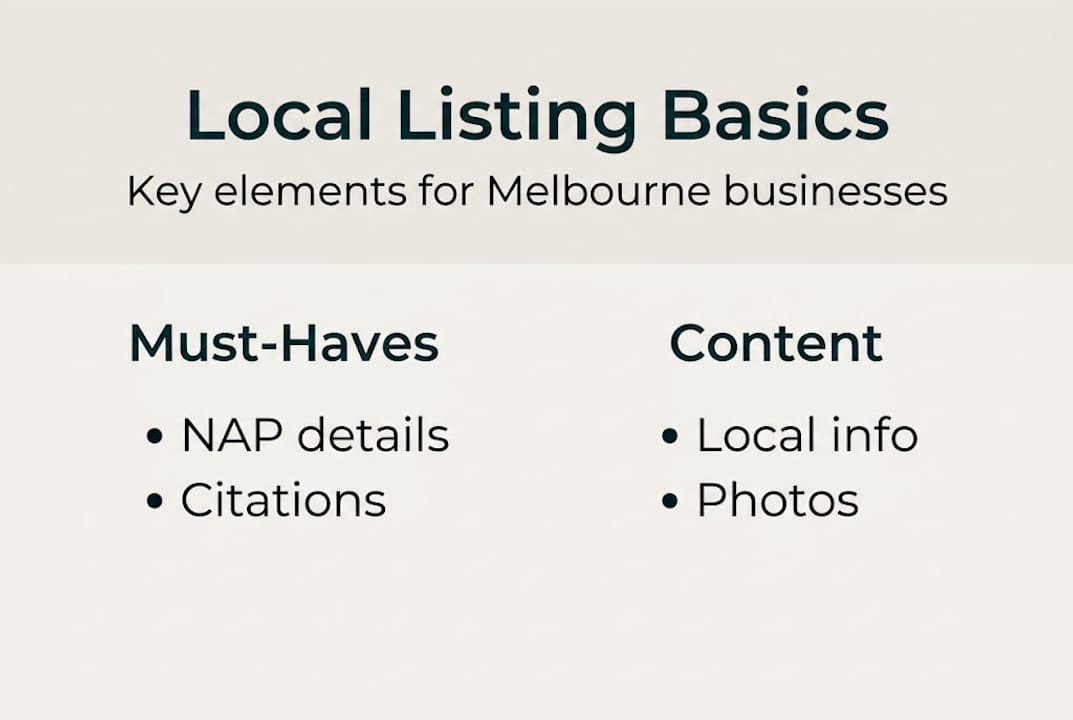
NAP consistency means your business name, address, and phone number are identical across every directory, social profile, and website where you appear. Even small differences, like writing "St" in one place and "Street" in another, can cause problems. NAP inconsistencies across 23 or more directories confuse Google's ability to recognise your business as a single, trustworthy entity.
Citations are mentions of your business details on other websites. They act as votes of confidence. The more consistent and credible your citations, the more Google trusts that your business is legitimate and relevant to local searches.
Content is where many businesses fall short. If you serve multiple areas or have more than one location, each listing and page needs to be genuinely different. Best practice is at least 60% unique content per location. Copying and pasting the same text with a suburb name swapped in can trigger what's known as a doorway penalty, where Google recognises the duplication and reduces your visibility.
Here's a quick comparison of listing quality levels:
| Element | Incomplete listing | Optimised listing |
|---|---|---|
| NAP details | Missing or inconsistent | Consistent across all platforms |
| Photos | None or outdated | Fresh, relevant, regularly updated |
| Reviews | Few or no responses | Regular, with owner responses |
| Business description | Generic or blank | Locally relevant and specific |
| Citations | Sparse or conflicting | Consistent across key directories |
Fixing inconsistent listings starts with an audit. Search your business name and address across Google, Yelp, True Local, and other directories. Note every variation and correct them one by one. Tools like Semrush's listing management feature or Moz Local can speed this up.
Pro Tip: Build your listing on websites that support Melbourne SEO from the ground up. When your website and your directory listings share the same NAP details, Google's confidence in your business grows significantly.
Now that you know what makes a listing accurate, it's time to explore what separates average profiles from those that stand out in Melbourne search results.
What makes a winning local profile in Melbourne?
Completeness is the single biggest factor separating visible local profiles from invisible ones. The average Google Business Profile sits at around 41% completeness. The top performers reach 90% or above. That gap is enormous, and it directly affects where you appear in local search results.

What does a high-completeness profile look like in practice? It has every field filled in, including services, products, attributes (like "wheelchair accessible" or "free parking"), and a well-written business description. It has photos added regularly, not just once at setup. And it has reviews coming in consistently, with the owner responding to each one.
For Melbourne businesses, local language matters too. Mentioning specific suburbs, referencing local landmarks, or speaking to the needs of your community creates relevance that generic content simply cannot match. A plumber in Fitzroy who mentions Fitzroy, Collingwood, and Carlton in their profile and website will outperform one who just lists "Melbourne" as their location.
Key traits of winning Melbourne profiles:
- Regular photo updates: At least monthly, showing real work and real people
- Review velocity: A steady stream of new reviews, not a burst followed by silence
- Accurate map pin: Critical for both customers and Google's proximity calculations
- Service area clarity: Especially important for trades and mobile services
- Local language: Suburb names, community references, and area-specific content
The 'set and forget' trap catches many small businesses. A profile that was complete in 2023 but hasn't been touched since will gradually lose ground to competitors who are actively managing theirs. Google's algorithm favours freshness and engagement.
For service area businesses (SABs), like electricians or cleaners who travel to customers, entity unity across your GBP, site, and citations is especially important. Your profile, your website, and your directory listings all need to tell the same story about who you are and where you work.
Generic pages that simply insert a city name into a template consistently underperform. Optimising your site for Melbourne local search means creating content that genuinely reflects the local area, not just repeating suburb names. For more practical ideas, the local SEO tips for Melbourne trades guide covers this in detail.
After learning what sets top listings apart, it's crucial to cover common challenges that can undermine your efforts.
Pitfalls and advanced strategies for Melbourne businesses
Even businesses with good intentions make mistakes that quietly hurt their local rankings. Knowing what to avoid is just as valuable as knowing what to do.
Here are the most common pitfalls to watch for:
- NAP mismatches: Different phone numbers or address formats across directories fragment your online identity
- Incomplete profiles: Missing hours, no photos, or a blank business description all reduce your ranking potential
- Map pin errors: A pin placed at the wrong location sends customers to the wrong place and confuses Google
- Duplicate listings: Multiple listings for the same business dilute your authority and can trigger penalties
- Generic location pages: Pages that swap suburb names into identical templates rarely rank and risk deindexation
- Stagnant review profiles: No new reviews in months signals inactivity to both Google and potential customers
For SABs, the map pin issue deserves special attention. When a service area business hides its address (which is often the right choice for privacy), Google can misplace the pin to the city centre, which hurts proximity rankings for the suburbs you actually serve. The fix is to set your service area clearly and verify your listing carefully after any changes.
For businesses with multiple locations, each site needs its own unique listing and its own locally relevant page on your website. As noted earlier, 60% unique content per location is the minimum to avoid doorway penalties.
Ongoing monitoring is not optional. Set a calendar reminder to audit your listings every month. Check for unauthorised edits, new duplicate listings, and any changes to your map pin or business details.
Pro Tip: Ask every satisfied customer for a review immediately after the job is done. A simple follow-up message with a direct link to your Google review page removes all friction and dramatically improves your response rate. For trades businesses, the digital marketing strategies for Melbourne roofers guide includes practical scripts for this.
When your situation becomes complex, such as managing five or more locations, dealing with a merged or suspended listing, or recovering from a penalty, it's worth seeking expert help. Some scenarios require technical knowledge that goes beyond standard advice.
Let's tie all these practical strategies together with an editorial perspective that goes beyond the standard playbook.
Why most local listing optimisation advice misses the point
Most guides tell you to fill in your profile, get some reviews, and keep your NAP consistent. That's all true. But it misses the deeper reason why so many Melbourne businesses still struggle to rank, even after doing everything on the checklist.
The real issue is authenticity. Templated geo-targeting — dropping a suburb name into a generic page — fails Google's quality standards and fails real users. Google has become remarkably good at recognising when content is genuinely local versus when it's been manufactured to look that way.
What actually works is embedding real local knowledge into your listings and your website. Mentioning the specific areas you serve, referencing local conditions, and writing like someone who actually lives and works in Melbourne. That's what local search is really about.
The businesses that win in local search are the ones treating optimisation as an ongoing practice, not a project with an end date. Small, consistent improvements compound over time. Your competitors who do nothing will fall behind. The ones who do a little each month will steadily pull ahead.
Next steps: optimise your local presence
If this guide has shown you anything, it's that local listing optimisation is a continuous process, not a box to tick once. At Troov Marketing, we help Melbourne small businesses build the kind of online presence that actually generates enquiries. From our step-by-step GBP optimisation guide to our Melbourne small business SEO services, we've built our approach around the details that make a real difference. If you're ready to stop guessing and start ranking, explore our website design and local SEO solutions to see how we can support your growth.
Frequently asked questions
How often should I update my local listings?
You should review and update your listings at least monthly. Regular audits, posts, and review responses are what keep your listing active and competitive in local search results.
What if my business has multiple locations?
Create a unique listing and a dedicated page for each location, ensuring at least 60% unique content per site to avoid Google's doorway page penalties and maintain strong local relevance.
Is adding my suburb to a standard webpage enough to rank locally?
No. Templated geo-targeting consistently underperforms and risks deindexation. Genuine localisation with real local content, language, and context is what Google rewards.
How do NAP errors affect my business?
Inconsistent NAP across directories confuses Google's entity recognition, which reduces your chances of appearing in local map results and organic search rankings.
What is a service area business (SAB) and why do map pins matter?
An SAB is a business that serves customers at their location rather than a fixed premises. Hiding your address can cause Google to misplace your map pin to the city centre, which lowers your proximity rankings for the suburbs you actually service.