

TL;DR:
- Nearly 46% of Google searches have local intent, making online presence vital for nearby customers.
- Effective local search marketing involves optimizing profiles, reviews, local content, and accurate business details.
- Consistent efforts in local SEO can significantly increase visibility, traffic, and customer engagement for Melbourne small businesses.
Nearly 46% of Google searches carry local intent, meaning people are actively looking for businesses near them right now. Yet most Melbourne small business owners are leaving those searches unanswered, not because they lack a great product or service, but because their online presence isn't set up to be found. Local search marketing is far more than updating your phone number on Google. It's a connected system of signals, content, and reputation that tells search engines you're the right business for a nearby customer. This guide breaks down exactly how it works and what you can do to start winning more local customers.
Table of Contents
- Understanding local search marketing
- How local search works: Ranking factors that matter
- Essential strategies for Melbourne small businesses
- Managing special cases: Service-area and multi-location businesses
- What most guides miss about local search in Melbourne
- Take your next step with local search marketing
- Frequently asked questions
Key Takeaways
| Point | Details |
|---|---|
| Local search drives real results | Most customers in Melbourne search local before visiting or buying, so local search tactics matter. |
| Relevance, distance, prominence | Google ranks businesses by how well you match searches, how close you are, and how reputable you seem. |
| Simple wins make a difference | Completing your Google Business Profile and managing reviews can get you seen by more local customers fast. |
| Custom strategies beat shortcuts | Tailoring your approach for Melbourne suburbs outperforms copied tactics or quick hacks from overseas guides. |
Understanding local search marketing
Local search marketing is the practice of making your business visible when people nearby search for what you offer. Think of it as your digital storefront on the street where your customers are already walking. When someone in Fitzroy types "plumber near me" or "best coffee in Collingwood," local search marketing determines whether your business appears or a competitor's does.
It's relevant for every type of Melbourne business. Cafes, tradies, accountants, physiotherapists, and retail shops all benefit from being found in local search results. The good news is that the fundamentals apply across all of them.
Local search marketing works across several platforms and touchpoints, not just Google. Here's where it shows up:
- Google Search and the Local Pack (the map and three business listings that appear at the top of results)
- Google Maps and navigation apps
- Local directories such as Yellow Pages, True Local, and industry-specific sites
- Your own website, which supports all other signals
- Customer reviews on Google, Facebook, and other platforms
According to Google's three ranking factors, local search results are governed by relevance, distance, and prominence. Here's a quick overview of each:
| Factor | What it means | How you influence it |
|---|---|---|
| Relevance | How well your listing matches the search | Complete your profile, use accurate categories |
| Distance | How close your business is to the searcher | Accurate address, service area settings |
| Prominence | How well-known and trusted your business is | Reviews, links, citations, website quality |
Pro Tip: Start by optimising your Google Business Profile before anything else. It's free, it's powerful, and it directly feeds into all three ranking factors.
How local search works: Ranking factors that matter
Now that you know what local search marketing is, let's see which factors genuinely influence your ranking and how they work together.
Google uses three main factors to decide which businesses appear in local results. Understanding each one helps you focus your effort where it counts most.
-
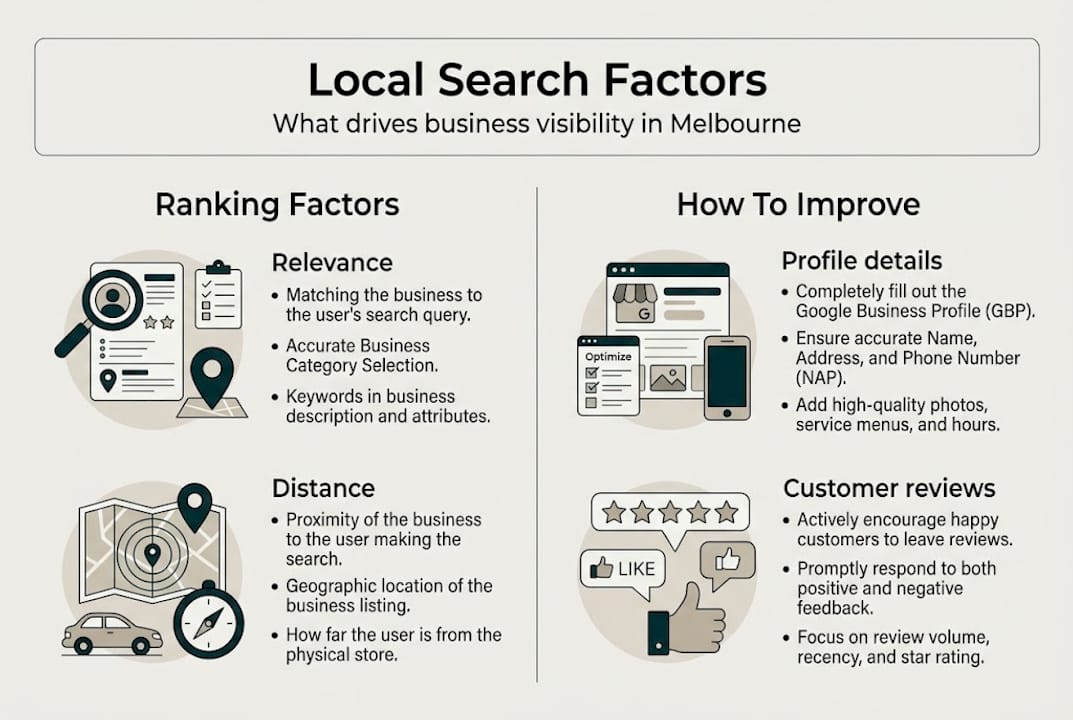
Relevance is about how closely your Google Business Profile and website match what someone is searching for. If you're a Melbourne electrician but your profile only says "contractor," you're missing relevant searches. Use the most specific category available and fill in every detail.
-
Distance is straightforward. Google estimates how far your business is from the person searching. You can't move your premises, but you can ensure your address is accurate and consistent everywhere online.
-
Prominence is where reputation comes in. Businesses with more reviews, stronger websites, and mentions across trusted directories rank higher. This is the factor you have the most control over over time.
Here's how these factors compare in terms of effort and impact:
| Factor | Your control | Time to impact | Key actions |
|---|---|---|---|
| Relevance | High | Fast (days) | Update profile, add services |
| Distance | Low | Fixed | Accurate address only |
| Prominence | High | Slower (weeks) | Reviews, links, content |
The payoff is significant. Businesses appearing in the Local Pack get 126% more traffic, and those with complete Google Business Profiles receive 7x more clicks than incomplete ones. That's a compelling reason to invest time in getting the basics right.
For a practical starting point, explore boosting your local SEO visibility after your profile is set up. You'll also find that combining website design and local SEO creates a compounding effect that neither approach achieves alone.
Essential strategies for Melbourne small businesses
With a clear understanding of what drives local search rankings, let's turn the focus to what you can actually do to set your business up for success.
The most impactful actions for Melbourne small businesses aren't complicated. They're consistent. Here's where to start:
- Claim and complete your Google Business Profile. Add your correct business name, address, phone number, hours, photos, and services. Choose the most accurate primary category.
- Encourage customer reviews and respond to them. Ask happy customers to leave a Google review after a job or purchase. Always reply, even to negative ones. It shows you care.
- Keep your NAP consistent. NAP stands for Name, Address, and Phone number. These details must match exactly across your website, Google, Facebook, and any directory listings.
- Create local content. Write blog posts or service pages that mention specific Melbourne suburbs you serve. Targeting "electrician in Northcote" is more achievable than competing for "electrician Melbourne."
- Avoid common traps. Keyword stuffing your business name, posting fake reviews, or choosing the wrong business category can get your listing suspended.
The results from getting this right are real. 76% of nearby mobile searches lead to a business visit within 24 hours, and 28% result in a purchase. One Melbourne cafe saw a 40% foot traffic increase after committing to local search improvements.
"Local search isn't about tricking Google. It's about making it easy for Google to understand who you are, where you are, and why you're the best choice for a nearby customer."
Pro Tip: A well-structured website is one of the strongest signals for prominence. Learn how professional websites boost local SEO and why your site's foundation matters as much as your Google profile. You can also follow a full walkthrough for complete Google Business Profile optimisation to make sure nothing is missed.
Managing special cases: Service-area and multi-location businesses
Not all businesses fit the classic model of a single shopfront in one suburb. Here's what to know if your set-up is different.
If you're a tradie, cleaner, or any business that travels to customers rather than receiving them at a fixed location, you're what Google calls a service-area business. The rules are slightly different for you.
- Hide your physical address in your Google Business Profile settings. Displaying a home address publicly creates confusion and can violate Google's guidelines.
- Set your service areas using the suburb or postcode list in your profile. Be specific. Listing all of Melbourne is less effective than listing the 10 to 15 suburbs you actually work in.
- Build suburb-specific landing pages on your website. A page for "roof repairs in Preston" signals relevance for searches in that area.
For businesses with multiple locations, the approach is different again. Service-area businesses must avoid address display and use service area targeting, while multi-location businesses need a separate Google Business Profile for each physical site. Never create duplicate listings for the same address. Google treats duplicates as a spam signal, and your listings can be suspended.
"One profile per location, accurate details throughout, and genuine reviews from real customers. That's the foundation every multi-location business needs."
Pro Tip: If you operate in regulated industries such as accounting, legal, or childcare, check your industry body's guidelines before publishing certain details online. Some professions have specific rules about advertising and claims.
For service-area businesses, the setup process is covered in detail in the guide to optimising service-area listings. If you're managing multiple locations, it's also worth thinking about writing effective calls-to-action for multiple locations so each page converts visitors into enquiries.
What most guides miss about local search in Melbourne
You've learnt the core strategies, but it's just as important to understand where generic advice falls short in our local context.
Most local SEO content is written for a US audience. The keyword volumes, the link-building tactics, and the competitive dynamics are simply different here. Melbourne is a city of distinct suburbs with strong local identities. Fitzroy and Footscray are not interchangeable to the people who live there, and Google knows it too. Suburb-level relevance matters far more than most guides suggest.
Here's the uncomfortable truth. 72% of small businesses recognise SEO as high-impact, yet only 35 to 40% have actually optimised their presence. That gap isn't about resources. It's about knowing where to focus.
Many Melbourne businesses spend time chasing backlinks or copying keyword strategies that work in bigger markets, while ignoring the basics that actually move the needle locally: genuine reviews, accurate listings, and suburb-specific content. Authentic engagement with your local community, responding to reviews, posting real photos, and writing content that reflects your actual service area, consistently outperforms any shortcut.
For trades businesses especially, the opportunity is significant. Explore digital marketing insights for Melbourne trades to see how the right approach translates into real enquiries.
Take your next step with local search marketing
Ready to turn knowledge into action? Here's where to go next for immediate results.
Local search marketing works best when your website, Google Business Profile, and online reputation all work together. If any one of those is missing or out of date, you're leaving customers to find a competitor instead. At Troov Marketing, we help Melbourne small businesses build that foundation properly, from the ground up.
Start by following our guide to optimising your Google Business Profile for step-by-step instructions. If your website needs a refresh or isn't structured for local search, explore professional web design for Melbourne businesses. And if you're ready for ongoing support, our affordable SEO for small business packages are built specifically for local businesses like yours.
Frequently asked questions
How long does it take to see results from local search marketing?
Local search improvements can appear in as little as 30 to 90 days when Google Business Profile and reviews are prioritised. Some businesses have seen a 347% ROI within 90 days by focusing on the fundamentals consistently.
What are the most common mistakes Melbourne businesses make with local search?
The top mistakes are inconsistent business details across platforms, ignoring customer reviews, and selecting the wrong business category in Google. Keyword stuffing or fake reviews can also trigger a listing suspension, which is difficult to recover from.
Can service-area businesses succeed in local search without a shopfront?
Absolutely. By hiding your address and using service area targeting in your Google Business Profile, tradies and mobile services can rank well in the suburbs they serve without displaying a home address.
Is it worth investing in local SEO if I only have one location?
Yes, without question. A single-location business can appear ahead of much larger competitors in the Local Pack. Complete profiles receive 7x more clicks, and one Melbourne cafe achieved a 40% boost in foot traffic through local search alone.