

If you've heard that SEO is too technical or time-consuming for small businesses, think again. On-page SEO improvements can increase click-through rate by over 21% and deliver measurable growth in rankings on their own. The truth is, targeted on-page changes directly boost your website's performance in Google search, and many of these adjustments require no technical knowledge at all. This guide will show you what on-page SEO is and exactly how to start applying it to your Melbourne business site.
Table of Contents
- What on-page SEO means (and why it matters for Melbourne businesses)
- The essential elements of on-page SEO for local sites
- Local SEO specifics: on-page strategies for Melbourne visibility
- Common mistakes and how to avoid them
- Measuring and improving your on-page SEO
- Maximise your SEO with professional support
- Frequently asked questions
Key Takeaways
| Point | Details |
|---|---|
| On-page SEO defined | On-page SEO is the practice of optimising each page’s content, headings and structure for search engines and users. |
| Local details matter | Including your Melbourne location and business details in key places directly boosts your Google visibility. |
| Avoid common mistakes | Mistakes like copied content, keyword stuffing, or messy addresses can stop your site from ranking well. |
| Track and improve | Regularly review your site’s SEO performance and update elements for steady ranking growth. |
What on-page SEO means (and why it matters for Melbourne businesses)
On-page SEO is the practice of optimising individual pages on your website to rank better in Google search results. On-page SEO encompasses elements like title tags, headings, keyword placement, and schema markup, all of which you control directly on your site. It's different from off-page SEO, which involves building links and citations from other websites, and technical SEO, which focuses on site speed, mobile responsiveness, and crawlability.
For new or small Melbourne business sites, on-page SEO matters most because it's the foundation of relevance. You can't build authority through backlinks if your pages don't clearly communicate what you offer and where you serve. On-page aspects provide around 50% of ranking influence, with off-page at 40% and technical at 10%. That means getting your titles, headings, and content right delivers the biggest immediate impact.
On-page delivers the relevance foundation, providing evidence of around 50% ranking weight and setting the stage for all other SEO efforts.
Here's how the three types of SEO compare:
| SEO Type | Key Actions | Impact | Difficulty |
|---|---|---|---|
| On-page | Title tags, headings, content, internal links | High (50% of ranking weight) | Low to medium |
| Off-page | Backlinks, citations, reviews | Medium (40% of ranking weight) | Medium to high |
| Technical | Site speed, mobile optimisation, crawlability | Lower (10% of ranking weight) | Medium to high |
When you're just starting out, focusing on on-page SEO gives you the most control and the fastest results. You don't need to wait for other sites to link to you or hire a developer to fix complex code issues. You can start improving your rankings today by optimising the pages you already have. Understanding how professional websites improve Melbourne local SEO and combining web design and local SEO helps you build a strong foundation from day one.
The essential elements of on-page SEO for local sites
Now that we know what on-page SEO covers, let's look at how these elements work in practice. Each component plays a specific role in helping Google understand your page and showing searchers why they should click.
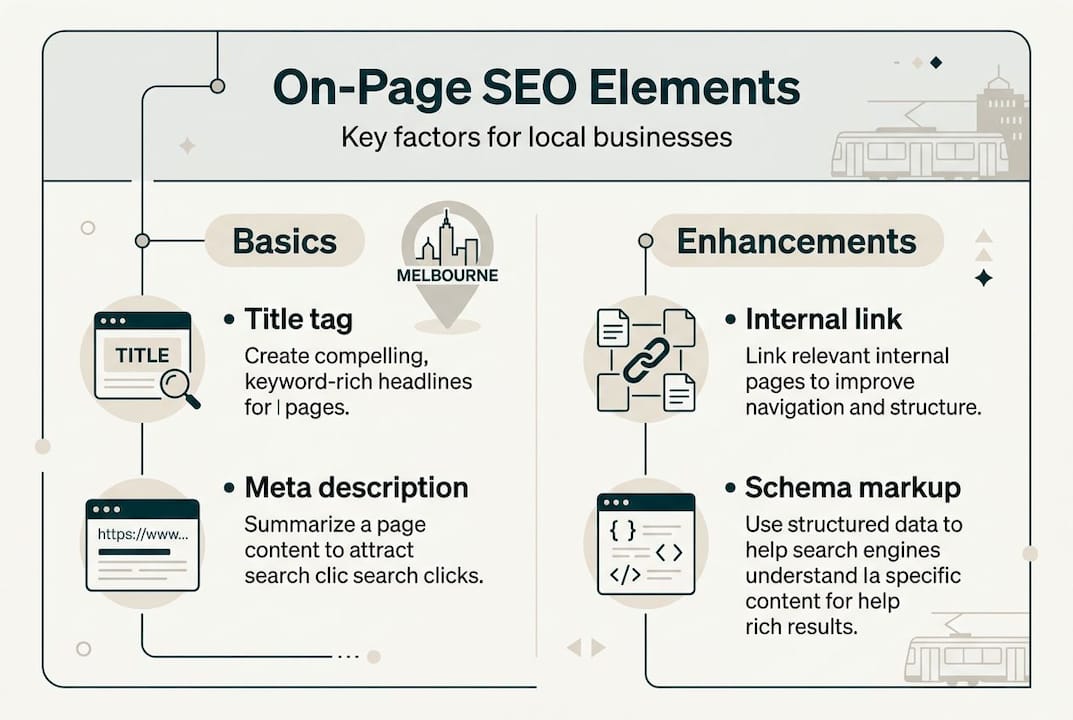
Title tags are the clickable headlines that appear in search results. They should be 50 to 60 characters long, include your target keyword near the beginning, and clearly describe what the page offers. For a Melbourne plumber, a good title might be "Emergency plumbing services in Melbourne | 24/7 response". Make every title unique across your site.
Meta descriptions are the short summaries that appear below your title in search results. While they don't directly affect rankings, they influence whether people click. Write engaging, benefit-focused descriptions that include your keyword and location. Aim for 150 to 160 characters.
Heading structure organises your content and signals importance to Google. Use one H1 per page (usually your main headline), then H2s for major sections and H3s for subsections. Place keywords naturally in headings without forcing them. Clear hierarchy makes your content easier to read and helps Google understand your page structure.
Image optimisation means adding descriptive alt text to every image on your site. Alt text explains what the image shows, which helps visually impaired users and gives Google context. For a Melbourne café, an image might have alt text like "outdoor seating area at Brunswick Street café". Include location details where relevant.
Internal links connect related pages on your site, helping visitors find more information and spreading ranking power across your pages. Use descriptive anchor text that tells readers what they'll find when they click. For example, link to your services page with text like "our commercial cleaning services" rather than "click here".
URLs should be short, descriptive, and use hyphens to separate words. A good URL looks like "yoursite.com.au/plumbing-services-melbourne" rather than "yoursite.com.au/page123". Clean URLs are easier for people to remember and for Google to understand.
Schema markup is code that helps Google display rich results like star ratings, business hours, and pricing in search. For local businesses, adding LocalBusiness schema can improve your visibility in local search results.
Pro Tip: Consistency in your business name, address, and phone number (NAP) is especially crucial for local search. Make sure these details match exactly across every page of your site, your Google Business Profile, and any online directories. Even small differences like "St" versus "Street" can confuse Google and hurt your rankings.
These elements work together to create a clear, search-friendly page. When you optimise all of them, you give Google every reason to rank your site higher. Learning web design best practice for small business, writing effective call to actions, and designing service pages that convert helps you apply these principles across your entire site.
Local SEO specifics: on-page strategies for Melbourne visibility
With the basics in place, let's address what helps most for Melbourne businesses competing in local search results. Local on-page SEO requires a slightly different approach because you're targeting people searching for services in a specific area.
Here's how to optimise your pages for Melbourne local intent:
- Include location keywords naturally in your title tags, H1 headings, and first paragraph. Instead of just "plumbing services", use "plumbing services in Melbourne" or "Melbourne plumber".
- Display your full address prominently on every page, typically in the footer. Make sure it matches your Google Business Profile exactly.
- Embed a Google Map on your contact page showing your business location. This reinforces your local presence and makes it easier for customers to find you.
- Feature local content like case studies from Melbourne clients, testimonials mentioning specific suburbs, or blog posts about local events and issues. This signals to Google that you're genuinely connected to the area.
- Create location-specific service pages if you serve multiple suburbs. A page titled "plumbing services in Brunswick" with content specific to that area will rank better than a generic services page.
Why does local content matter so much? For local, inconsistent NAP details hurt rankings and unique local content is essential under Google's Helpful Content guidelines. Generic text copied from competitors or written without local context won't rank well. Google wants to show searchers businesses that genuinely serve their area, and local content is how you prove that.
The cost of getting this wrong is real. Sites with inconsistent NAP information across pages or thin, generic content often face ranking penalties. On the flip side, businesses that fix their NAP consistency and add genuine local content can see triple the ranking improvements compared to those that don't.
Here's a quick checklist to plug Melbourne into your key on-page elements:
- Title tag includes "Melbourne" or specific suburb
- H1 heading mentions your location
- First paragraph explains where you serve
- Footer displays complete, consistent NAP
- Contact page has embedded Google Map
- Service pages mention local areas
- Blog content references Melbourne topics
- Image alt text includes location where relevant
These small adjustments make a big difference in local search visibility. When you combine them with strong on-page fundamentals, you create pages that rank well for both broad keywords and location-specific searches. Understanding integrating web design with local SEO and optimising Google Business Profile helps you maximise your local presence across all channels.
Common mistakes and how to avoid them
Even with the best intentions, it's easy to make on-page SEO mistakes that hurt your rankings. Here are the most common issues we see with small business websites and how to fix them:
- Keyword stuffing: Repeating the same keyword unnaturally throughout your content makes it hard to read and triggers Google penalties. Use keywords naturally and focus on writing for humans first.
- Duplicate content: Copying text from other sites or using the same content across multiple pages confuses Google about which page to rank. Write unique content for every page.
- Over-optimisation: Forcing keywords into every heading, making anchor text too exact-match, or adding unnecessary schema markup can look manipulative. Keep everything natural and user-focused.
- Ignoring mobile: More than half of searches happen on mobile devices. If your site isn't mobile-friendly, you'll lose rankings and visitors.
- Missing alt text: Images without alt text are invisible to Google and inaccessible to visually impaired users. Add descriptive alt text to every image.
- Thin content: Pages with very little text or low-value content don't rank well. Avoid keyword stuffing, duplicate content, cloaking; Google may rewrite titles and penalise thin content. Aim for at least 300 words per page and make sure every sentence adds value.
Google will sometimes rewrite your title tags and meta descriptions if they don't accurately reflect your page content or if they're poorly written. This isn't necessarily bad, but it means you're losing control over how your site appears in search results. Writing clear, accurate titles and descriptions that match your content helps you maintain that control.
Pro Tip: Audit your key pages regularly using free tools like Google Search Console. Check that your titles and metas are displaying correctly, your NAP is consistent, and your content is still relevant. Update pages every few months to keep Google happy and maintain your rankings.
Avoiding these mistakes is important, but let's make sure your optimisation work actually pays off by tracking results.
Measuring and improving your on-page SEO
You can't improve what you don't measure. Tracking your on-page SEO performance helps you see what's working, identify problems early, and prioritise the changes that will have the biggest impact.
Start with Google Search Console, a free tool that shows which keywords your site ranks for, how many people see your pages in search results, and which pages get the most clicks. It also alerts you to technical issues like crawl errors or mobile usability problems.
Google Analytics tracks visitor behaviour once people land on your site. You can see which pages get the most traffic, how long people stay, and whether they complete actions like filling out a contact form. This helps you understand which pages are performing well and which need improvement.
Local pack movement refers to your position in the map results that appear for local searches. Track whether you're showing up in the three-pack for your target keywords and which competitors appear alongside you.
Here are some free and affordable tools for monitoring your on-page SEO:
| Tool | Key Features | Pricing |
|---|---|---|
| Google Search Console | Keyword rankings, click-through rates, technical issues | Free |
| Google Analytics | Traffic sources, user behaviour, conversion tracking | Free |
| Screaming Frog SEO Spider | Site audits, broken links, duplicate content | Free up to 500 URLs |
| Ubersuggest | Keyword research, competitor analysis, site audits | Free with limits |
| Yoast SEO (WordPress) | On-page optimisation guidance, readability checks | Free basic version |
What should you check monthly?
- Titles and metas: Make sure they're displaying correctly in search results and haven't been rewritten by Google.
- Headings: Verify your H1s are unique and your heading structure is logical.
- Internal links: Check for broken links and add new internal links as you publish content.
- Core Web Vitals: Monitor your site speed, interactivity, and visual stability. Optimising for Core Web Vitals and page experience can triple positions in search.
- Content quality: Review your pages for accuracy, relevance, and value. Update outdated information and expand thin content.
If you're using AI tools to help write content, remember that human oversight remains crucial for AI-written content if you want to rank well. AI can speed up the writing process, but you need to review everything for accuracy, tone, and alignment with Google's quality guidelines.
Continuous improvement pays off. Sites that regularly audit and update their on-page SEO see better rankings, higher click-through rates, and more qualified traffic over time. The work you put in today builds a stronger foundation for tomorrow.
Learning SEO basics and fixing website mistakes helps you maintain momentum and avoid common pitfalls as your site grows.
Maximise your SEO with professional support
You now have a solid understanding of on-page SEO and how to apply it to your Melbourne business site. But if you want to get things right the first time or simply save time and stress, working with local experts ensures every detail is covered.
Professional web designers and SEO specialists understand the nuances of local search and can implement best practices across your entire site. They'll audit your existing pages, identify quick wins, and build a long-term strategy that grows with your business. You'll avoid common mistakes, get faster results, and have more time to focus on running your business.
Whether you're building a new site or improving an existing one, having access to proven frameworks and expert guidance makes the process smoother. We've created resources to help Melbourne small businesses succeed online, from detailed checklists to step-by-step guides.
If you're ready to take the next step, explore our expert website design for small business services, download our ultimate website checklist, or start learning with our easy SEO guide for beginners. Every resource is designed to give you practical, actionable advice you can use right away.
Frequently asked questions
What are the top three on-page SEO factors for a Melbourne business?
The three most important are keyword-optimised title tags, accurate business name and address (NAP), and descriptive, local-centric headings. Key mechanics include title tags, correct NAP for local, and proper headings.
How long does it take to see ranking improvements from on-page SEO?
Effective changes often produce noticeable results in four to eight weeks, especially for local searches. On-page optimisation increases organic rankings and can yield results quickly.
Is it better to hire an SEO pro or do it myself for on-page optimisation?
DIY can work for basics, but expert help ensures you avoid pitfalls and get the maximum ranking lift. Expert oversight can elevate on-page SEO and ensure best results.
Should I use AI tools for writing website content?
AI is useful but always review output for accuracy, expertise, and alignment to Google's guidelines. AI content needs human oversight for rankings and user trust.
What is NAP consistency and why does it matter?
NAP means Name, Address, Phone; consistent details across web pages are critical for local SEO rankings. Inconsistent NAP details damage local search rankings.