
TL;DR:
- Successful Melbourne local SEO in 2026 relies on optimized Google Business Profiles and consistent local signals.
- Regular review acquisition, local content, and accurate listings significantly boost search visibility and rankings.
- Ongoing maintenance, avoiding penalties, and tracking real user actions are essential for sustained SEO success.
If a potential customer in Melbourne searches for your service right now, are you showing up? Many local businesses are losing leads every week simply because their competitors have stronger local search signals. This is not about having the flashiest website. In 2026, local SEO is driven by specific, measurable factors: your Google Business Profile, on-page signals, reviews, and consistent business information across the web. This guide cuts through the noise and gives you a clear, step-by-step approach to improving your visibility in Melbourne searches, covering what you need to prepare, what to do, and what to avoid.
Table of Contents
- What you need before optimising for local search
- Step-by-step: Optimising your site for Melbourne local search
- Supercharge your visibility with reviews and local signals
- Troubleshooting, avoiding penalties, and keeping your rankings
- How to measure and verify your local search gains
- What most guides miss: The real local difference in Melbourne SEO
- Take your next step with local search experts
- Frequently asked questions
Key Takeaways
| Point | Details |
|---|---|
| GBP is essential | A complete and regularly updated Google Business Profile is now the foundation for local search success. |
| Reviews drive ranking | Steady, keyword-rich reviews make a major difference in Map Pack visibility for Melbourne businesses. |
| Consistency matters | Check that your business details match across your website, GBP, and all local listings. |
| Measure what works | Track traffic, calls, reviews, and map presence to see real improvement from your optimisation efforts. |
| Think suburb-first | Optimising pages for specific Melbourne suburbs gives you a proven competitive edge in local searches. |
What you need before optimising for local search
Before getting hands-on, let's cover exactly what you'll need to set up successful local search optimisation.
The single most important asset you have is your Google Business Profile (GBP). Think of it as your digital storefront on Google. Complete Google Business Profiles are 70% more likely to attract visits, which makes getting it right a genuine priority before anything else. Our Google Business Profile guide walks through the full setup if you need a starting point.
Here is what you should have ready before you begin:
- Business name, address, and phone number (NAP): These must be identical everywhere online. Use a Melbourne landline with a 03 area code where possible, as it reinforces your local presence.
- Website admin access: You will need to make changes to your site's pages, footer, and metadata.
- Logo and brand assets: High-quality images, including photos of your premises, team, and work.
- Business description: A clear, keyword-aware summary of what you do and where you serve.
- Products and services list: Specific, not vague. "Bathroom renovation in Fitzroy" beats "home services."
- Schema markup readiness: This is structured data that helps Google understand your business details. If it sounds technical, that is fine. You can get help with it.
| Preparation item | Why it matters |
|---|---|
| Complete GBP | 70% more likely to attract visits |
| NAP consistency | Prevents confusion across directories |
| Local photos (20+) | Boosts profile engagement and trust |
| Schema markup | Helps Google read your business details |
| Review management plan | Needed for ongoing ranking signals |
Pro Tip: Set a weekly reminder to check your GBP for accuracy. Business hours, addresses, and service areas change, and an outdated profile can quietly cost you rankings.
Step-by-step: Optimising your site for Melbourne local search
Now, let's get practical: follow these steps to ensure your site stands out in Melbourne searches.
According to 2026 research, GBP signals carry 32% weight in Local Pack rankings, with reviews accounting for 16 to 20% and on-page factors up to 33%. That means both your profile and your website need attention.
- Complete every GBP field. Select your primary category carefully. Add all relevant services, set accurate opening hours, and upload more than 20 quality photos. Avoid stuffing keywords into your business name or description unnaturally.
- Optimise your homepage and service pages. Each page should mention your suburb or service area naturally, include your NAP in the footer, and use local intent keywords like "plumber in Northcote" or "accountant Carlton."
- Add schema markup to key pages. LocalBusiness schema tells Google exactly who you are, where you are, and what you do. It is one of the clearest signals you can send.
- Publish content that answers local questions. Melbourne searchers look for things like "best café near Fitzroy in winter" or "emergency electrician South Yarra." Near me searches have risen 900% in recent years, and seasonal weather queries are a real opportunity for Melbourne businesses.
- Post weekly GBP updates. Share offers, news, or photos. Consistent activity signals to Google that your business is active and relevant.
For more on how your site structure supports these steps, read our guide on Melbourne SEO website tips and how to combine website design and SEO effectively.
| Approach | Time investment | Best for |
|---|---|---|
| Manual optimisation | High | Businesses with time to learn |
| Tool-assisted (e.g. BrightLocal) | Medium | Businesses tracking multiple locations |
| Agency-managed | Low (for you) | Businesses wanting expert execution |
Pro Tip: Do not try to optimise everything at once. Start with your GBP and homepage, get those right, then move to suburb-specific service pages.
Supercharge your visibility with reviews and local signals
After optimising your pages, it's time to focus on the off-site factors that Google weighs heavily.

Reviews are one of the most powerful and most overlooked tools in local SEO. Steady review acquisition consistently outperforms large one-off bursts, and reviews carry a 16 to 20% impact on your Local Pack ranking. Aim for two to four new genuine reviews per week rather than chasing a big number all at once.
Here is how to build a strong review and local signals strategy:
- Ask at the right moment. Request a review right after completing a job or delivering a service, when satisfaction is highest.
- Guide customers on what to say. Politely suggest they mention the specific service and suburb. A review mentioning "roof repair in Brunswick" carries more local weight than a generic five-star rating.
- Respond to every review. Positive or negative, your response shows Google and future customers that you are engaged. Keep replies warm and local in tone.
- Maintain consistent NAP across all platforms. Your details on Google, Facebook, True Local, and any industry directories must match exactly.
- Get listed on local directories. Seek out Melbourne-specific and industry-relevant directories. Each consistent citation strengthens your local authority.
Businesses that respond to reviews regularly and maintain consistent local signals build the kind of trust that Google rewards with better visibility over time.
For ideas on turning that trust into actual enquiries, our service page conversion tips are worth a read.
Troubleshooting, avoiding penalties, and keeping your rankings
With your main strategies in place, let's make sure you avoid the common issues that trip up even experienced locals.
Many Melbourne businesses do the hard work of optimising their site and GBP, then unknowingly undo it with a few simple mistakes. Here is what to watch for:
- Keyword stuffing in your GBP title. Adding extra keywords to your business name (e.g. "Smith Plumbing Best Plumber Melbourne") is a GBP guideline violation and can get your profile suspended. Use your real business name only.
- Inconsistent contact details. If your address on Google differs from your website or a directory listing, it creates confusion and weakens your authority.
- Ignoring AI overview changes. In 2026, Google's AI overviews sometimes cite pages that are not even in the top ten results. Getting your business mentioned in "best of Melbourne" lists and local publications can put you in front of searchers even without a top ranking.
- Stale content. Melbourne has distinct seasons and events. Refresh your site content to reflect summer demand, winter queries, and local events like the Melbourne Cup or school holidays.
- Outdated citations. If you have moved premises or changed your phone number, audit every directory listing and update it promptly.
Pro Tip: Search for non-obvious local terms related to your trade, such as specific suburb names combined with niche services. These lower-competition phrases can drive highly targeted traffic and act as strong local signals.
If you need to revisit your GBP setup after reading this, our optimise your profile guide covers every field in detail.
How to measure and verify your local search gains
Once you've optimised and maintained your site, you'll want to know if the work is actually paying off.
Behavioural signals, including click-throughs and calls, are rising in importance in the 2026 Google algorithm. That means tracking real actions, not just rankings, gives you a truer picture of your progress.
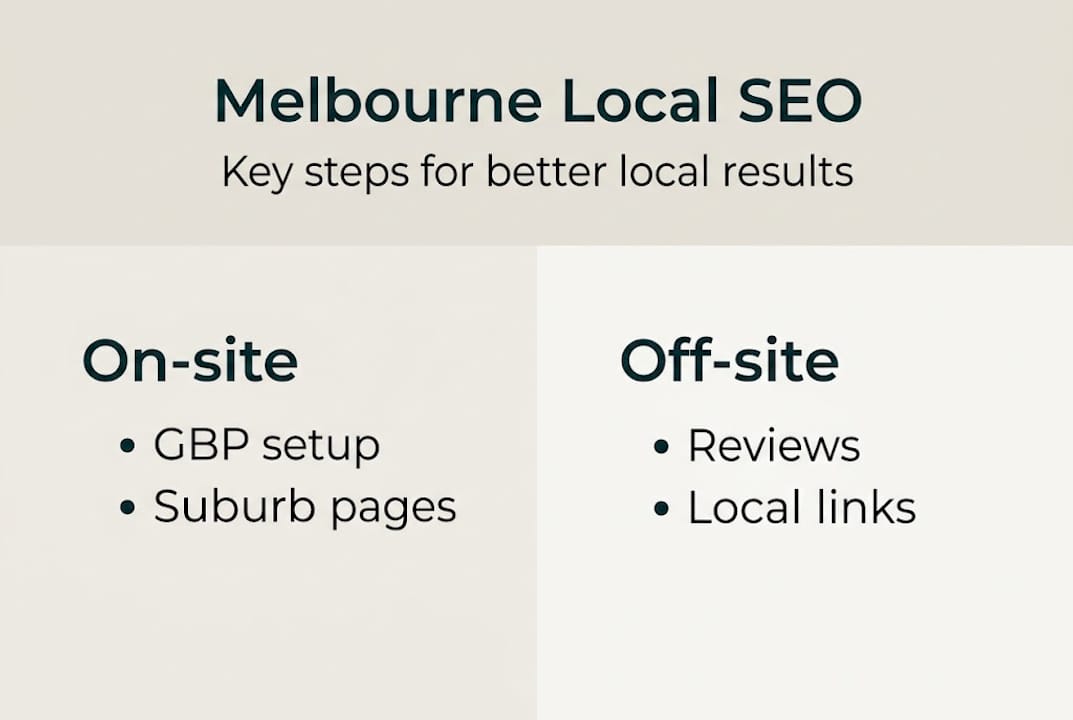
Key metrics to monitor:
| Metric | Tool to use | What to look for |
|---|---|---|
| Map Pack appearances | Google Search Console | Impressions and clicks from local queries |
| Website traffic from Melbourne | Google Analytics | Sessions filtered by city/region |
| Keyword rankings | BrightLocal or Semrush | Movement on suburb and service terms |
| Call and enquiry volumes | GBP Insights, CRM | Month-on-month growth |
| Review count and rating | GBP dashboard | Steady weekly growth |
Follow this process monthly:
- Log into Google Search Console and filter for queries containing your suburb or service keywords.
- Check Google Analytics for traffic from Melbourne and compare to the previous month.
- Review your GBP Insights for profile views, direction requests, and calls.
- Record your current review count and average rating.
- Note any AI Overview mentions by searching your key terms and checking if your business appears in the generated summary.
- Adjust your strategy based on what is growing and what is flat.
For tools that make ongoing management easier, our guide to website management tools covers practical options for small business owners.
What most guides miss: The real local difference in Melbourne SEO
Looking at the bigger picture, here is what experience tells us about winning at local SEO in Melbourne in 2026.
Most generic SEO guides still lead with link building as the primary growth lever. For Melbourne small businesses, that advice is increasingly outdated. Suburb-specific content and a well-maintained Google Business Profile now deliver stronger results for most local service providers than chasing backlinks from high-authority domains.
The real breakthrough factors in 2026 are entity consistency, behavioural signals, and appearing in curated "best of Melbourne" lists. Google is getting better at understanding whether your business is genuinely embedded in a local community, not just optimised for it. That distinction matters.
Melbourne's market is competitive and geographically nuanced. A business in Prahran competes differently from one in Epping. Suburb-level content, reviewed and refreshed regularly, is what separates businesses that hold their rankings from those that slip. There is no set-and-forget approach here. The businesses winning consistently are the ones treating local SEO as an ongoing practice, not a one-time project. Explore how domain management for Melbourne SEO fits into that bigger picture. Prioritise trust, consistency, and local relevance, and the results will follow.
Take your next step with local search experts
Ready for real improvement? These trusted resources will help you keep the momentum going.
At Troov Marketing, we work with Melbourne small businesses every day to build websites and local SEO strategies that actually produce enquiries. Whether you are starting from scratch or looking to sharpen what you already have, we have practical resources to help. Start with our detailed Google Business Profile optimisation guide to get your profile working harder. If your website needs a stronger foundation, explore our approach to Melbourne business web design. And if you are ready to talk strategy, our Melbourne small business SEO solutions page is the right place to start.
Frequently asked questions
What is the most important factor for local SEO in 2026?
Google Business Profile completeness and steady review growth are the top factors for ranking in local Melbourne searches. GBP signals and reviews now account for over 50% of Local Pack ranking weight combined.
How often should I update my Google Business Profile?
Update your profile at least once a week with posts, new photos, or timely offers. Frequent GBP activity improves both visibility and the chance that a visitor will contact you.
How can I track if my local SEO efforts are working?
Monitor Google Search Console, web traffic from Melbourne, new reviews, and changes in your Map Pack ranking each month. Click-through rates and calls are now key signals in Google's 2026 algorithm, so track real actions, not just positions.
Is using suburb names in my site effective for Melbourne local SEO?
Absolutely. Suburb-specific pages and content give your site a clear advantage for local searches across Melbourne. Locality-specific pages consistently outperform generic content for Melbourne searchers.
What's the biggest mistake Melbourne businesses make with local SEO?
Adding extra keywords to your GBP business name or having inconsistent contact details across platforms are two of the most damaging errors. Keyword stuffing in GBP titles is a direct guideline violation and can result in penalties from Google.