

TL;DR:
- Most potential clients search Google first, making local SEO vital for accounting firms.
- Key strategies include optimizing Google Profiles, collecting reviews, and creating helpful local content.
- Consistent online presence and regular updates build trust, leading to sustained organic lead growth.
Word of mouth has always been the lifeblood of accounting firms across Australia. But here's the reality check: before a potential client ever picks up the phone or asks a colleague for a recommendation, they search Google first. They type in something like "accountant near me" or "tax accountant Melbourne" and choose from what appears on screen. If your firm isn't showing up in those results, you're invisible to a large portion of people who are actively looking for exactly what you offer. Search engine optimisation, or SEO, is how you change that. It's not reserved for big corporations with huge marketing budgets. It's one of the most practical and cost-effective tools available to local accounting practices right now.
Table of Contents
- What does SEO mean for accountants?
- Key SEO strategies tailored for Australian accountants
- SEO components that drive results for accounting firms
- Common misconceptions and mistakes in SEO for accountants
- What most accountants get wrong about SEO (and how to get it right)
- Boost your accounting firm with expert SEO solutions
- Frequently asked questions
Key Takeaways
| Point | Details |
|---|---|
| Focus on local search | Appearing in local results through Google Business Profile and accurate directories is crucial for Australian accountants. |
| Reviews and leads matter most | Track new reviews and organic leads as your main success indicators, not just search rankings. |
| Consistent updates are key | Update your site, content, and Google Business Profile regularly to maintain and improve your visibility. |
| Avoid common SEO traps | Steer clear of shortcuts and focus instead on trust, clarity, and client value for steady growth. |
What does SEO mean for accountants?
With more Australians turning to Google to find professional services, understanding what SEO actually means for your firm is the first step toward real growth.
SEO stands for search engine optimisation. In plain language, it means making adjustments to your online presence so that search engines like Google are more likely to show your firm to people searching for accounting services in your area. For accountants, this isn't about gaming algorithms or stuffing keywords into web pages. It's about presenting your firm clearly, accurately, and helpfully to both search engines and potential clients.
For local accounting firms, SEO has a strong focus on local intent. When someone types "business accountant Geelong" or "BAS lodgement help Brisbane," they want a nearby, trustworthy professional. Your job is to make sure your firm appears as a credible answer to that search. The key elements that make this happen include:
- Keywords: The specific phrases your ideal clients type into search engines, such as "tax return accountant" or "SMSF advice Melbourne."
- Google Business Profile (GBP): Your firm's listing on Google Maps and local search results. This is often the first thing a potential client sees.
- Online reviews: Star ratings and written feedback from past clients that signal trustworthiness to Google and to potential clients alike.
- Clear service pages: Web pages that describe what you do, who you help, and where you're located, written in language your clients actually use.
- Consistent business information: Your name, address, and phone number listed the same way across every online directory and platform.
It's also important to understand how SEO success is measured. Many accountants assume the goal is simply to rank number one on Google. In reality, the most meaningful metrics are the leads coming through your website, the number of phone calls generated from your Google Business Profile, and the steady growth of your online reviews. As Google's own guidance confirms, it's wise to track review momentum and organic leads over rankings alone.
A strong website is the foundation that makes all of this work. Reviewing website best practices for accounting firms is a smart early step before you invest time in any other SEO activity.
"SEO for accountants isn't about tricks or quick fixes. It's about making your firm easy to find, easy to trust, and easy to contact for the clients who need you most."
Key SEO strategies tailored for Australian accountants
Now that you know what SEO is and why it matters, let's break down which strategies actually move the needle for accounting firms in Australia.
The good news is that you don't need to do everything at once. Starting with the highest-impact actions and building from there is the most sustainable approach for a busy practice.
-
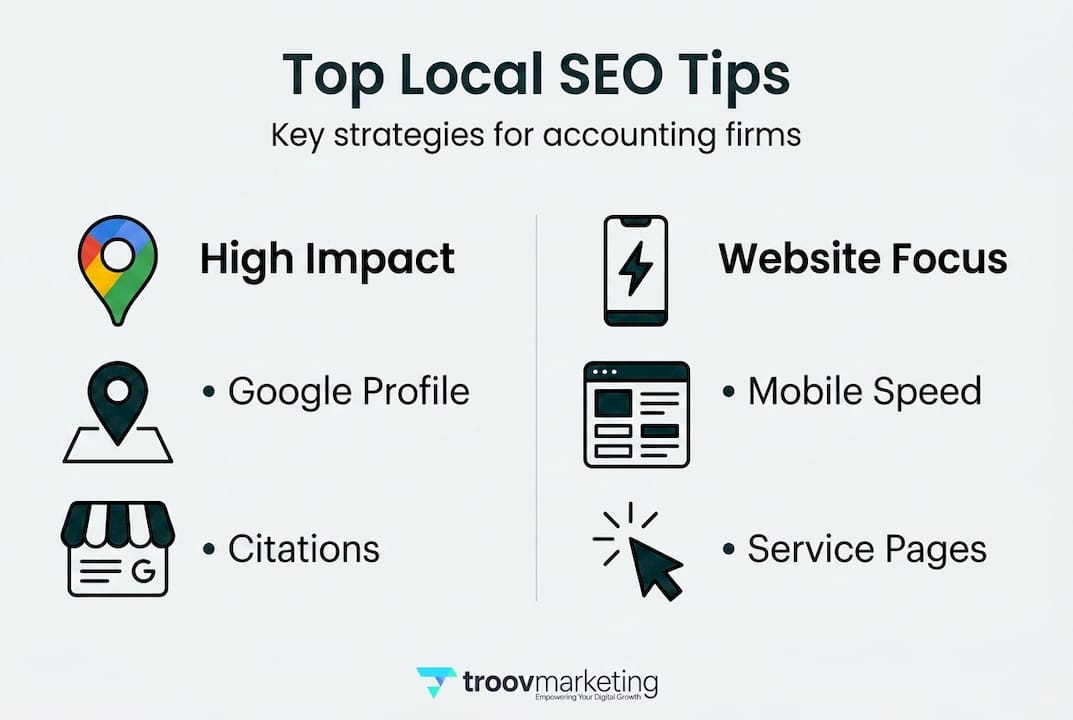
Optimise your Google Business Profile. Your GBP listing is your single most powerful local SEO asset. Fill in every section: business name, address, phone number, website, opening hours, and a detailed description of your services. Add photos of your office or team. Select the most accurate business categories, such as "Accountant" and "Tax Preparation Service." Keep this information up to date at all times. Thorough Google Business Profile optimisation can dramatically improve how often your firm appears in local search results and on Google Maps.
-
List your firm in local Australian directories. Directories like True Local, Yellow Pages Australia, Hotfrog, and the Australian Business Register are places Australians actually check. Make sure your business details are listed consistently across all of them. Inconsistent information confuses Google and can hurt your rankings.
-
Publish content that answers real client questions. Think about the questions clients ask you every week. "When is the EOFY deadline?" "Do I need to register for GST?" "What records should I keep for my small business?" Writing clear, helpful answers to these questions on your website positions your firm as an expert and attracts people searching for exactly that information.
-
Ask satisfied clients for Google reviews. Reviews are one of the strongest signals Google uses to rank local businesses. After completing a job well, send clients a simple follow-up message with a direct link to your Google review page. Aim to collect reviews consistently throughout the year, not just during tax season.
-
Make sure your website is fast and mobile-friendly. Most local searches happen on smartphones. If your site takes more than three seconds to load or is hard to navigate on a small screen, potential clients will leave immediately. Google also penalises slow, poorly designed sites in search rankings.
As Google recommends, prioritise your GBP and local citations for the fastest visibility wins in Australia, and consider integrating structured data (schema) for further search enhancements.
Pro Tip: When building an accountant website, include a dedicated page for each core service you offer, for example "Tax Returns," "Business Advisory," and "SMSF Accounting." This gives Google clear signals about what you do and helps each service attract relevant searches independently.
SEO components that drive results for accounting firms
Once you understand the essential strategies, it's useful to see how the different components compare and which ones produce the biggest impact for your firm.
| SEO component | Priority level | Impact on local rankings | Notes |
|---|---|---|---|
| Google Business Profile | Very high | Major | Complete and active profiles rank significantly higher |
| Online reviews (Google) | Very high | Major | Quantity and recency both matter |
| Consistent NAP listings | High | Significant | Name, Address, Phone must match everywhere |
| Local service pages | High | Significant | One page per core service, with suburb or city mentioned |
| Mobile-friendly website | High | Significant | Google uses mobile-first indexing |
| Page loading speed | Medium to high | Moderate to significant | Slow sites lose visitors and ranking positions |
| Schema markup | Medium | Moderate | Helps search engines and AI tools understand your content |
| Blog or resource content | Medium | Moderate | Builds authority and attracts informational searches |
| Social media activity | Low to medium | Indirect | Signals brand presence, not a direct ranking factor |
Looking at this table, it becomes clear that the top priorities for most accounting firms are their Google Business Profile, their reviews strategy, and the accuracy of their business information online. These three elements alone can produce noticeable improvements in local visibility within a matter of weeks.
Schema markup deserves a mention because it's often overlooked. Schema is a type of code added to your website that helps Google understand your content more precisely. For an accounting firm, this might mean tagging your business type, location, services, and opening hours in a way that search engines and newer AI-powered search features can read clearly. As Google's guidance outlines, integrating schema for AI and search enhancements is increasingly important as search technology evolves.
Understanding how websites impact local SEO is equally important. A poorly built site can undo even excellent GBP work.

Pro Tip: Run a free speed test on your website using Google PageSpeed Insights. If your site scores below 70 on mobile, fixing those speed issues should be a top priority before focusing on any other SEO activity.
Common errors to watch for when starting out include: creating a GBP listing but never updating it, collecting a handful of reviews then stopping, targeting keywords that are too broad (like "accountant" rather than "small business accountant Parramatta"), and publishing service pages that are so brief they give Google nothing substantial to rank.
Common misconceptions and mistakes in SEO for accountants
Knowing what helps is just as important as avoiding the pitfalls that hold many accounting firms back. Let's clear up some of the most damaging myths.
-
"SEO is a one-time job." This is the most common mistake. Search rankings change constantly. Your competitors are updating their content, collecting new reviews, and refining their profiles. SEO requires regular attention, even if it's just a small amount of time each month.
-
"I need to rank number one to get results." Appearing in the local map pack (the three listings with a map that appear near the top of local search results) can drive significant enquiries even if you're not in the first organic position. Focus on visibility and leads, not just the number one spot.
-
"Keyword stuffing still works." It doesn't. Google's algorithms are sophisticated enough to detect when a page is cramming in keywords unnaturally. Write for your clients first, using language they'd actually use, and your rankings will benefit.
-
"A fancy website is enough." A beautiful site with no SEO structure won't attract organic traffic. Design and SEO need to work together from the start.
-
"Paid ads replace SEO." Ads stop the moment you stop paying. Organic visibility built through SEO continues to deliver leads over time.
"Google rewards accuracy, relevance, and genuine helpfulness. Any approach that prioritises tricks over those qualities will eventually stop working."
It's also worth understanding which type of website suits your firm's goals, since the structure of your site directly affects how well your SEO can perform. As Google confirms, the most reliable measure of SEO progress is tracking organic leads and review growth, not rankings in isolation.
Poor mobile experience is another common problem. If a prospective client finds your firm on their phone but can't easily read your content or find your phone number, they'll move on to a competitor whose site works properly on mobile. That's a lost lead that SEO brought to your door but a poor site turned away.
What most accountants get wrong about SEO (and how to get it right)
Here's an honest take from our experience working with professional services firms: most accountants who struggle with SEO aren't making technical mistakes. They're making a more fundamental error. They're treating SEO as a task to complete rather than a reputation to build.
We see accounting firms invest in keyword research, tick that box, and then wonder why nothing changes six months later. The reason is usually that they've focused on what they want Google to see rather than what their potential clients actually need. Those two things are very different.
The firms that consistently attract new clients through organic search share a few habits. They keep their Google Business Profile genuinely up to date, posting occasional updates and responding to every review. They ask real clients for honest feedback and make it easy to leave a review. They publish content that answers the specific questions their local clients are asking, not generic articles that could apply to any accountant anywhere in Australia.
There's also a sustainability argument worth making clearly. Paid advertising can deliver quick enquiries, but the cost compounds over time. For many accounting firms, a well-executed local SEO strategy provides a steadier stream of inbound leads at a fraction of the long-term cost of ads. The leads also tend to be higher quality because the person searching has already expressed specific intent.
The foundation of all of this is a well-structured website. When building an accountant website, every page should have a clear purpose, be easy to navigate, load quickly, and include your location prominently. Think of your website not as a brochure but as your most hardworking team member, one that's available around the clock and represents your firm to every person who finds you online.
The accountants who win at local SEO aren't chasing algorithms. They're building genuine trust online, the same way they build it with clients in person.
Boost your accounting firm with expert SEO solutions
If you've taken in everything from this article, you'll know that local SEO for accountants comes down to a few consistent actions done well: a complete and active Google Business Profile, a fast and well-structured website, fresh reviews, and helpful content. At Troov Marketing, we help accounting firms in Australia put all of these pieces in place. We build websites specifically designed to support local SEO for small businesses from day one, and we handle Google Business Profile optimisation so your firm shows up where clients are looking. If you're newer to all of this, our plain-English SEO guide is a great place to start. Reach out to us and let's talk about a tailored plan for your practice.
Frequently asked questions
How fast can SEO bring results for my accounting firm?
Most local accounting firms notice genuine improvements in visibility and enquiries within one to three months, particularly after completing their Google Business Profile and generating a steady flow of fresh reviews.
Do I need a blog for SEO as an accountant?
A blog isn't mandatory, but publishing helpful client content signals expertise to Google and attracts people searching for answers to specific tax or accounting questions, which can meaningfully improve your local rankings over time.
Is paying for ads better than investing in SEO?
Paid ads can deliver quick visibility, but organic local leads generated through SEO are more sustainable and cost-effective over the long term because they continue without ongoing ad spend.
What is the most important online profile for accountants?
Your Google Business Profile is the single most powerful tool for attracting local clients, as it directly influences your visibility in Google Maps and local search results.