

Your website is often the first thing a potential customer sees before they ever call you or walk through your door. And that first impression matters enormously. 94% of first impressions are design-related, and 75% of consumers judge business credibility based on website design alone. For Melbourne small businesses, this means your website is either building trust or quietly pushing people away. In this guide, we break down what website usability actually means, how it affects your conversions and local visibility, and what practical steps you can take to turn more visitors into real enquiries.
Table of Contents
- Understanding website usability: What it really means for small businesses
- The business impact: Usability and conversion rates in Melbourne
- Making usability actionable: Practical steps for Melbourne small businesses
- Usability and local SEO: Visibility, trust, and enquiries
- Why most website usability advice misses the real challenge
- Take the next step: Usability support for Melbourne small businesses
- Frequently asked questions
Key Takeaways
| Point | Details |
|---|---|
| Usability drives conversions | Optimising website usability can triple your conversion rate and boost business enquiries in Melbourne. |
| Credibility depends on design | Three out of four customers judge your business by how your website looks and works. |
| Checklist isn't enough | Always validate usability improvements with real user testing—not just a checklist. |
| Usability boosts visibility | Better usability helps your site rank higher in local search and increases trust. |
Understanding website usability: What it really means for small businesses
Website usability is a straightforward concept with a big impact. It simply means how easily a visitor can use your website to find what they need and take action. Think of your website as a digital storefront. If the layout is confusing, the doors are hard to find, or the signage is unclear, people leave without buying anything.
For Melbourne small businesses, usability comes down to four core principles:
- Clarity: Your message, services, and contact details are immediately obvious.
- Accessibility: Your site works well for all users, including those on mobile devices or with accessibility needs.
- Speed: Pages load quickly, because slow sites frustrate visitors and cost you enquiries.
- Intuitive navigation: Visitors can find what they need without thinking too hard about where to look.
When these four elements work together, your website feels effortless to use. When they break down, visitors lose confidence in your business. 75% of users judge credibility based on design, which means a poorly structured site can undermine even the best reputation you've built locally.
A usable website is not just about looking good. It is about making it genuinely easy for the right people to contact you, trust you, and choose you over a competitor.
This is especially important in Melbourne, where local competition is strong and customers have plenty of options. Understanding the web design benefits of a well-structured site helps you see usability not as a technical concern but as a direct business investment. When your site is clear and easy to use, you build local trust faster and convert more visitors into paying customers.
The business impact: Usability and conversion rates in Melbourne
With usability defined, let's see how it transforms real business results in Melbourne. A conversion happens when a visitor takes a desired action on your site, whether that's filling out an enquiry form, calling your number, or booking a service. Your conversion rate is the percentage of visitors who actually do this.
For most small and medium businesses, the average SMB conversion rate sits at 2 to 3%, while top-performing sites reach 6 to 11%. That gap is largely explained by usability.
| Website quality | Typical conversion rate |
|---|---|
| Poor usability | Below 1% |
| Average SMB site | 2 to 3% |
| Well-optimised site | 6 to 11% |
Common usability mistakes that drag conversion rates down include:
- Missing or unclear calls to action (CTAs): If visitors don't know what to do next, they leave.
- Slow loading speeds: Every extra second of load time reduces the chance someone stays.
- Confusing layouts: Too much information, poor structure, or unclear service descriptions all create friction.
Reviewing your homepage design best practices is a strong starting point because your homepage is usually where most visitors land first. A clear, focused homepage with a strong CTA can meaningfully lift your overall conversion rate.
Pro Tip: Use a free tool like Google Analytics to check your current conversion rate. Set a baseline, make one usability change at a time, and measure the difference. Even small improvements add up quickly. You can also use the website checklist to identify quick wins across your whole site.
Making usability actionable: Practical steps for Melbourne small businesses
Understanding the impact is only half the battle; here's how to put usability principles into practice. The good news is that most usability improvements don't require a full website rebuild. Many of the highest-impact changes are straightforward.
Here are five practical steps to get started:
- Clarify your primary CTA. Every page should have one clear action you want visitors to take. Make it visible, specific, and easy to click. 70% of SMB homepages lack a clear CTA, which is a significant missed opportunity.
- Improve your page speed. Compress images, reduce unnecessary plugins, and use a reliable hosting provider. Speed directly affects both usability and search rankings.
- Simplify your homepage. Focus on who you are, what you do, who you help, and what to do next. Cut anything that doesn't serve one of these four purposes.
- Review your service pages. Each service page should answer the visitor's key questions and guide them toward an enquiry. See service page conversion tips for a structured approach.
- Fix common mistakes. Review the common website mistakes that cost small businesses money and address any that apply to your site.
When it comes to evaluating your site, there are two main approaches: heuristic evaluation and user testing.
| Method | What it involves | Best used for |
|---|---|---|
| Heuristic evaluation | Expert review against usability principles | Quick audits, early-stage fixes |
| User testing | Real users completing tasks on your site | Validating changes, finding hidden issues |
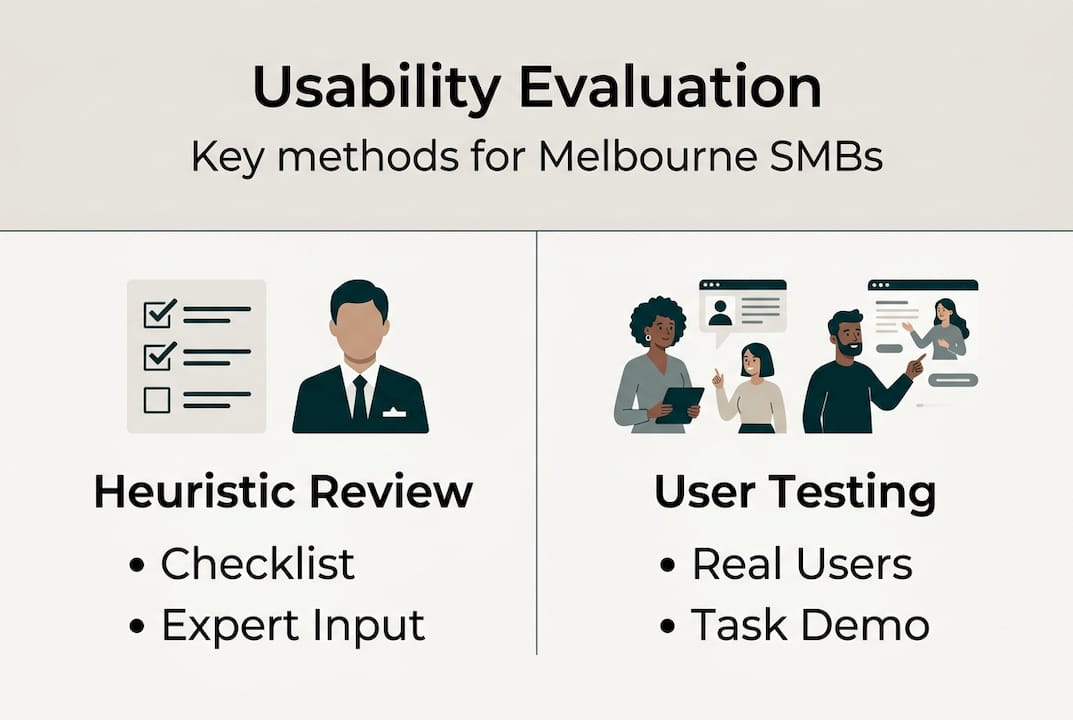
Heuristics can create false positives, so always validate with real user testing before making major decisions based on a checklist alone.
Pro Tip: Ask a friend or family member who doesn't know your business to find your contact details on your website. Watch where they hesitate or get confused. That real-world feedback is often more valuable than any automated audit tool.
Usability and local SEO: Visibility, trust, and enquiries
Once usability improvements are underway, it's vital to connect these efforts with your local SEO strategy. Search engines like Google pay close attention to how users behave on your site. If visitors land on your page and leave quickly, Google interprets that as a signal that your site isn't meeting their needs. This affects your search ranking.
Good usability helps your local SEO in several important ways:
- Lower bounce rates: When your site is easy to use, people stay longer and explore more pages, which signals quality to Google.
- More page interactions: Clicks, form fills, and time on site all contribute to positive engagement signals.
- Faster mobile experience: Most local searches in Melbourne happen on mobile. A fast, mobile-friendly site is essential for local visibility.
- Clear structured pages: Well-organised pages help Google understand what your business offers and where you operate.
Design-related trust influences local search performance, meaning a credible-looking, easy-to-use site supports your chances of appearing in local results. This is the connection between usability and visibility that many Melbourne businesses overlook.
Combining strong usability with smart local SEO creates a powerful foundation. You can explore how to do this well through design and local SEO tips tailored to Melbourne businesses. For a broader view of how search visibility works for local businesses, small business SEO resources can help you build a complete strategy.
When your site is easy to use and well-structured for local search, more of the right people find you, trust you, and reach out. That's the real goal.
Why most website usability advice misses the real challenge
Applying usability best practices is important, but let's take a deeper look at what most advice gets wrong. Most usability guides hand you a checklist and call it done. Tick the boxes, fix the obvious issues, and assume your site is now usable. The problem is that checklists reflect general principles, not the specific behaviour of your actual customers.
Here's the uncomfortable truth: heuristics often miss real behaviours, with up to 43% false positives identified in expert reviews. That means nearly half the issues flagged may not actually matter to your users, while the real obstacles go unnoticed.
What we've seen working with Melbourne businesses is that the edge cases are often the most important journeys. A tradie's website might look fine on a checklist, but real customers are trying to find a phone number while standing on a job site, on a cracked phone screen, in bright sunlight. That specific scenario rarely appears in a standard audit.
The solution isn't to abandon checklists. They're a useful starting point. But the real work is ongoing. You need to review your website usability mistakes regularly, test with real users, and pay attention to local context. Melbourne customers have specific expectations. Meeting them requires more than a one-time fix. It requires a mindset of continuous improvement, grounded in how your actual customers behave.
Take the next step: Usability support for Melbourne small businesses
With these insights in mind, here's how Troov Marketing can help you turn usability improvements into real-world results. We work with Melbourne small businesses to build websites that are clear, fast, and structured to convert visitors into enquiries from day one. Whether you're starting fresh or improving an existing site, our Melbourne web design approach puts usability and local SEO at the centre of every decision. Start with the Melbourne website checklist to identify where your site needs attention. If you want to strengthen your local visibility alongside your site improvements, our guide to optimise your Google profile is a practical next step. We're here to help you build a site that works as hard as you do.
Frequently asked questions
How do I know if my website has usability issues?
Look for unclear calls to action, slow loading speeds, and confusing navigation, as these are the most common problems. 70% of SMB homepages lack a clear CTA, so that's often the best place to start.
Is usability linked to SEO for Melbourne businesses?
Yes. Good usability improves search rankings by signalling quality and trust to Google, which means better local visibility and more enquiries. Design-related trust directly influences your chances in local search results.
Can improving usability really boost my conversion rate?
Absolutely. Melbourne businesses with improved usability can see conversion rates rise from the average 2 to 3% up to 6 to 11%, which represents a significant increase in enquiries from the same traffic.
Should I use a checklist or focus on user testing?
Use a checklist as a starting point, but always validate with real user testing. Up to 43% of heuristic findings can be false positives that don't reflect how your actual customers behave on your site.