

TL;DR:
- Google uses Core Web Vitals as a ranking factor impacting local search and trust.
- Website speed affects search rankings, mobile visibility, and customer conversion for Melbourne businesses.
- Practical actions like image optimization and better hosting can significantly improve site speed today.
Most Melbourne small business owners assume a second or two of extra load time is no big deal. After all, if your site loads eventually, customers will wait, right? Not quite. Core Web Vitals are now a direct Google ranking factor, measured using real visitor data from your actual users. That means your site's speed affects where you appear in local search results and whether potential customers trust you enough to make an enquiry. This guide walks you through what website speed really means, how it shapes your local SEO, and the practical steps you can take to improve it today.
Table of Contents
- What website speed really means (and how Google measures it)
- How website speed impacts your Melbourne local SEO
- How website speed drives customer trust and sales
- Practical steps to improve your website speed today
- Our perspective: the overlooked costs of slow websites for small Melbourne businesses
- How we help you build a lightning-fast website that wins Melbourne customers
- Frequently asked questions
Key Takeaways
| Point | Details |
|---|---|
| Google uses real speed data | Your site's real-world performance directly affects SEO rankings in 2026. |
| Speed boosts customer trust | Fast-loading websites increase customer satisfaction and sales in Melbourne. |
| Simple fixes drive results | You can make practical changes today to improve speed, SEO, and engagement. |
| Small gains bring big wins | Even minor speed improvements can outpace competitors in local search. |
What website speed really means (and how Google measures it)
Website speed is not just about how quickly a page appears on your screen. It covers the entire experience of loading and interacting with a page, from the moment a visitor clicks your link to when they can fully use your site. Google breaks this down into three key measurements called Core Web Vitals.
Largest Contentful Paint (LCP) measures how long it takes for the main content on a page to load. Think of it as the moment your digital storefront becomes visible. Interaction to Next Paint (INP) tracks how quickly your site responds when someone clicks a button or fills in a form. Cumulative Layout Shift (CLS) captures how much your page jumps around while loading, which frustrates users when buttons or text move unexpectedly.
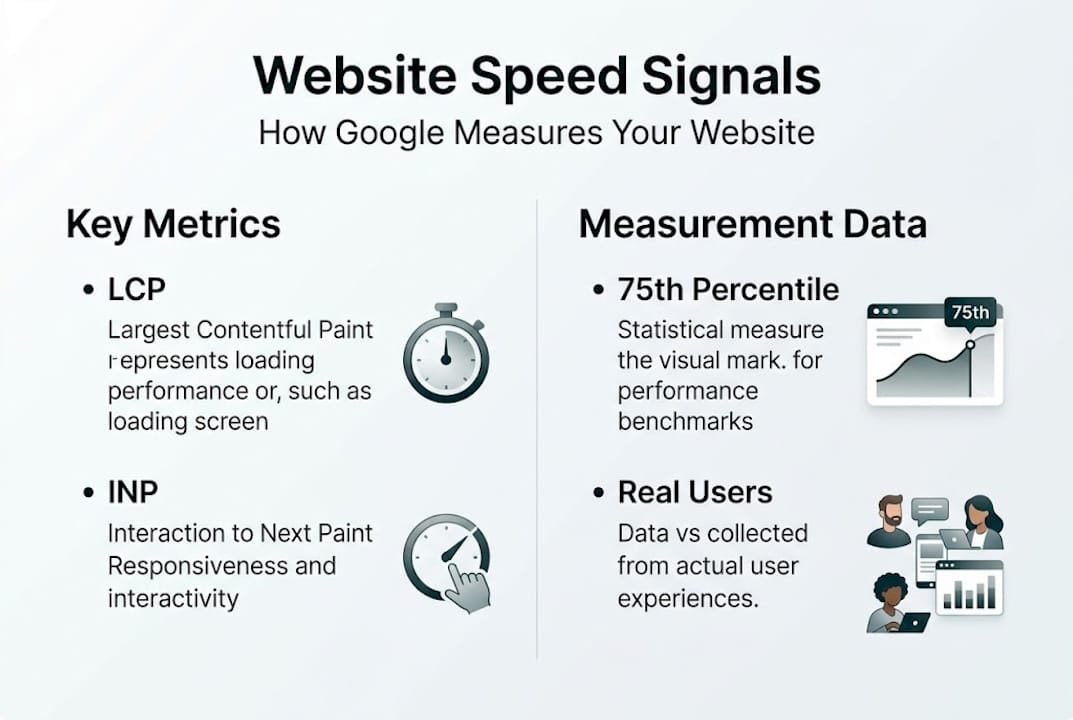
Google scores these using real-user CrUX data collected at the 75th percentile, meaning your score reflects how 75% of your actual visitors experience your site. Lab testing tools give you a snapshot, but Google's ranking decisions are based on real-world usage.
| Metric | Good | Needs improvement | Poor |
|---|---|---|---|
| LCP | ≤2.5s | 2.5s to 4.0s | >4.0s |
| INP | ≤200ms | 200ms to 500ms | >500ms |
| CLS | ≤0.1 | 0.1 to 0.25 | >0.25 |
For Melbourne small businesses, the metrics worth tracking closely are:
- LCP: Is your homepage hero image or headline loading fast?
- INP: Can visitors click your contact button without a delay?
- CLS: Does your page layout stay stable as it loads?
- Mobile scores: Are these metrics met on a phone, not just a desktop?
- Field data: What does your real-user data show in Google Search Console?
Pro Tip: Even a site that loads in 3.5 seconds can hurt your ranking. Because Google measures at the 75th percentile, a portion of slow visits is enough to push you into the 'needs improvement' bracket. Avoid common website mistakes that quietly drag your score down, and make sure your site includes the essential elements that support both speed and usability.
How website speed impacts your Melbourne local SEO
Now that you understand what website speed means, it is worth seeing exactly how it shapes your search visibility. Speed is not just a technical detail. It is a ranking signal that directly influences whether your business appears in Melbourne's local search results and the Google Maps pack.
Google uses Core Web Vitals as a ranking factor across all search results, including local ones. A slow site signals a poor user experience, and Google rewards sites that treat visitors well. For a Melbourne tradie, café, or professional services firm competing for local customers, this matters enormously.
"43% of sites fail Google's INP speed metric in 2026." This means nearly half of your local competitors may already be losing ranking ground because of slow interactivity. A faster site gives you a real, measurable edge.
Here is how speed affects your local SEO outcomes:
- Search rankings: Faster sites earn better positions in organic results, putting you in front of more local searchers.
- Map pack visibility: Google's local 3-pack favours sites with strong page experience signals, including speed.
- Mobile results: Most local searches happen on phones. A slow mobile site is a direct disadvantage in Melbourne's competitive market.
- Click-through rates: Higher rankings from speed improvements mean more clicks, more visits, and more enquiries.
- Bounce rates: Slow pages cause visitors to leave before engaging, which signals poor relevance to Google.
| Factor | Fast website | Slow website |
|---|---|---|
| Google ranking | Higher positions | Lower positions |
| Local map pack | More likely to appear | Often excluded |
| Mobile traffic | Strong performance | High bounce rate |
| Lead generation | More enquiries | Fewer conversions |
| Competitor edge | Visible advantage | Falls behind |
If you are working on your Melbourne local SEO, speed is one of the most direct levers you can pull. Pair it with the fundamentals covered in a local SEO beginner's guide and you will be building on a much stronger foundation. For a broader view of how small business SEO works in Melbourne, it helps to see speed as one part of a larger, connected strategy.
How website speed drives customer trust and sales
Beyond rankings, website speed has a direct effect on whether visitors stay, trust your business, and ultimately contact you. A slow site does not just frustrate people. It quietly signals that your business may not be professional or reliable.

Think about your own experience. When a page takes too long to load, you probably leave and try the next result. Your customers do exactly the same. Conversion rates drop steeply as load time increases, and for a local business, each lost visitor is a lost opportunity.
Consider these real scenarios:
- A Melbourne homeowner searches for a local plumber. Two results come up. One loads in 1.8 seconds, the other in 4.5 seconds. They call the first one.
- A customer browsing local cafés on their phone clicks your site. It takes five seconds to load. They close it and open the next result.
- A small business owner looking for an accountant visits two websites. One responds instantly to their clicks. The other lags. They trust the faster one more, without even knowing why.
Speed is an invisible advantage. Customers rarely notice when a site is fast, but they absolutely notice when it is slow. That first impression shapes whether they see your business as credible.
Speed and sales by the numbers: Even a one-second improvement in load time can lift conversion rates noticeably. For an ecommerce business, the impact is even more direct, with faster checkout experiences reducing cart abandonment. Check out more business growth resources if you want to see how speed fits into a broader marketing strategy.
Pro Tip: Mobile users expect pages to load in under two seconds. If your site is not optimised for mobile speed, you are likely losing a significant share of local enquiries before visitors even see your content.
Practical steps to improve your website speed today
Knowing speed matters is one thing. Doing something about it is another. The good news is that many of the most effective improvements are achievable without a full website rebuild. Here is where to start.
- Test your current speed. Use Google PageSpeed Insights or the Core Web Vitals report in Google Search Console. These free tools show your real-user scores and flag specific issues to fix.
- Optimise your images. Oversized images are one of the most common causes of slow LCP scores. Compress images before uploading and use modern formats like WebP where possible.
- Reduce unnecessary plugins. If your site runs on WordPress, too many plugins slow everything down. Audit what you have installed and remove anything you are not actively using.
- Enable caching. Caching stores a version of your pages so returning visitors and Google's crawlers load them faster. Most hosting providers and CMS platforms support this.
- Choose better hosting. Cheap shared hosting is often the hidden culprit behind slow sites. Upgrading to a quality host with Australian servers can make a noticeable difference for Melbourne visitors.
- Minimise render-blocking scripts. JavaScript and CSS files that load before your page content can delay LCP. A developer can help you load these more efficiently.
- Use a content delivery network (CDN). A CDN serves your site from servers closer to your visitors, reducing load times across Melbourne and beyond.
Web performance improvements benefit both your Core Web Vitals scores and overall visitor satisfaction, making them one of the highest-value investments you can make in your site.
Pro Tip: If your site is built on WordPress, start with image optimisation and caching. These two changes alone can move you from 'poor' to 'good' on LCP without touching a line of code. Follow a solid mobile design approach from the start to avoid rebuilding later. Use a structured website checklist to keep speed improvements on track over time. And if you are in a professional services field, reviewing accounting website best practices can show you how speed and trust-building work together.
Our perspective: the overlooked costs of slow websites for small Melbourne businesses
Here is something most agencies will not tell you. A site that scores in the 'acceptable' range is not a win. It is a missed opportunity.
We see this regularly with Melbourne small businesses. Their sites load in around three to four seconds, pass a basic audit, and get labelled as fine. But in a competitive local market, fine is not enough. The businesses consistently winning local search are not just meeting the threshold. They are sitting well inside the 'good' zone.
Slow sites also carry hidden costs that go beyond today's rankings. When a referred customer visits your site and it loads slowly, that referral's confidence drops. Word of mouth is powerful in Melbourne's tight-knit business communities, and a poor digital experience quietly erodes the trust that took years to build.
We believe speed is a signal of business health, not just a technical metric. The lessons from real-world ecommerce apply equally to service businesses. Small, consistent improvements compound over time. Do not settle for acceptable. Treat speed as a competitive lever and revisit it regularly.
How we help you build a lightning-fast website that wins Melbourne customers
At Troov Marketing, we build websites for Melbourne small businesses that are fast from day one, not as an afterthought. Every site we design is structured to perform well on Core Web Vitals, load quickly on mobile, and support your local SEO goals from the ground up. If you are not sure where your site currently stands, our website checklist is a great starting point. For businesses ready to invest in a properly built foundation, explore our expert web design services tailored for local businesses. We also offer local SEO support to help you rank higher and attract more Melbourne customers consistently.
Frequently asked questions
What is considered a 'good' website speed for Google in 2026?
A good site should have an LCP under 2.5 seconds, INP under 200ms, and CLS under 0.1, measured at the 75th percentile of real users visiting your site.
How do I test my Melbourne business website's speed?
You can use Google PageSpeed Insights or the Core Web Vitals report in Google Search Console to see your site's real-world performance scores and specific areas to improve.
Does mobile speed matter more for local search?
Yes. Most local searches happen on phones, and Google's mobile-first indexing means your mobile speed score carries significant weight in how your site ranks for Melbourne customers.
How quickly can improving site speed impact my rankings?
Improvements can show results within weeks, as Google refreshes CrUX data regularly and updates local rankings based on the latest real-user experience signals from your site.
Recommended
- Website Design & Local SEO | Troov Marketing | Melb.
- Top advantages of mobile-friendly sites for Melbourne small businesses
- Why modern websites matter for Melbourne small businesses
- Website Design Tips 2026: Boost Local Leads by 30% Melbourne
- Zu große Bilder und fehlende ALT-Texte rasch finden und beheben - DER KI-AUDIT