

If you're running a small business in Melbourne, you already know your website matters. But here's the reality: having a site that simply exists isn't enough anymore. 94% of Australians trust a business more if it has a professionally designed, up-to-date website. That's not just about looking good. It's about whether customers choose you or scroll past to a competitor. Modern websites aren't a luxury. They're the difference between being found, trusted, and contacted, or being invisible. In this article, we'll show you what makes a website truly modern, why it drives more leads and better search rankings, and how Melbourne small businesses are already seeing real results.
Table of Contents
- What makes a modern website?
- Customer trust, first impressions, and competitive advantage
- Modern websites and Melbourne local SEO: getting found, staying found
- What small business owners get wrong (and how to fix it)
- Small business case studies: modern websites in action
- Ready for more leads? Next steps for your modern website
- Frequently asked questions
Key Takeaways
| Point | Details |
|---|---|
| Trust comes first | A modern website earns customer trust and sets you apart from local competitors. |
| SEO drives customers | Up-to-date design and optimisation help your business appear in local searches and get more enquiries. |
| Avoid common mistakes | Simple errors on your website can cost you leads—use checklists and regular updates to stay ahead. |
| Results you can measure | Melbourne businesses saw 18-30% lead growth from modernising their site. |
What makes a modern website?
Let's start by clearing up what 'modern' actually means. It's not just a fresh coat of paint or a trendy font. Modern websites are mobile-optimised, SEO-ready, and focused on clear calls to action. They load quickly, work seamlessly on phones, and guide visitors toward booking, calling, or enquiring. If your site doesn't do these things, it's costing you customers.
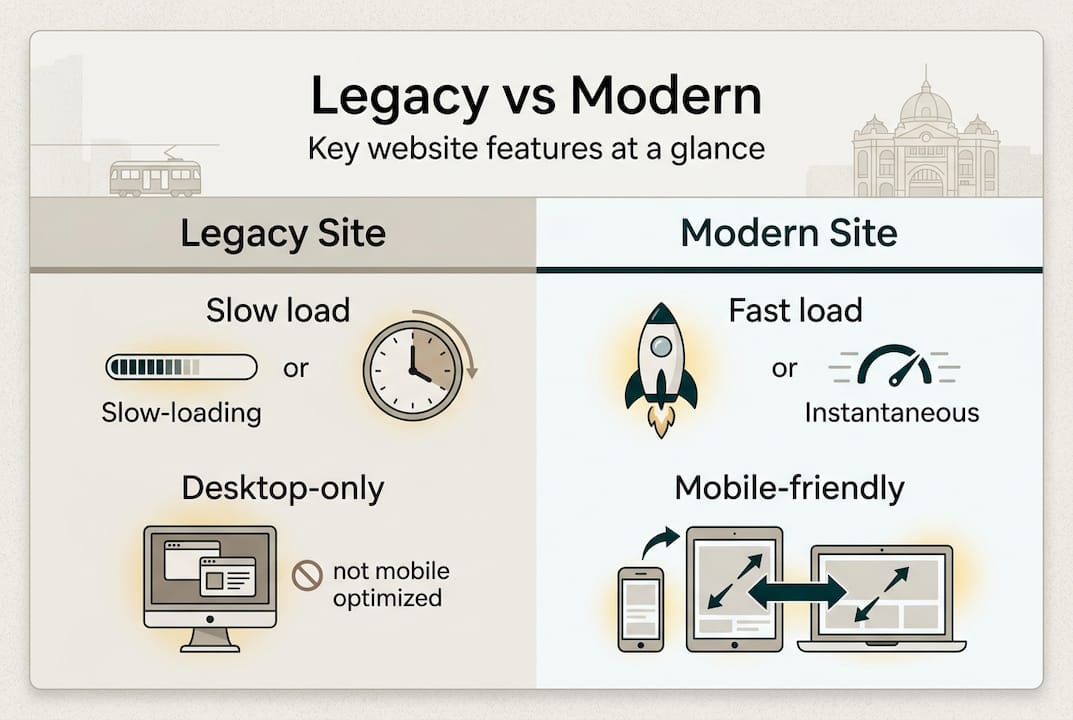
Here's a side-by-side comparison to help you see where your site sits:
| Legacy website | Modern website |
|---|---|
| Slow loading (3+ seconds) | Fast loading (under 2 seconds) |
| Desktop-only design | Mobile-first, responsive design |
| Outdated visuals, cluttered layout | Clean, professional visuals |
| Hidden or unclear contact details | Prominent calls-to-action |
| No SEO structure | Built with SEO foundations |
| Difficult navigation | Intuitive, user-friendly navigation |
| Not accessible | Accessible to all users |
Many small business owners assume any website 'will do.' That's a costly myth. Customers judge your business in seconds, and a dated site sends a clear message: you're not keeping up. On the other hand, a modern site signals professionalism, reliability, and attention to detail.
Must-have elements for 2026:
- Mobile-first design that works perfectly on phones and tablets
- Fast page load speed (under 2 seconds)
- Clear, visible calls-to-action on every page
- SEO-friendly structure with proper headings and metadata
- Accessible design for all users
- High-quality images and updated content
- Easy-to-find contact details and enquiry forms
If your site is missing even one of these, you're leaving leads on the table. The good news? These aren't impossible to achieve. With the right approach, any small business can build or upgrade to a modern site that performs.
Customer trust, first impressions, and competitive advantage
Your website is often the first interaction a potential customer has with your business. That first impression happens fast. Really fast.
First impressions of credibility are formed in under 1 second based on website design.
Think about that. In less time than it takes to blink, a visitor has decided whether your business looks trustworthy or not. If your site looks outdated, cluttered, or unprofessional, they're gone. And they're probably heading straight to a competitor whose site looks current and credible.
This isn't just about aesthetics. It's about how customers perceive your business. A modern, well-designed site tells visitors you care about quality, you're active, and you're serious about serving them. A dated site suggests the opposite, even if that's not true.
Visuals matter. Structure matters. Fresh content matters. When your site looks polished and functions smoothly, customers feel confident reaching out. When it doesn't, they hesitate. And hesitation means lost enquiries.
Pro Tip: Refresh just one element, like updating photos or adding recent testimonials, and you can instantly boost perceived credibility. Small changes make a big difference.
Melbourne is competitive. Your customers have options. If your site doesn't match or exceed what they see elsewhere, you're handing business to competitors who've invested in a professional web design. The businesses winning local customers aren't necessarily the biggest or oldest. They're the ones that look the most trustworthy online. That's the competitive advantage a modern website delivers.
Modern websites and Melbourne local SEO: getting found, staying found
Beyond trust, search performance is where a modern website becomes a true growth engine. If customers can't find you on Google, your site might as well not exist. And here's the reality: modern, well-optimised websites boost local SEO outcomes by up to 45% for Melbourne businesses.
That's not a small difference. That's the gap between showing up on page one or being buried on page three where no one looks.
So what makes a modern site rank better? It's a combination of technical features and content strategy. Here's what Google looks for:
| SEO feature | Why it matters |
|---|---|
| Mobile-friendly design | Google prioritises mobile-first indexing |
| Fast load speed | Slow sites rank lower and lose visitors |
| Clear site structure | Helps Google understand and index your pages |
| Optimised headings and metadata | Improves relevance for search queries |
| Local keywords and content | Connects your business to Melbourne searches |
| Regular updates | Signals your site is active and relevant |
| Secure HTTPS connection | Builds trust with users and search engines |
Google rewards websites that are current, fast, and easy to use. If your site ticks those boxes, you're already ahead of competitors still running outdated designs.
But ranking well is only half the story. Once a customer finds you, your site needs to convert that visit into an enquiry. Here's how that journey typically works:
- Customer searches for a service in Melbourne (e.g., 'plumber near me')
- Your business appears in search results
- Customer clicks through to your website
- They quickly scan your homepage and service pages
- They decide whether to call, email, or move on
Your website makes or breaks this journey at every step. If it loads slowly, looks unprofessional, or makes it hard to contact you, they're gone. If it's fast, clear, and trustworthy, they're reaching out.
One more thing: connect your website to your Google Business Profile. Make sure your Name, Address, and Phone (NAP) details are identical across both. Consistency here boosts your local search visibility and helps customers find you faster.
What small business owners get wrong (and how to fix it)
Many sites are unintentionally costing their owners leads. It's not always obvious, but small mistakes add up fast. Here's what to watch for and how to lift your site above common pitfalls.
The biggest myth? 'Our site is good enough. Customers don't care.' They do. And they're judging you based on what they see. If your site feels neglected, they assume your business might be too.
Classic errors Melbourne small businesses make:
- Outdated information: Old service descriptions, expired promotions, or incorrect contact details confuse visitors and damage trust.
- Clumsy navigation: If customers can't find what they need in seconds, they leave. Menus should be simple and logical.
- No mobile optimisation: Over half your visitors are on phones. If your site doesn't work well on mobile, you're losing them.
- Weak or missing calls-to-action: Every page should guide visitors toward the next step, whether that's calling, booking, or enquiring.
- No testimonials or social proof: Customers want to see that others trust you. Reviews and testimonials build confidence.
These aren't hard to fix, but they require attention. Service page clarity and updated calls-to-action significantly improve conversion rates. Even small tweaks, like making your phone number more visible or adding a contact form to every page, can lift enquiries.
Pro Tip: Use a website checklist and audit your site quarterly. Technology, SEO, and design trends change. Regular check-ins keep your site competitive.
If you're not sure where to start, look at small business website examples that are driving leads. See what they're doing right and compare it to your own site. You'll quickly spot gaps and opportunities.
Small business case studies: modern websites in action
Seeing is believing. Here's how similar businesses nearby have benefited from investing in a modern site.
Across Melbourne, small businesses that upgraded or built modern websites saw real, measurable results. Some small business sites saw lead growth of 18-30% after a modern redesign. That's not hype. That's what happens when your site works the way customers expect.
Take a local tradie business that rebuilt their site with mobile-first design, clear service pages, and prominent contact buttons. Within three months, phone enquiries jumped 22%. Why? Because customers could finally find what they needed and reach out without friction.
Or consider a professional services firm that updated their outdated site with fresh visuals, faster load times, and better SEO structure. Their Google rankings improved, and they started appearing in local searches they'd never ranked for before. More visibility meant more enquiries.
The lesson? Modern websites aren't just nice to have. They're business tools that deliver tangible outcomes. Whether you're in trades, professional services, or retail, the principles are the same. Make your site fast, clear, mobile-friendly, and trustworthy, and customers will respond.
If you're in a trade-based business, check out website tips for roofers to see how similar businesses are attracting more local clients. The strategies apply across industries.
Ready for more leads? Next steps for your modern website
If you're ready to join the ranks of successful, modern Melbourne businesses, here's exactly how to start.
You've seen why modern websites matter. They build trust, improve search rankings, and turn visitors into customers. The question now is: what's your next move?
First, audit your current site. Use the ultimate website checklist to identify what's working and what's not. Look for the must-have elements we covered: mobile optimisation, fast load speed, clear calls-to-action, and up-to-date content. If you're missing any of these, prioritise fixing them.
Second, consider whether a refresh or a full rebuild makes more sense. Sometimes small updates are enough. Other times, starting fresh is the smarter investment. If you're unsure, reach out for an expert review. We help Melbourne small businesses build modern, lead-generating websites that perform from day one.
Third, connect your website to your broader local SEO strategy. Make sure your Google Business Profile is optimised, your NAP details are consistent, and your site is structured to rank well in Melbourne searches. These pieces work together to maximise your visibility.
The businesses that thrive in Melbourne aren't waiting for customers to find them by chance. They're making it easy. They're investing in websites that work as hard as they do. If you're ready to do the same, get in touch with Troov Marketing and let's build something that drives real results.
Frequently asked questions
How do I know if my website is modern enough?
Check for mobile optimisation, fast loading, clear calls-to-action, and up-to-date content. Use a website checklist for a full audit.
Can a new website really help my small Melbourne business get more local customers?
Yes. Updated websites have driven up to 45% better local SEO results and 18-30% more customer enquiries for small businesses.
How often should I update my business website?
Audit your website every three to six months to stay ahead of changes in technology, SEO, and visual trends. Regular audits are key to effective website management.
Is it expensive to upgrade a small business website?
Costs vary, but many improvements like updating content or images can be affordable and deliver strong results quickly. Website design tips can help you prioritise budget-friendly changes.
What's the biggest mistake small businesses make with their websites?
Assuming 'good enough' is actually good enough. Customers compare your site to competitors, and outdated design or poor functionality sends them elsewhere.