
TL;DR:
- SEO requires consistent effort in technical setup, content, and off-page activities for local ranking success.
- Proper keyword research and competitor analysis help tailor website content to Melbourne homeowners' search habits.
- Regular updates, genuine reviews, and ongoing monitoring are essential to improve and maintain roofing website rankings.
If your Melbourne roofing website isn't showing up when local homeowners search for a roofer nearby, you're losing work to competitors who've simply done the groundwork. SEO (search engine optimisation) can feel overwhelming, but it doesn't have to be. A structured workflow breaks the process into clear, manageable steps that any roofing business owner can follow. Get it right and your website becomes a genuine source of new enquiries, not just a digital business card collecting dust.
Table of Contents
- What you need to start your roofing website SEO workflow
- Research and plan: laying the groundwork for local SEO success
- Step-by-step optimisation: on-page and technical tasks
- Off-page SEO, tracking, and ongoing workflow
- Why most local roofing SEO fails: lessons from Melbourne projects
- Get expert help to fast-track your roofing website SEO
- frequently asked questions
Key Takeaways
| Point | Details |
|---|---|
| Prepare the essentials | Gather all accounts and tools before starting to avoid roadblocks and confusion. |
| Prioritise local research | Use Melbourne-focused keywords and competitor research for maximum visibility. |
| Follow a clear workflow | Completing each SEO step in order leads to predictable gains in rankings and enquiries. |
| Monitor and adapt | Regularly check your results and refine your approach for ongoing improvement. |
What you need to start your roofing website SEO workflow
Now that you understand why SEO workflow matters, let's look at what you'll need before you begin. Starting without the right tools and access is one of the most common reasons local roofers stall before they've even begun.
Core technical requirements
Before touching a single keyword, make sure you have the following sorted:
- Login access to your website's content management system (CMS), such as WordPress or your website builder
- Admin access to Google Business Profile (GBP), which is your free listing on Google Maps and Search
- Google Analytics installed on your site (this tracks visitor behaviour)
- Google Search Console connected (this shows how Google sees your site)
- A spreadsheet or project tool to track your progress
Business information you'll need ready
Local SEO relies on consistent, accurate business details. Have these on hand:
- Your exact business name, address, and phone number (NAP)
- A list of your services and the Melbourne suburbs you service
- High-quality photos of your team and completed roofing jobs
- Any existing customer reviews or testimonials
As the SEO basics guide from our team explains, using the right tools streamlines local SEO and content management significantly.
| Tool | Purpose | Cost | Priority level |
|---|---|---|---|
| Google Analytics | Track website traffic | Free | Essential |
| Google Search Console | Monitor search performance | Free | Essential |
| Google Business Profile | Local visibility on Maps | Free | Essential |
| SEMrush or similar | Research keywords and competitors | Free or paid | High |
| A keyword spreadsheet | Plan and track target keywords | Free | High |
For a deeper look at how local SEO for Melbourne businesses works in practice, it's worth reviewing what signals Google looks for when ranking local trades.
Pro tip: One of the most common mistakes roofers make is setting up Google Analytics but never checking it. Set a recurring reminder to log in at least once a month. Data you never look at won't help your business.
Research and plan: laying the groundwork for local SEO success
With your tools and essentials ready, the next step is to research and plan your approach. This stage sets the direction for everything that follows, so it's worth spending real time here.
Finding keywords your customers actually use
Keyword research means identifying the exact words and phrases Melbourne homeowners type into Google when they need a roofer. The goal is to match your website's content to those searches. Local intent keywords drive more qualified leads for trades than broad, generic terms.
Here's a simple process to get started:
- Open Google and start typing "roofer" or "roof repair" and note the autocomplete suggestions
- Check the "People also ask" and "Related searches" sections at the bottom of results
- Use a free tool like Google's keyword planner or the free version of a tool like local SEO guide resources to find search volume
- List service-specific terms (e.g. "roof restoration," "metal roofing," "gutter replacement")
- Add suburb-level terms (e.g. "roofer in Richmond," "roof repairs Brighton")
What to look for in competitor websites
Visiting your top-ranking competitors' websites tells you a lot. Look at the headings they use, the suburbs they mention, and how they structure their service pages. Compare your current site against theirs using this quick checklist:

| What to check | Your site | Top competitor | Gap to close |
|---|---|---|---|
| Service pages for each job type | Yes/No | Yes/No | High/Low |
| Melbourne suburb mentions | Yes/No | Yes/No | High/Low |
| Customer reviews on site | Yes/No | Yes/No | High/Low |
| Clear contact details on every page | Yes/No | Yes/No | High/Low |
For more ideas on structuring your site effectively, the roofing website design tips we've put together are a practical starting point.
Pro tip: Many roofers make the mistake of using trade jargon in their content, words like "fascia replacement" or "sarking installation" that most homeowners simply won't search for. Use plain language first, then explain the technical term in brackets if needed.
Step-by-step optimisation: on-page and technical tasks
Once you've finished planning, it's time to roll up your sleeves and work through each optimisation step. This is where your research becomes real action on your website.
On-page optimisation steps
On-page SEO refers to changes you make directly on your web pages. Work through these in order:
- Write a unique meta title for each page (the clickable headline in Google results), including your main keyword and suburb
- Write a meta description (the short summary under the title in search results) that encourages clicks
- Use your target keyword naturally in the first paragraph of each page
- Add heading tags (H1 for the main title, H2 for sections) that include relevant keywords
- Name your images descriptively and add alt text (a short description of each image for Google and accessibility)
- Include your service area suburbs naturally within your content
For pages that need to convert visitors into calls, the service page conversion guide covers exactly how to structure those pages for both SEO and enquiries.
Technical essentials
Beyond content, Google also evaluates how your site performs technically. Make sure your site:
- loads quickly on mobile devices (most homeowners search on their phones)
- uses https (a secure connection, shown by the padlock icon in the browser)
- has no broken links or missing pages
- is easy to navigate with a clear menu structure
The Google SEO starter guide is a reliable reference for understanding what Google's crawlers look for. And as our own research shows, regular site improvements boost Melbourne service provider SEO performance over time.
For a broader look at how combining design and SEO creates stronger results, it's worth reading how these two elements work together.
Important: Never copy content from another roofer's website or use the same text across multiple pages of your own site. Google penalises duplicate content, meaning your pages may not appear in search results at all. Every service page needs original, unique content.
Off-page SEO, tracking, and ongoing workflow
With strong on-page and technical groundwork in place, ensure your workflow supports lasting SEO growth with off-page actions and regular tracking. This is where many roofers stop, and it's exactly why their rankings plateau.
Key off-page strategies for Melbourne roofers
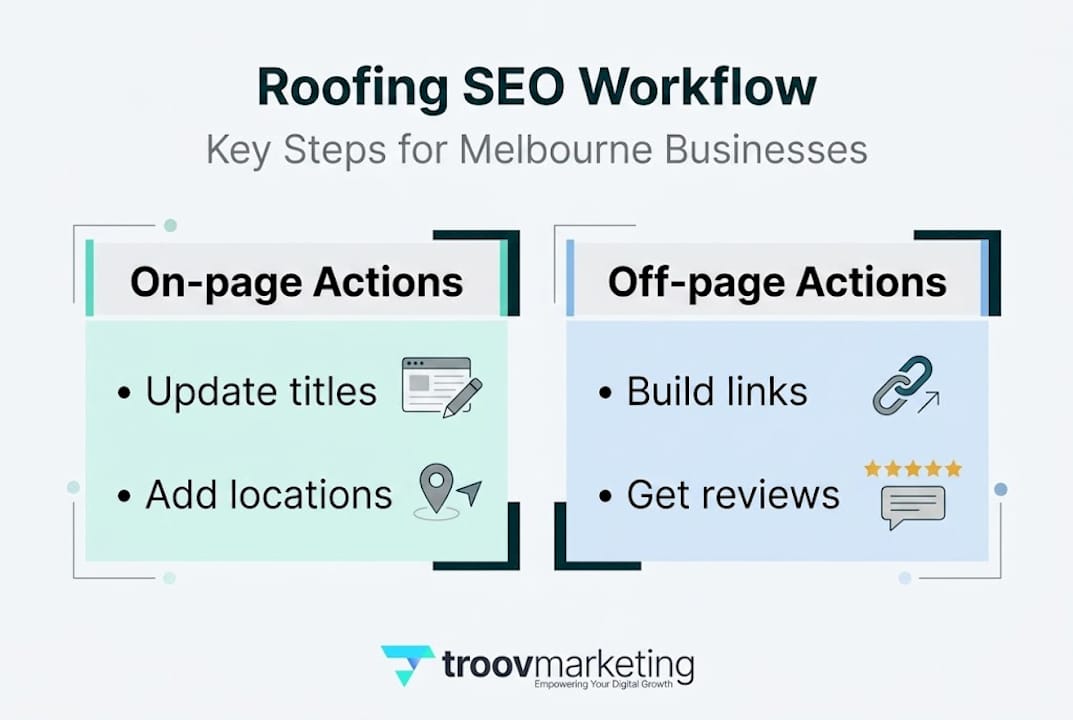
Off-page SEO refers to actions taken outside your website that still influence your rankings. The most impactful ones for roofers include:
- Citations: List your business on directories like Yellow Pages, True Local, and hipages with consistent NAP details
- Reviews: Ask satisfied customers to leave a Google review. Even five new reviews can noticeably shift your local ranking
- Local links: Get your business mentioned or linked from local community sites, suppliers, or industry associations
- Social signals: Keep your Facebook or Instagram active with project photos and location tags
For a practical example of how this all fits together, the SEO workflow example we've documented for another trade gives a clear picture of the ongoing rhythm involved. As our team notes, consistent off-page activity and monitoring results are essential for SEO success.
Setting up a monthly tracking routine
Tracking doesn't need to be complicated. Follow this simple monthly sequence:
- Log into Google Search Console and check which keywords are sending traffic
- Review Google Analytics to see how many visitors came to your site and which pages they visited
- Count new leads or enquiries from the website that month
- Check your Google Business Profile insights for calls and direction requests
- Note any ranking changes for your target keywords
For more detail on link building basics and how external links strengthen your authority, it's a topic worth exploring as your SEO matures.
Pro tip: Most roofers see meaningful improvement within 3 to 4 months of consistent effort. Don't expect overnight results, but do expect a steady upward trend if you stick to the workflow.
Why most local roofing SEO fails: lessons from Melbourne projects
After following the step-by-step workflow, it's worth pausing to understand why even structured approaches can go off track. In our experience working with Melbourne trades, the failure point is rarely the strategy itself. It's the execution gaps in between.
The biggest issue we see is roofers treating SEO as a one-time job. They optimise their pages once, tick the box, and move on. But Google rewards consistency. A site that gets small, regular updates will outperform a site that had a big overhaul two years ago and hasn't changed since.
Another overlooked problem is over-optimised content. This means stuffing keywords into every sentence until the page reads awkwardly. Google's algorithm is sophisticated enough to detect this, and real customers will simply leave the page. Natural, helpful writing wins every time.
Finally, many roofers ignore the power of genuine reviews. A templated five-star review that reads like marketing copy does far less than an honest, detailed review from a real customer in a specific Melbourne suburb. The Melbourne roofing marketing strategies that actually work are built on trust signals, not tricks. The human element, real photos, real reviews, and real local knowledge, is what separates roofing websites that rank from those that don't.
Get expert help to fast-track your roofing website SEO
If you want to accelerate your results or bypass common mistakes, explore these options for tailored support. Working through an SEO workflow on your own is absolutely achievable, but having a local team behind you makes the process faster and more reliable. At SEO for small businesses, we work specifically with Melbourne trades to build websites and SEO strategies that are grounded in real local knowledge. Whether you're starting from scratch or improving an existing site, our ultimate website checklist is a free resource to help you identify gaps quickly. And if you're ready to talk about a proper website build, our Melbourne web design experts are here to help you take the next step.
frequently asked questions
What is the biggest SEO mistake for Melbourne roofing websites?
The most common mistake is failing to target location-specific keywords that real customers use in Melbourne. Generic terms like "roofer" without a suburb won't help you compete locally.
How long before I see results from my roofing SEO workflow?
You can usually see noticeable improvements in 3 to 4 months if the workflow is done consistently. Off-page activity and regular monitoring are key to keeping that momentum going.
Do I need to hire an SEO expert or can I do it myself?
Many Melbourne roofers start with DIY SEO using guides and free tools. Using the right tools streamlines the process, but professional help can speed things up and prevent costly errors.
How do I know if my site's SEO is working?
Track your Google rankings, website traffic, and new roofing leads each month. Regular site improvements and consistent monitoring will show you a clear upward trend over time.
Recommended
- Garden website SEO workflow: step-by-step Melbourne guide
- Website design tips for roofers: attract Melbourne clients
- Top digital marketing strategies for Melbourne roofers
- Website design tips for gardeners: boost Melbourne leads 80%
- Why your website structure could be holding back your rankings in 2026 (and how to fix it) - Gregg King SEO