

TL;DR:
- In 2026, local SEO for Melbourne businesses relies heavily on demonstrating genuine expertise, trust, and authority through structured content and schema markup. Maintaining foundational practices like Google Business Profile accuracy, while expanding across multiple platforms, is crucial for future-proofing search visibility. Businesses that consistently invest in brand authority, create topic clusters, and diversify their online presence can achieve sustained local dominance amid evolving AI-driven search landscapes.
Search engine optimisation is not something you set up once and leave to run. The rules shift, the tools evolve, and the businesses that stay visible are the ones that keep adapting. In 2026, artificial intelligence is reshaping how people search, how content gets surfaced, and how Google decides who earns a spot in the local map pack. For Melbourne small businesses, this creates both a challenge and a real opportunity. This guide breaks down exactly what's changing, what still matters, and what you can start doing right now to stay ahead.
Table of Contents
- Why SEO in 2026 is different: local business realities
- AI, content quality, and E-E-A-T: what wins in 2026
- Topic clusters and content pillars: the new architecture for ranking
- Multi-platform and multi-format: how to future-proof your SEO
- Why most small businesses miss the real SEO opportunity in 2026
- Boost your Melbourne SEO with tailored solutions
- Frequently asked questions
Key Takeaways
| Point | Details |
|---|---|
| Structure matters | Topic clusters and content pillars are essential for local SEO in 2026. |
| Be human, show trust | Authentic, expert-driven content outperforms AI-generated text for Melbourne businesses. |
| Go beyond Google | Spreading content across platforms boosts share-of-voice and helps future-proof your SEO. |
| Invest in authority | Real reviews, staff bios, and schema markup enhance credibility and search visibility. |
Why SEO in 2026 is different: local business realities
Having set the stage for why SEO can't be static, let's examine the foundational shifts shaping success this year.
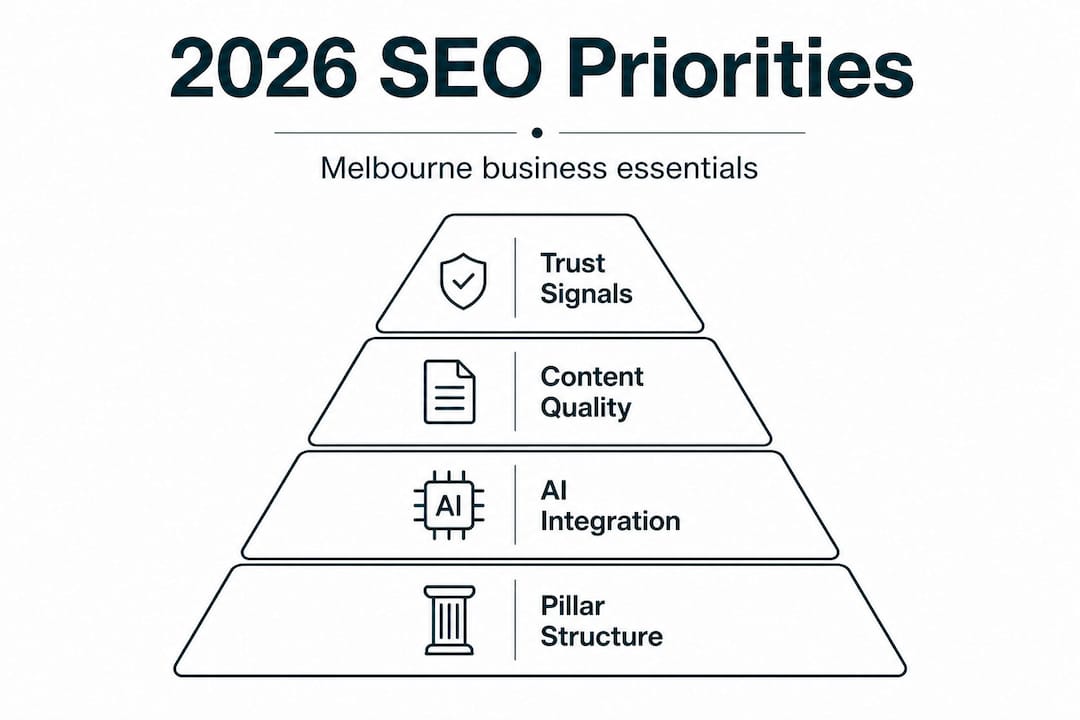
The good news first. Core SEO practices, such as on-page optimisation, quality backlinks, and consistent local citations, are still the bedrock of strong rankings. Understanding small business SEO pricing helps you invest wisely rather than overspend on tactics that won't move the needle. These foundations have not been replaced by AI. They've been raised to a higher standard.
What has changed is how search engines and AI tools interpret and reward your content. Google's local map pack now looks beyond simple keyword matches. It favours businesses that demonstrate genuine topic authority across multiple pages and content formats. At the same time, AI-powered search assistants are pulling answers directly from websites, which means your site needs to be structured in a way that machines can easily read and trust.
"Traditional SEO foundations remain the bedrock despite AI hype, but AI query fan-out now favours topic clusters over single keywords, and agentic AI increasingly requires back-end API accessibility."
For Melbourne businesses, this shift matters locally too. More businesses across the city are waking up to SEO, which means competition for local search positions is tighter than ever. A plumber in Fitzroy, a bookkeeper in Richmond, or a physio clinic in Brunswick all face more digital competition than they did two years ago.
Here's a quick summary of what's changed and what hasn't:
- Still essential: Google Business Profile accuracy, local citations, mobile-friendly websites, fast page load speeds
- Growing in importance: Topic authority, structured data (schema markup), and authentic trust signals
- New frontier: AI citation visibility, multi-platform presence, and content designed for language model extraction
Following Melbourne website design tips that align design with SEO structure gives you a meaningful head start on competitors who treat these as separate concerns.
AI, content quality, and E-E-A-T: what wins in 2026
With the realities of local SEO in mind, it's time to get practical about the strategies that separate top-ranking Melbourne businesses from the rest in 2026.
E-E-A-T stands for Experience, Expertise, Authority, and Trust. It's the framework Google uses to evaluate whether your content deserves to rank. In 2026, this framework carries even more weight because AI ranking systems actively look for signals that confirm a real person with genuine knowledge created the content.
For a local business, E-E-A-T shows up in practical ways. Real photos of your team and workspace build trust visually. Staff bios that mention qualifications or years of experience signal expertise. Genuine Google reviews reinforce authority. These aren't just nice-to-haves. They're now ranking signals that influence whether you appear in AI-generated answers and local packs.
| E-E-A-T signal | What it looks like on your website | Why it matters in 2026 |
|---|---|---|
| Experience | Case studies, before-and-after photos, project examples | Shows real-world application of skills |
| Expertise | Staff bios, certifications, detailed service pages | Confirms credibility to AI and users |
| Authority | Quality backlinks, press mentions, industry associations | Builds your reputation across the web |
| Trust | Reviews, clear contact info, secure HTTPS site | Reassures both visitors and search engines |
Schema markup, which is a type of code you add to your pages, helps AI search tools understand exactly what your business does. Schema markup boosts AI citation rates significantly, particularly for LocalBusiness, FAQ, and HowTo formats. If your site doesn't have this in place yet, it's one of the most practical upgrades you can make this year.
Pro Tip: Ask your web developer to add LocalBusiness schema to your homepage and contact page. Include your business name, address, phone number, and opening hours in the code. This small technical addition can meaningfully improve how often AI tools surface your business in local results.
The measurement of SEO success is also shifting. Traffic numbers alone don't tell the full story anymore. Human-led content outperforms AI-generated text in both trust and rankings, and forward-thinking businesses are tracking share-of-voice and AI citation counts alongside traditional metrics. Share-of-voice means looking at how often your brand appears in search results relative to your competitors, not just how many clicks you receive.
Building your foundational SEO essentials the right way from the start makes every additional strategy more effective. It's also worth reading through a beginner's SEO guide if you want to solidify the basics before layering in more advanced tactics. Understanding AI market research tips can also help you find the specific topics your Melbourne audience is actively searching for.
Topic clusters and content pillars: the new architecture for ranking
Now that quality and authority are crucial, let's look at the technical structure Melbourne businesses should adopt for competitive strength.
The old approach to SEO was simple. Pick a keyword, write a page, hope it ranks. That method is losing ground fast. In 2026, search engines and AI tools reward businesses that demonstrate deep knowledge across a whole topic, not just a single search term.
This is where topic clusters come in. A topic cluster links a group of related pages back to one central "pillar" page. The pillar page covers a broad subject thoroughly. The cluster pages go deeper on specific sub-topics and link back to the pillar. Together, they signal to Google that your site is a genuine authority on the subject.
Topical authority via pillar-cluster structures is now one of the clearest ways to rank for competitive local terms. And because AI query fan-out favours topic clusters, being structured this way also improves your chances of being cited by AI search assistants like Google's AI Overviews.
Here's a side-by-side look at the difference in approach:
| Traditional keyword focus | Topic cluster architecture |
|---|---|
| One page targeting "plumber Melbourne" | Pillar page on plumbing services in Melbourne, plus cluster pages on emergency repairs, hot water systems, blocked drains, etc. |
| Isolated pages with no internal linking strategy | Strong internal links connecting all cluster pages back to the pillar |
| Targets one search intent | Covers multiple related intents and questions |
| Harder for AI to understand site authority | AI tools can follow topic relationships and cite your site more confidently |
How to build your own topic cluster for a Melbourne business:
- Choose your pillar topic. Pick the main service or subject you want to be known for. For example, a Melbourne accountant might choose "small business tax" as their pillar topic.
- Map out your cluster pages. Think about every question a client might ask related to that topic. Each question becomes a potential cluster page. Topics like "how to claim home office expenses," "GST for small business," and "end-of-year tax checklist" all fit naturally.
- Write the pillar page first. Make it thorough. Cover the main topic from every angle, and link out to the cluster pages as you mention each sub-topic.
- Create and publish cluster pages. Each one should answer a specific question in depth, and each should link back to the pillar page.
- Add schema markup. Use FAQ schema on pages that answer questions, and HowTo schema on instructional content.
- Update regularly. Search engines reward freshness. Revisit your cluster pages every six months to keep the content accurate and relevant.
For trades and professional services, combining design and SEO within your site structure ensures your cluster pages look professional and perform well in search at the same time. See how this applies in practice with SEO for accountants as a worked example of a cluster strategy in a competitive Melbourne niche.
Multi-platform and multi-format: how to future-proof your SEO
Once your site's structure is ready, the next leap is expanding your reach across multiple channels to secure future growth.

Relying entirely on Google for business discovery is a risk in 2026. Algorithm updates happen regularly. AI-driven changes to search results pages can reduce traffic overnight even when your rankings stay the same. Spreading your presence across platforms protects you against these shifts and opens new discovery channels.
The reason this matters for SEO goes deeper than just reaching more people. Multi-platform content increases LLM training data presence, which means AI tools like ChatGPT and Google's AI Overviews are more likely to reference your business when someone asks a related question. Being present on Reddit, YouTube, and LinkedIn isn't just a social media strategy anymore. It's an SEO strategy.
Here's how Melbourne businesses can apply this practically:
- YouTube: Record a short video answering a common customer question. A carpet cleaner in Prahran could film "how often should you professionally clean your carpets?" in under three minutes. This surfaces in both YouTube search and Google video results.
- LinkedIn: Post your blog content as a native LinkedIn article. Professional service providers like lawyers, financial advisers, and consultants build authority with their local network while generating content that AI tools can index.
- Reddit: Find or create threads in suburb-specific or industry subreddits. Genuine, helpful contributions (not promotional posts) build credibility and add to the pool of online conversations where your business appears.
- Google Business Profile posts: Short updates tied to seasonal services or local events keep your profile active and signal relevance to Google.
Pro Tip: Take one existing blog post each month and turn it into three pieces of content. A written summary for LinkedIn, a short talking-head video for YouTube, and a helpful reply or thread on a relevant Reddit community. This repurposing approach multiplies your reach without multiplying your workload.
Understanding which channels make the most sense for your business is also part of the picture. Explore LinkedIn alternatives if LinkedIn doesn't feel like the right fit for your audience. There are strong platforms suited to different industries and local audiences across Melbourne.
Why most small businesses miss the real SEO opportunity in 2026
Here's the hard truth most guides don't share about lasting SEO results in 2026.
After working with local businesses across Melbourne, we've noticed a consistent pattern. Most businesses either do nothing because SEO feels too technical, or they try quick fixes that don't hold up. Both approaches leave them behind.
The businesses that gain and hold strong local rankings share three qualities. They invest in brand authority over time, not just keyword rankings. They spread their presence so no single algorithm change can wipe them out. And they stay genuinely helpful, producing content that real people find useful rather than content engineered purely to game the system.
The shortcut that catches a lot of businesses out right now is relying too heavily on AI-generated content. It's fast and cheap, but human-led content outperforms AI-generated text when it comes to earning trust, attracting links, and getting cited by AI tools. A page written by a real expert with real opinions and real examples will almost always outperform a page assembled by a content generator, particularly in competitive local markets.
The other missed opportunity is review management. Most small businesses let reviews accumulate without any strategy. Responding to reviews, encouraging satisfied customers to leave them, and addressing negative reviews professionally all contribute to E-E-A-T signals. It's one of the most accessible local SEO levers available, and most businesses ignore it.
Avoiding the common website mistakes that undermine otherwise solid SEO efforts is also worth your attention. A slow, poorly structured, or hard-to-navigate website will cancel out the benefits of even the best content strategy.
The real opportunity in 2026 is not a secret formula. It's consistent, well-structured effort across content, trust signals, platform presence, and technical foundations. The businesses winning locally are the ones willing to commit to that over time.
Boost your Melbourne SEO with tailored solutions
If this article has given you a clearer picture of where your business stands and where it could go, the next step is putting those ideas into action with the right support behind you.
At Troov Marketing, we help Melbourne small businesses build websites and SEO strategies that are designed for long-term local visibility. Whether you're starting from scratch or looking to improve what you already have, we can help you strengthen your Google Business Profile optimisation, upgrade your site through our Melbourne web design experts, or develop a full local search strategy with our Melbourne SEO specialists. Get in touch with us to talk through a strategy built around your business, your suburb, and your goals.
Frequently asked questions
What is the most important SEO trend for Melbourne small businesses in 2026?
Building topic clusters and demonstrating real expertise with trust signals is key for winning local visibility, as topical authority and E-E-A-T are now central to how AI and Google evaluate and rank local businesses.
Do I need AI-generated content to succeed in SEO now?
No, you don't. Human-led original content consistently outperforms AI-generated text for trust, rankings, and AI citation rates in 2026.
How can schema markup help my local business rank higher?
Adding LocalBusiness or FAQ schema helps AI search engines accurately understand your business details, meaning schema markup boosts AI extraction and increases how often your Melbourne business is featured in AI-driven results.
Why should I post on platforms like Reddit or LinkedIn for SEO?
Content across multiple platforms feeds into AI training data, so diversifying to multi-platform publishing increases your chances of being referenced by AI tools like Google's AI Overviews, well beyond what Google alone can offer.