

TL;DR:
- Testimonials are crucial for small businesses as they increase conversion rates and build trust among local customers. Effective testimonials feature specific details, real names, photos, and are strategically placed on key website pages to maximize impact. Authentic, well-placed testimonials help establish long-term community reputation, boosting referrals and customer loyalty.
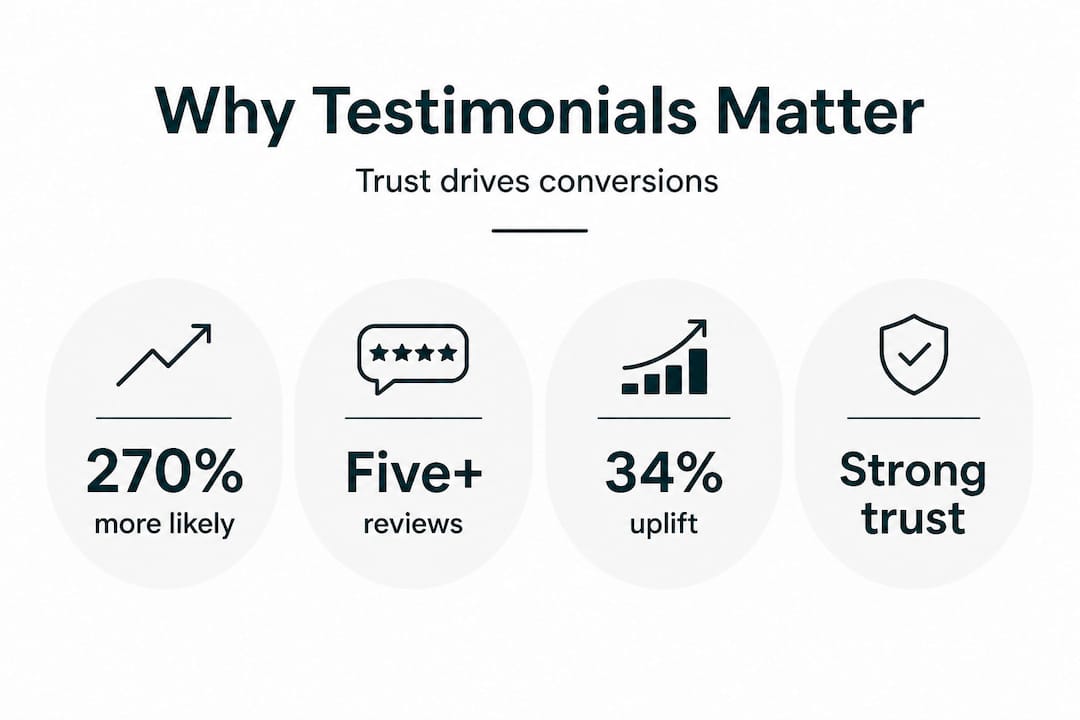
Testimonials are not just a nice touch on your website. They are one of the most powerful tools you have to turn curious visitors into paying customers. In fact, pages with testimonials can see up to 34% higher conversion rates. For Melbourne small businesses competing in a crowded local market, that kind of uplift is not something you can afford to ignore. This guide walks you through why testimonials work, what makes them effective, where to place them, and how to avoid the common mistakes that quietly cost businesses enquiries every day.
Table of Contents
- Why testimonials matter for small business websites
- What makes a powerful testimonial: Features, formats, and best practices
- Where to place testimonials and how to optimise their impact
- Common mistakes and expert tips for testimonial success
- Real lessons Melbourne businesses learn about testimonials
- Boost your website results with Melbourne experts
- Frequently asked questions
Key Takeaways
| Point | Details |
|---|---|
| Trust drives conversions | Genuine testimonials increase customer trust and uplift sales results for local businesses. |
| Quality beats quantity | A handful of specific, credible testimonials can outperform dozens of vague ones. |
| Video testimonials stand out | Adding video testimonials delivers some of the highest conversion boosts. |
| Placement and updates matter | Strategic and regularly refreshed testimonials keep trust high and maximise impact. |
| Avoid common pitfalls | Steer clear of fake or outdated testimonials to maintain credibility and business growth. |
Why testimonials matter for small business websites
Think about the last time you tried a new café, tradie, or accountant. Chances are you checked reviews first. Your potential customers do exactly the same thing before they pick up the phone or fill out a contact form.
Testimonials work because they tap into a very human tendency: we trust other people's experiences more than we trust advertising. When a real customer describes a genuine result they achieved with your business, that carries far more weight than anything you can write about yourself. Research confirms this clearly. Customer reviews positively affect online purchase intention, with trust identified as the key mediating factor. In other words, reviews build trust, and trust drives decisions.
The numbers make this even harder to ignore. Products and services with five or more reviews are 270% more likely to be purchased compared to those with none. For a small business in Melbourne, that gap between zero social proof and a handful of quality testimonials could represent a dramatic difference in monthly enquiries.
For service businesses especially, testimonials are critical. When someone is hiring a plumber, a bookkeeper, or a web designer, they cannot inspect the product before they buy. They are making a judgement call based on trust. Testimonials fill that gap.
Here is what genuine testimonials do for your business:
- Build credibility by showing real outcomes from real customers
- Reduce hesitation by answering unspoken objections visitors have
- Support local SEO by adding relevant, natural language content to your site
- Strengthen user experience by making your website feel active and trustworthy
There is also a meaningful SEO benefit. Rich, keyword-relevant testimonials contribute to boosting local SEO by adding authentic content that search engines reward. And a website that feels credible and well-maintained contributes directly to building trust online with both visitors and Google alike.
"People don't buy from businesses. They buy from people they trust."
Generic five-star ratings without context rarely move the needle. What genuinely converts visitors is specificity. A testimonial that says "great service" does very little. One that says "Troov Marketing redesigned our site and we went from two enquiries a week to twelve" tells a story that resonates.
What makes a powerful testimonial: Features, formats, and best practices
Not all testimonials are created equal. A wall of five-star ratings might look impressive at first glance, but it is the quality and structure of each testimonial that determines whether it actually influences behaviour.
The anatomy of a strong testimonial
The most effective testimonials share a few key characteristics:
- Full name and photo of the reviewer (first name only feels anonymous and less credible)
- Business name or suburb for local relevance, especially important in Melbourne
- Specific outcome or result, not just a vague compliment
- Natural language that sounds like a real person, not a marketing tagline
- Relevance to the service or product being promoted nearby on the page
A testimonial like "Sarah M. from Fitzroy said it was good" tells visitors almost nothing. Compare that to "James Nguyen, owner of a Richmond café, said our new website helped him reduce no-shows by 30% because customers could finally book online easily." The second version is specific, credible, and directly relevant.

Types of testimonials and how they compare
| Format | Trust level | Effort to produce | Conversion impact |
|---|---|---|---|
| Written with name and photo | High | Low | Strong |
| Video testimonial | Very high | Medium | Very strong |
| Star rating only | Low | Very low | Weak |
| Case study with data | Very high | High | Excellent |
| Logo-only social proof | Medium | Low | Moderate |
Video testimonials deserve special attention. They are harder to fake and more emotionally engaging than text alone. Video testimonials can increase conversions by up to 80%, making them one of the highest-return content investments you can make. Even a short 60-second clip filmed on a smartphone, where a happy client talks about their experience, can outperform a page full of written quotes.
Collecting strong testimonials does not need to be complicated. The key is to ask the right questions at the right time. Rather than asking clients to "leave a review," try prompting them with something specific like: "What was your biggest concern before working with us, and how did that turn out?" or "What specific result have you noticed since we started working together?" These prompts guide clients toward the detailed, specific responses that actually convert.
Pro Tip: Set a reminder to refresh your testimonials every six months. Outdated testimonials from several years ago can unintentionally signal that your business has not had recent happy customers.
You should also consider schema markup for your testimonials. Schema is a type of code added to your website that helps Google understand and display your reviews directly in search results. This is one of the testimonial best practices that makes a real difference to visibility, and it is something that carries genuine SEO impact for professionals across a range of industries. Before publishing any testimonial, always get written permission from the customer.
Where to place testimonials and how to optimise their impact
Even the best testimonials will underperform if they are buried on a page nobody visits or placed where visitors are not yet thinking about trust. Placement matters as much as content.
Strategic placement by page type
Think about where a visitor is in their decision-making process when they land on each page. Your goal is to match the right testimonial to the right moment of doubt.
-
Homepage – Place one or two strong testimonials near the top of the page, ideally close to your primary call-to-action. Visitors are assessing whether to keep reading, and a compelling quote can instantly build confidence.
-
Service or product pages – Use testimonials that are specific to that service. If someone is reading about your plumbing services, a testimonial from a happy plumbing customer is far more persuasive than a general compliment. Check out service page inspiration to see how this works in practice.
-
Pricing or contact page – This is where visitors face the most hesitation. A testimonial here that addresses cost concerns or describes how easy the process was can be the deciding factor.
-
About page – Personal testimonials that speak to your character, reliability, or communication style fit perfectly here.
-
Thank you and confirmation pages – Reinforcing a new customer's decision with a testimonial reduces post-purchase doubt and increases the chance they refer others.
Pages with well-placed testimonials see measurable results. The conversion rate uplift of up to 34% reflects what happens when testimonials are integrated thoughtfully, not just added as an afterthought. Even more compelling, visitors who spend time reading reviews show a 30% higher average order value, meaning testimonials do not just convert more visitors, they attract customers who spend more.
Pro Tip: Test two versions of a key page, one with testimonials near the top and one without. Even a simple A/B test over 30 days can reveal significant differences in enquiry rates.
For small businesses just starting out with limited testimonials, prioritise quality over quantity. Two or three detailed, specific testimonials placed strategically will outperform ten generic ones scattered randomly. Use structured data (also called structured data insights) to help Google read and display your testimonials in search results. And use the website checklist to confirm your site is set up to make the most of the content you add.
Common mistakes and expert tips for testimonial success
Understanding what not to do is just as important as knowing best practices. Many Melbourne businesses make avoidable errors that actually undermine the credibility they are trying to build.
The biggest testimonial mistakes to avoid
-
Using fake or embellished testimonials. Visitors are remarkably good at detecting inauthentic language. Generic phrases like "amazing company, highly recommend!" with no context raise red flags rather than building confidence.
-
Publishing outdated reviews. A testimonial from five years ago quietly signals that you have not had a satisfied customer since. Keep your testimonials fresh and dated where possible.
-
Overloading pages with too many testimonials. More is not always better. A page flooded with quotes becomes noise. Curate your best five to ten and place them where they matter most.
-
Ignoring negative feedback. A page with only glowing reviews can actually appear less credible. If you have a professional, constructive response to a less-than-perfect review elsewhere online, that authenticity often builds more trust than perfection.
-
Missing specific detail. If a testimonial does not mention a concrete result, a real name, or a relevant situation, it is doing very little work for you.
It is also worth being realistic about the scale of impact. Some marketing claims suggest testimonials can lift conversions by 250% to 380%. Real-world data tells a more measured story. Evidence suggests a positive but realistic correlation between reviews and conversions, with strong gains at the 100-plus review mark. The lesson is not to chase inflated numbers, but to focus on genuine, well-placed testimonials as a consistent long-term strategy.
"Authenticity isn't a tactic. It's the foundation of every testimonial that actually works."
For practical inspiration on how lead-generating site examples handle testimonials, it is worth studying what local businesses are already doing well and applying those lessons to your own site.
Real lessons Melbourne businesses learn about testimonials
Here is something that most testimonial guides miss entirely. The real long-term value of testimonials is not just a percentage point increase in your conversion rate. It is the compounding effect on your local reputation.
In Melbourne's small business landscape, word of mouth still drives a huge amount of new business. When a potential customer in Collingwood reads a testimonial from someone they recognise in Fitzroy, that is not just social proof. That is community validation. It signals that you are a legitimate, active part of the local market. That kind of recognition is worth far more than any generic five-star badge.
We have seen this play out repeatedly. Businesses that collect and display honest, specific testimonials from local customers build a recognisable presence over time. They become the business that "everyone seems to use." That reputation compounds. Referrals increase. Return customers bring their friends. And new visitors to your site feel like they are already part of a trusted community before they even make contact.
The key word here is honest. Testimonials that are verifiable, specific, and transparently attributed do more for your long-term brand than a dozen polished quotes ever could. Transparency is a differentiator in a market where everyone is trying to look perfect.
Check out how service page conversion lessons put this philosophy into action. The businesses that convert best are not the ones with the slickest sites. They are the ones that feel real.
Boost your website results with Melbourne experts
At Troov Marketing, we work with Melbourne small businesses every day to build websites that do more than look good. We integrate testimonials strategically into service pages, homepages, and contact pages as part of a broader structure designed to convert visitors into enquiries. Our team understands the local market and knows what Melbourne customers respond to. If you are ready to make your website work harder, explore our Melbourne web design experts page to see how we approach this for local businesses. You can also grab our free ultimate website checklist to assess where your site stands right now and identify your biggest opportunities for improvement.
Frequently asked questions
How many testimonials does my website need?
Start with at least five genuine, specific testimonials. Products with 5+ reviews are 270% more likely to be purchased, making that number a practical minimum for building meaningful credibility.
Are video testimonials better than written ones?
Video testimonials generally deliver stronger trust signals because they are harder to fake and more emotionally engaging. Video testimonials can increase conversions by up to 80%, making them worth the extra effort to produce.
Does having fake or generic testimonials harm my business?
Yes. Visitors can detect inauthenticity quickly, and fake or overly polished testimonials can reduce trust rather than build it, potentially driving potential customers to a competitor who feels more genuine.
Where should testimonials be placed for best results?
Place testimonials on your homepage near your main call-to-action, on service or product pages matching the relevant service, and on your contact or pricing page where visitors are closest to making a decision.