

TL;DR:
- Effective property branding in Melbourne combines digital signals, messaging, and website structure.
- Consistent local SEO, Google Profile, and schema markup are critical for online visibility.
- Building trust across all touchpoints and focusing on local search optimizes enquiry flow.
Many Melbourne property owners pour money into logos and colour palettes, then wonder why enquiries stay flat. The truth is that flashy visuals alone won't get your property site found, trusted, or remembered. Effective branding is a system, not a single design choice. It covers your digital identity, your website structure, your local search presence, and the consistent message you send across every touchpoint. This guide breaks down exactly what property site branding means, why it matters in Melbourne's competitive market, and the practical steps you can take to build a brand that actually works.
Table of Contents
- What is property site branding and why does it matter?
- Step-by-step guide to building a winning brand for your property site
- Digital visibility: why strong branding isn't just about visuals
- Building trust and consistency: applying your brand across every touchpoint
- A Melbourne-first approach: what most property brands miss
- Take your Melbourne property brand further
- Frequently asked questions
Key Takeaways
| Point | Details |
|---|---|
| Entity first | Digital visibility and trust signals are more crucial than surface visuals for Melbourne property brands. |
| Consistency matters | Every touchpoint from your website to signage must reinforce the same professional message. |
| Step-by-step process | Building a standout brand involves UVP, local SEO, investor data, and regular audits. |
| Investor vs. owner focus | Investor brands must feature data-backed proof, while owners should balance visuals and clear local presence. |
What is property site branding and why does it matter?
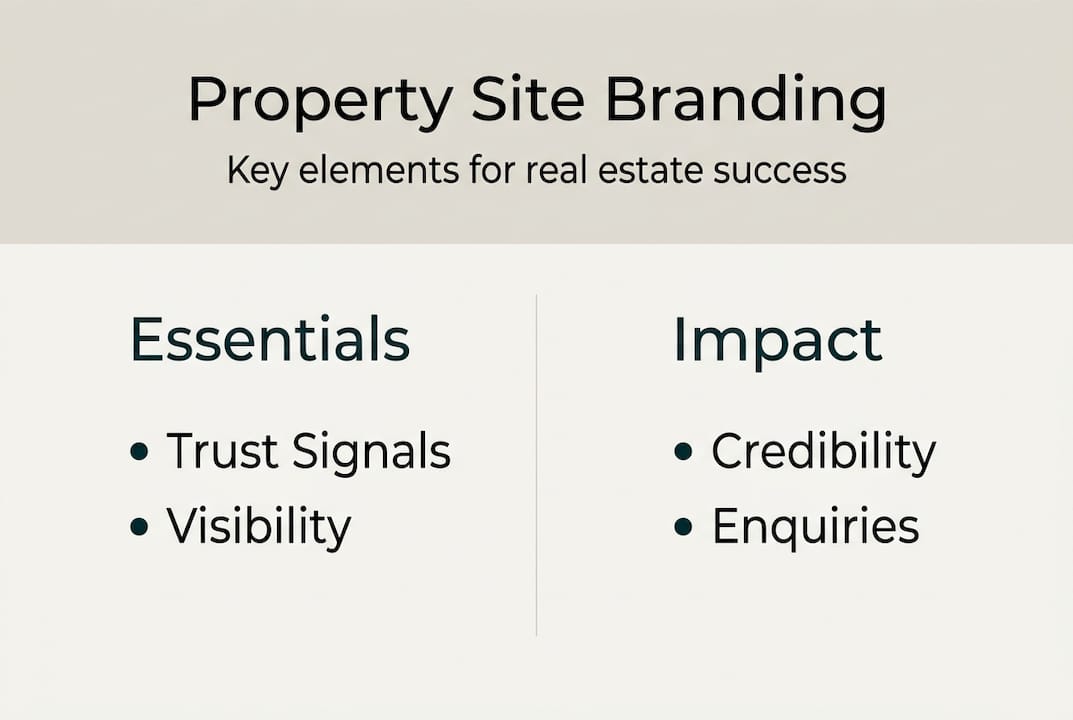
Property site branding is the full set of signals your business sends to prospective clients and investors, both online and offline. It's not just your logo or colour scheme. It's the combination of your digital identity, your website experience, your messaging, and how consistently all of these appear wherever people encounter your business.
For Melbourne property owners and investors, branding plays a direct role in three things: trust, credibility, and findability. A potential tenant searching for a rental manager in Brunswick, or an investor researching opportunities in Footscray, will judge your professionalism within seconds of landing on your site or finding your Google listing. If your brand feels inconsistent or hard to find, they'll move on.
It's also worth noting that branding looks different depending on your goal. A property owner focused on attracting tenants needs warm, reassuring messaging that highlights reliability and responsiveness. A real estate investor, on the other hand, needs a brand built around data, transparency, and performance. Both need strong digital foundations, but the tone and content differ significantly. You can explore more about designing property sites tailored to these goals.
Here are the core elements that make up a complete property site brand:
- Unique Value Proposition (UVP): What makes you the right choice for your target client in Melbourne?
- Visual identity: Logo, colours, typography, and photography that reflect your market position
- Content and messaging: The words you use, the stories you tell, and the problems you solve
- Website: Your digital storefront, structured for both users and search engines
- Local SEO: Suburb-specific pages, schema markup, and Google Business Profile
- Consistency: The same look, tone, and message across every channel
According to property investor branding insights, visual branding alone fails without a strong digital entity behind it. The essential branding steps for real estate include defining your UVP, niche targeting such as luxury or investor-focused suburbs, and treating your website as your flagship with local keywords, suburb pages, and schema. Strategy always comes before visuals.
"Your brand strategy needs to be locked in before you open a design tool. The visuals are just the expression of a decision you've already made."
This mindset shift is what separates property brands that generate consistent enquiries from those that look good but stay invisible. Boosting your local SEO foundations is just as important as getting your logo right.
Step-by-step guide to building a winning brand for your property site
Now that we know what branding is, here's a practical step-by-step process tailored for Melbourne property professionals.
- Define your UVP. What specific problem do you solve, and for whom? Be precise. "Property management in Melbourne" is not a UVP. "Stress-free investment property management for landlords in Melbourne's inner north" is.
- Research your audience. Understand whether you're speaking to owner-occupiers, landlords, or investors. Each group has different fears, goals, and language preferences.
- Develop your visual identity. Logo, colour palette, and typography should reflect your market position. A luxury investor brand looks very different from a community-focused rental manager.
- Build your website with SEO in mind. Your site needs suburb-specific pages, fast load times, and structured data (schema). These essential branding steps are non-negotiable for Melbourne visibility.
- Set up and optimise your Google Business Profile. This is your most powerful free local trust signal. Get it right before spending on anything else.
- Establish your social presence. Choose one or two platforms where your audience actually spends time, and show up consistently.
- Apply your brand consistently. Every email, listing, and social post should feel like it comes from the same business.
Pro Tip: Before investing in a new website design, make sure your Google Business Profile is fully optimised with accurate categories, photos, and suburb-specific details. It's often the first thing a prospective client sees, and it's free. Read more on SEO for property managers to understand why this step matters so much.
| Brand element | Property owners | Real estate investors |
|---|---|---|
| UVP focus | Reliability, local knowledge | Returns, transparency, data |
| Website content | Tenant guides, suburb info | Cap rates, IRRs, case studies |
| Visual tone | Warm, approachable | Professional, data-driven |
| SEO priority | Suburb + service pages | Investment-focused keywords |
| Trust signals | Reviews, response time | Track record, financials |
Also consider your domain management approach, as a well-chosen domain name reinforces your brand and supports local search rankings from day one.
Digital visibility: why strong branding isn't just about visuals
Branding steps in place, the next crucial question is whether your site actually shows up where it matters most.
Here's a scenario worth thinking about. Two Melbourne property managers each spend on their brand. One invests $10,000 in a beautifully designed website with no local SEO, no Google Business Profile, and no schema markup. The other builds a simpler site for a fraction of the cost but sets up every digital trust signal correctly. Six months later, the second business is ranking on page one for their suburb searches. The first is invisible.
This is not a hypothetical. Visual branding without digital entity consistently underperforms because search engines and prospective clients rely on structured signals to verify your credibility. Google Business Profile, local keywords, and schema markup are the foundations of digital trust.
| Approach | Design investment | Local SEO | Visibility outcome |
|---|---|---|---|
| Visuals only | High ($10k+) | None | Poor search ranking |
| Balanced brand | Moderate | Full setup | Strong local presence |
| SEO-first | Low to moderate | Comprehensive | Best long-term results |
For investor-focused sites, the stakes are even higher. Investors want proof. They want to see performance data, credible case studies, and a site that loads fast on mobile. A mobile-friendly design isn't optional in 2026. It's a baseline expectation.
Quick wins for building your digital entity signals include:
- Claiming and fully completing your Google Business Profile
- Adding schema markup to your website's key pages
- Creating suburb-specific landing pages with locally relevant content
- Earning and responding to Google reviews consistently
Your online branding strategy should treat these technical elements as part of your brand, not as separate tasks. And if you want to see how design and SEO work together, explore combining website design and local SEO for a practical overview.
Building trust and consistency: applying your brand across every touchpoint
Visibility is essential, but sustained trust comes from presenting a united, professional message no matter how people find you.
Think about every place a prospective client or investor might encounter your brand. Your website is the obvious one. But what about your social media profiles, your signboards on a property, your brochures, your portal listings on Domain or realestate.com.au? Each of these is a touchpoint, and each one either reinforces or undermines your brand.

Consistency across all touchpoints builds the kind of trust that turns a curious visitor into a genuine enquiry. For property investors especially, your brand functions as credibility architecture. Every inconsistency is a reason to doubt you.
Here's a simple audit you can do right now. Search for your business name on Google. Look at everything that appears: your website, your Google Business Profile, your social profiles, any directory listings. Ask yourself whether they all tell the same story. This is the "Google Yourself" test, and it's one of the most useful brand checks you can run.
Consistency tips for Melbourne property owners:
- Use the same logo, colours, and fonts across your website, social profiles, and printed materials
- Keep your business name, address, and phone number identical on every platform
- Match the tone of your written content whether it's a listing description or an Instagram caption
- Update all profiles whenever your contact details or services change
- Consider adding virtual tours to your listings for a consistent, high-quality presentation
Pro Tip: For investors, treat every brand touchpoint as a trust signal. A polished PDF brochure that doesn't match your website's visual style creates doubt. Consistency tells the market you're organised, professional, and reliable. Review your property management website essentials to make sure your site is pulling its weight.
A Melbourne-first approach: what most property brands miss
Having explored each facet of branding, here's what actually shifts the dial for property professionals in Melbourne.
Most property owners we speak with have spent real money on a logo or a website redesign, but haven't touched their Google Business Profile in months. Their suburb pages are thin or missing entirely. Their schema markup doesn't exist. And yet they're wondering why their site isn't generating enquiries.
The top-performing property brands in Melbourne do something different. They treat Google, schema, and local trust signals as the core of their brand, not an afterthought. They check their brand the way a prospective client would, by searching their suburb, reading their reviews, and clicking through their site on a phone.
The uncomfortable truth is that a generic template with strong local SEO will outperform a custom-designed site with no digital foundations. Every time. If you want results that are genuinely differentiated, start with Melbourne-first site design that builds trust signals into the structure from day one, not as an add-on.
Take your Melbourne property brand further
If you're ready for your site to be seen and trusted by the right Melbourne clients and investors, here's how to get real-world results.
At Troov Marketing, we work with Melbourne property professionals to build websites and digital brands that are structured for local visibility from the ground up. Whether you need professional site design that reflects your market position, help to optimise your Google Business Profile for suburb-level searches, or want to learn SEO basics so you can manage your own presence with confidence, we're here to help. Reach out to our team and let's build something that works.
Frequently asked questions
What is the most important element of property site branding?
Digital entity signals such as Google Business Profile, local SEO, and schema markup are now more critical than visual design alone for Melbourne property sites. Without them, even the most polished brand stays invisible in local search.
How does investor-focused branding differ from standard owner branding?
Investor sites should lead with data, transparency, and performance metrics like cap rates and IRRs. Investor branding emphasises proof over aesthetics, so your content and site structure need to reflect that priority.
Does my property website design really matter for local SEO?
Yes. A well-structured site with local keywords and suburb pages helps your property business rank higher for Melbourne suburb searches and builds long-term organic visibility.
How can I check if my property brand is working?
Search your business name and key services on Google and review everything that appears. This "Google Yourself" audit quickly reveals gaps in consistency, missing profiles, and visibility issues across your brand touchpoints.