
TL;DR:
- Over 94.8% of property websites contain WCAG errors, risking legal action and missed market reach.
- Accessibility improvements enhance tenant experience, streamline management, and boost trust and inquiries.
- Regular audits and prioritizing key fixes are essential for ongoing compliance and competitive advantage.
Most property owners assume their website is doing its job. But a striking gap exists between what managers believe about their sites and what tenants with disabilities actually experience. 94.8% of homepages globally contain WCAG errors, and Australian property management sites are far from immune. With millions of potential tenants relying on accessible digital tools, this isn't a fringe concern. It's a real business risk and a missed opportunity. This guide breaks down what web accessibility means for your property site, where Australian sites are falling short, and the practical steps you can take to close the gap.
Table of Contents
- What accessibility means for property management sites
- The accessibility gap: Facts, risks and realities in Australia
- How accessibility boosts tenant experience and management efficiency
- Practical steps to improve accessibility on your property site
- Why accessibility is the foundation, not the afterthought, of property management success
- Need help improving your property's website accessibility?
- Frequently asked questions
Key Takeaways
| Point | Details |
|---|---|
| Accessibility gap is real | Most property management sites fall short on accessibility, risking compliance failures and lost tenants. |
| Tenant experience drives value | Accessible sites make it easier for all tenants to engage, boosting satisfaction and management efficiency. |
| Simple steps yield big results | Practical audits and quick improvements can dramatically enhance your site's accessibility without major costs. |
| Competitive advantage awaits | Owners who invest in accessibility early set themselves apart and avoid legal risks. |
What accessibility means for property management sites
Digital accessibility means building websites and online tools that everyone can use, including people with visual, hearing, mobility, or cognitive disabilities. The international standard guiding this is WCAG, or Web Content Accessibility Guidelines. These guidelines set clear rules for how content should be structured, displayed, and interacted with so that assistive technologies like screen readers can work properly.
For property management, this isn't abstract. Think about the everyday tasks tenants perform online: submitting a maintenance request, reviewing a lease, paying rent, or contacting an agent. If your tenant portal or listings page isn't accessible, a significant portion of your potential and existing tenants simply can't complete those tasks.
Consider this: 4.4 million Australians live with disability, representing 18% of the population. That's not a niche audience. These are real people looking for rental properties, reviewing landlord sites, and trying to manage their tenancy online. If your site excludes them, you're limiting your market reach before a conversation even starts.
Key areas where accessibility matters most for property sites include:
- Tenant portals and self-service apps for maintenance and communication
- Property listings with image descriptions and readable text
- Contact forms that work with keyboard navigation alone
- Documents and lease agreements available in accessible formats
- Video walkthroughs with captions or transcripts
Accessibility isn't just about ticking a compliance box. It's about ensuring every prospective tenant can find, evaluate, and engage with your property without unnecessary barriers.
There's also a legal dimension. Australia's Disability Discrimination Act places obligations on service providers, including those offering digital services. Beyond legal risk, there's a growing body of evidence that accessibility is a hidden revenue booster for property businesses. Improving engagement through accessibility reduces bounce rates and builds trust with a wider audience. If you're unsure where to begin, an accessibility checklist tailored to small business sites is a practical starting point.
The accessibility gap: Facts, risks and realities in Australia
With the basics of accessibility established, it's essential to see how Australian property management sites are performing and what risks may be going unnoticed.
Here's where the numbers get uncomfortable. Some reports suggest around 85% of Australian sites are compliant. But broader global data tells a different story: 94.8% of homepages have measurable WCAG errors, and 88% of sites globally fail basic accessibility checks, with Australian government sites among those struggling.
The honest reality is that compliance claims often reflect outdated or incomplete audits. Property management platforms, listings pages, and tenant portals are complex environments with frequent content updates, which makes maintaining accessibility harder than a single site snapshot suggests.
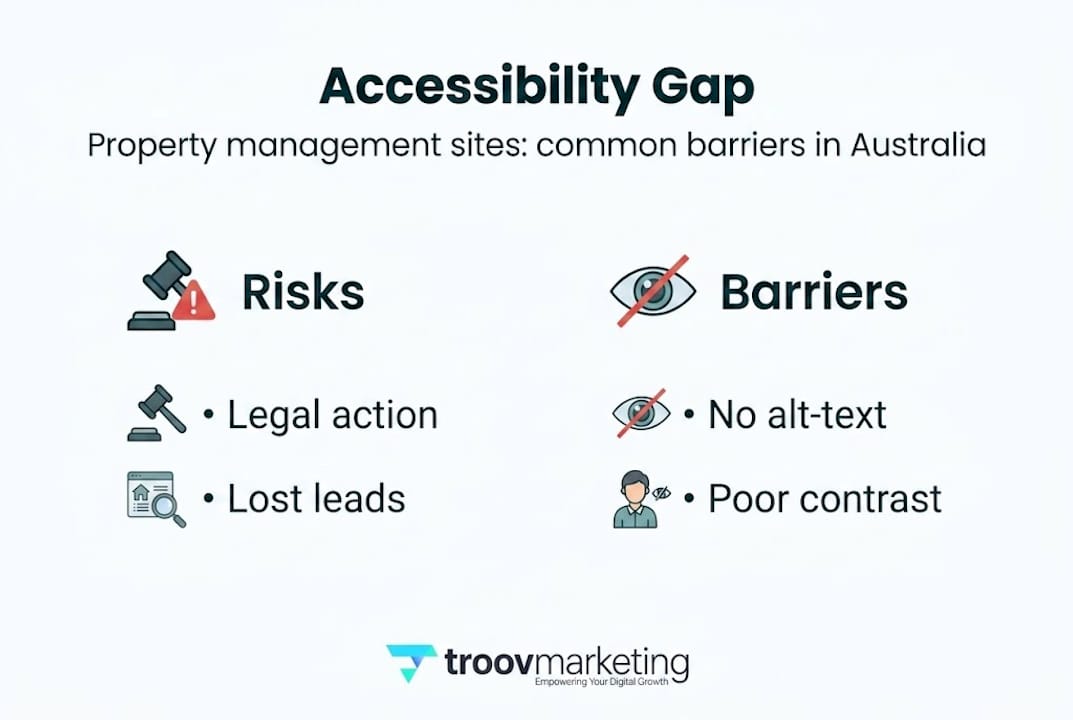
| Common failure | Impact on tenants | Risk level |
|---|---|---|
| Missing image alt-text | Screen readers can't describe photos | High |
| Poor colour contrast | Low-vision users can't read content | High |
| No keyboard navigation | Motor-impaired users are locked out | Critical |
| Inaccessible PDFs | Lease documents unreadable | High |
| Auto-playing video/audio | Cognitive and hearing disruption | Medium |
Common accessibility failures on property portals include:
- Images without alt-text, leaving screen reader users without context for property photos
- Forms that require a mouse, excluding users with motor impairments
- Low contrast text, making listings unreadable for users with visual impairments
- Non-captioned video tours, cutting off deaf or hard-of-hearing tenants
The legal exposure is real. Australia's Disability Discrimination Act applies to digital services, meaning a tenant who cannot access your portal has grounds for a complaint. And beyond legal action, reputational damage from being known as an inaccessible landlord or agency is difficult to recover from.
For property managers focused on lead generation essentials, accessibility barriers quietly suppress enquiry rates. A responsive design guide can help address many structural issues, and reviewing Victorian compliance strategies is a sensible step for any Melbourne-based investor.
How accessibility boosts tenant experience and management efficiency
Understanding the risks is only one side. Let's explore how accessibility upgrades translate into real gains for both digital property management and liveability.
Accessible property sites aren't just about removing barriers. They actively make the management process smoother for everyone. When tenants can independently submit maintenance requests, sign documents, or access their rental history through an easy-to-use portal, your team spends less time on the phone and more time focused on higher-value work.
Platforms like PropertyMe and Property Tree are actively building with WCAG accessibility in mind, recognising that stronger tenant self-service rates improve satisfaction scores and reduce admin overhead. That's a direct efficiency win for property managers.
Here's a straightforward comparison of the tenant experience:
| Feature | Accessible site | Non-accessible site |
|---|---|---|
| Maintenance request | Submitted independently online | Requires phone call or email |
| Lease review | Screen-reader compatible PDF | Scanned image, unreadable |
| Property search | Keyboard navigable filters | Mouse-only, excludes users |
| Contact form | Labelled fields, easy to complete | Unclear fields, high drop-off |
Practical accessibility improvements that make a measurable difference include:
- Add alt-text to all property photos so screen readers can describe them clearly.
- Ensure all forms are keyboard navigable, removing the reliance on mouse interaction.
- Use sufficient colour contrast across all text and button elements.
- Caption all video tours, making them accessible to deaf or hard-of-hearing viewers.
- Structure your content with proper headings, so assistive technologies can navigate the page logically.
Pro Tip: Test your site using a free tool like WAVE or Axe before engaging a specialist. This gives you a baseline understanding of issues before any investment decision.
For property owners thinking about the design layer, designing for accessibility from the outset is far less costly than retrofitting later. Small changes in design thinking at the start create lasting benefits for your tenants and your business.
Practical steps to improve accessibility on your property site
Effective strategies can turn accessibility challenges into clear wins. So what steps should you take to transform your property management site?
The good news is that you don't need to overhaul everything at once. Accessibility improvements work best when prioritised by impact. Start with the changes that affect the most users and create the greatest barriers.
- Run a free audit first. Tools like WAVE, Axe, and Google Lighthouse give you an immediate snapshot of accessibility issues on any page. They flag missing alt-text, contrast failures, and keyboard navigation gaps within minutes.
- Fix colour contrast. This single change improves readability for a large portion of users with low vision. Aim for a contrast ratio of at least 4.5:1 for normal text.
- Label every form field clearly. Unlabelled fields are one of the most common failures on property portals and one of the easiest to fix.
- Make navigation keyboard friendly. Ensure users can tab through your menu, forms, and listings without ever touching a mouse.
- Audit your documents. Lease agreements and inspection reports are often uploaded as scanned images. Convert these to properly tagged PDFs or HTML documents.
Pro Tip: Regular accessibility audits are far more reliable than a one-off compliance claim. Aim to review your site at least twice a year, and after any significant content or design update.
Key areas to prioritise:
- Navigation menus and search filters
- Property listing pages with images
- Tenant portal login and self-service tools
- Contact and enquiry forms
- Any downloadable documents
If your site runs on a platform that doesn't support accessibility upgrades easily, it may be time to consider a rebuild. Website management tools designed for ongoing site health make it easier to stay compliant without constant specialist intervention. When the changes feel beyond your current skills or resources, engaging a professional to handle the technical work is a sound investment.
Why accessibility is the foundation, not the afterthought, of property management success
Most conversations about web accessibility start with compliance. That framing is limiting, and frankly, it's why so many property sites still fall short.
Waiting for a complaint, a regulatory change, or a legal notice to act on accessibility is a reactive strategy. It's also expensive. Retrofitting an inaccessible site costs significantly more in time, money, and disruption than building with accessibility in mind from day one.
But here's what conventional advice misses: accessibility is a competitive signal. When a prospective tenant encounters a site that works well for them, regardless of their ability, that experience builds trust immediately. Trust accelerates enquiries. Enquiries fill vacancies faster. And lower vacancy rates are the single biggest driver of investment returns.
Property owners who treat accessibility as a revenue booster rather than a compliance burden are quietly building a reputation advantage that compounds over time. They attract a broader tenant pool, generate fewer disputes, and retain tenants longer because the management experience is simply easier.
The property investors who outperform in the next decade won't just have great assets. They'll have great digital infrastructure supporting those assets.
Need help improving your property's website accessibility?
If you're ready to act on what you've learned, the next step is getting your site assessed and improved by people who understand both web design and the Australian property context. At Troov Marketing, we help property owners and real estate businesses build websites that are fast, accessible, and structured to perform from day one. Whether you need professional small business web design, want to work through a complete website checklist, or need guidance on website management tools to keep your site compliant ongoing, we're here to help. Reach out to the Troov Marketing team and let's make your property site work for every tenant.
Frequently asked questions
What is WCAG and why does it matter for property management sites?
WCAG stands for Web Content Accessibility Guidelines, an international standard ensuring websites are usable by people with disabilities. With over 94% of homepages containing WCAG errors globally, compliance is both a legal expectation and a practical necessity for property sites in Australia.
How do I check if my property site is accessible?
Free tools like WAVE, Axe, or Google Lighthouse can quickly identify common issues such as missing alt-text, poor colour contrast, or non-keyboard-friendly navigation. Audits are more reliable than generic compliance claims, so test regularly rather than assuming your site is fine.
What are the penalties for non-compliance with accessibility standards?
Sites that aren't accessible risk legal action under Australia's Disability Discrimination Act and can face reputational damage or lose tenant trust over time.
Which features make a property portal more accessible?
Essential features include text alternatives for images, keyboard navigation, readable text with sufficient colour contrast, and easy-to-use self-service tools. Accessible portals like PropertyMe and Property Tree demonstrate how these features lift tenant satisfaction and reduce management workload.
Recommended
- Why Website Accessibility Is Your Small Business's Hidden Revenue Booster
- Website Accessibility Explained: Boost Engagement 20% in 2026
- Responsive Design for Property Sites: Cut Visitor Loss 50%
- Melbourne Property Management: 30% More Leads in 2026
- Accessible Signage: Essential Inclusive Design Guide UK