

TL;DR:
- In 2026, local SEO for property managers depends heavily on Google Business Profile completeness, reviews, and local signals. Optimizing suburb-specific content, technical website foundation, and active review management significantly improve visibility and lead generation. Regular tracking and adapting strategies ensure sustained growth and stronger positioning in local search results.
You have a professional website, great photos of your properties, and a clear list of services. But when a landlord in Richmond or Northcote types "property manager near me" into Google, your business does not appear anywhere near the top. This is a frustration shared by many Melbourne property managers in 2026. The local search landscape has shifted significantly, and simply having a quality website is no longer enough. This guide walks you through the practical, research-backed steps you need to improve your local SEO, attract more enquiries, and grow your rent roll with confidence.
Table of Contents
- Understand what drives local SEO for property managers in 2026
- Prepare your site: Technical SEO essentials for Melbourne property managers
- Create suburb-specific pages and content that converts
- Optimise your Google Business Profile and grow local reviews
- Track what works: Measuring, verifying, and adjusting your SEO
- What most guides miss about local SEO for property managers
- Take your Melbourne property SEO further with expert support
- Frequently asked questions
Key Takeaways
| Point | Details |
|---|---|
| Local SEO factors in 2026 | Google Business Profile completeness, frequent reviews, and local pages are now the biggest ranking drivers for Melbourne property managers. |
| Technical SEO is foundational | Mobile-friendly design and fast site speed are non-negotiable prerequisites for local search success. |
| Unique suburb pages win leads | Creating tailored content, FAQs, and testimonials for each target suburb directly boosts visibility and conversions. |
| Review velocity matters more | Adding 10+ new reviews per month and replying to all builds local authority faster than just chasing high total counts. |
| Track and adapt | Regularly monitor calls, traffic, and interaction for each suburb page to refine your SEO and maximise lead generation. |
Understand what drives local SEO for property managers in 2026
Before you change anything on your website, it helps to understand what actually influences your position in local search results. The rules have evolved, and what worked a few years ago may now be holding you back.
The SEO impact for property managers in 2026 is enormous. Local intent searches now represent 46% of all searches, and 76% of people who find a local business visit or contact it within 24 hours. That means every day your site does not appear in local results is a real, measurable loss of potential clients.
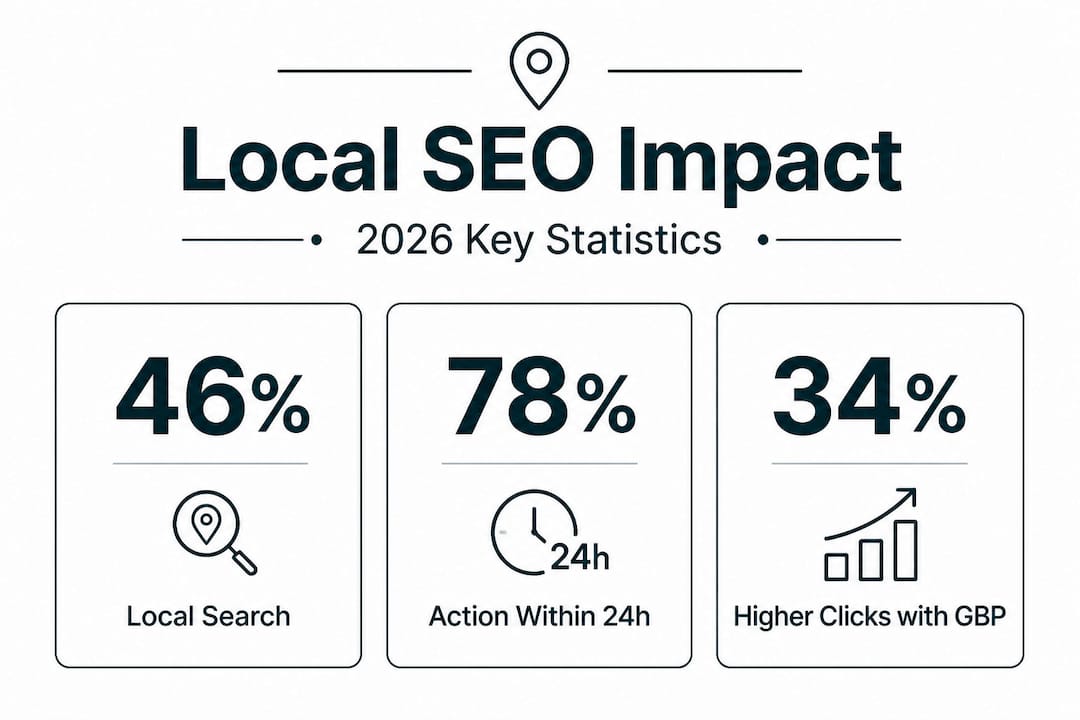
Here is a snapshot of the key local ranking factors and their estimated weight for property management businesses in 2026:
| Ranking factor | Estimated weight | What it means for you |
|---|---|---|
| Google Business Profile (GBP) completeness | 32% | A fully completed GBP is the single biggest lever you can pull |
| Reviews (quantity, recency, responses) | 24% | Fresh reviews posted regularly carry more weight than a large historical count |
| On-page local signals (suburb content, schema) | 21% | Pages that speak directly to local suburbs get indexed and ranked better |
| Behavioural signals (calls, clicks, engagement) | 15% | How users interact with your listing matters as much as your content |
| Link signals and citations | 8% | Quality directory listings and local backlinks still play a supporting role |
Understanding SEO trends for Melbourne businesses makes it clear that behavioural signals are becoming far more important. Google pays close attention to whether people actually click on your listing, call your office, or visit your website. Keyword stuffing, which means cramming location names into pages without context, no longer moves the needle.
Key takeaways for property managers at this stage:
- Prioritise your Google Business Profile before anything else
- Think about how your ideal clients actually search, using phrases like "rental property manager Fitzroy" or "best property management South Yarra"
- User behaviour on your site, such as time spent reading and clicking to call, signals quality to Google
"Local SEO in 2026 rewards businesses that genuinely serve their community, not those that simply optimise for algorithms."
Prepare your site: Technical SEO essentials for Melbourne property managers
With an understanding of local SEO priorities, it is time to get your website's technical foundation in order. Even excellent content will underperform if your website has fundamental technical problems.
Mobile responsiveness and clear site architecture are the starting point for any effective local SEO strategy. More than 70% of local property searches happen on mobile devices, so a site that loads slowly or displays poorly on a phone will cost you enquiries directly.
Consider the difference between these two site setups:
| Technical element | Poorly optimised site | Well-optimised site |
|---|---|---|
| Mobile load speed | 7+ seconds | Under 2.5 seconds |
| Schema markup | None | LocalBusiness and RealEstateAgent schema in place |
| Site architecture | Flat, no suburb pages | Clear hierarchy with suburb service pages |
| HTTPS | Not active | Fully secured |
| Internal linking | Minimal | Strategic links between suburb pages and service pages |
Responsive design for property sites is not just about aesthetics. Google uses mobile-first indexing, which means it primarily uses the mobile version of your site for ranking decisions. If your mobile experience is poor, your rankings will reflect that regardless of how well your desktop site performs.

Schema markup is worth taking seriously. Schema is a type of code added to your website that helps Google understand exactly what your business does and where it operates. For a Melbourne property manager, adding RealEstateAgent or LocalBusiness schema to your pages tells Google your name, address, phone number, and service areas without any ambiguity. This directly improves how your business appears in search results, often generating rich snippets with your contact details and star ratings visible right in the results page.
Common technical issues that undermine property management sites include:
- Duplicate content across suburb pages (copying the same text and changing only the suburb name)
- Missing or broken meta descriptions and title tags
- No sitemap submitted to Google Search Console
- Slow image loading due to uncompressed photos of properties
- Poor domain management for SEO, such as inconsistent domain usage across listings
Pro Tip: Run your site through Google's PageSpeed Insights (free tool) and aim for a score above 80 on mobile. Fix the top three issues flagged and you will often see a meaningful improvement in both rankings and bounce rate within weeks.
Create suburb-specific pages and content that converts
Once your technical foundation is solid, it is time to speak directly to your local audience using suburb-focused pages. This is where many property managers fall short and where the biggest opportunity lies.
Suburb-specific service pages should include unique content, local keywords in the title and main heading, FAQs tailored to that area, local testimonials, schema markup, and strong calls to action. This is not about duplicating a template. It is about genuinely addressing what landlords and property investors in that suburb care about.
Here is a practical process for building each suburb page:
- Choose your target suburbs based on where you currently manage properties or want to grow. Start with your five strongest areas.
- Research local keywords by typing "[suburb] property management" into Google and noting the auto-suggest phrases. These show you exactly what people search.
- Write genuinely unique content for each page, including references to local rental market conditions, nearby infrastructure, or tenant demographics specific to that suburb.
- Add a local FAQ section addressing questions like average rental yields, common lease terms in that area, or what landlords should know about that suburb's property market.
- Include a recent testimonial from a client in or near that suburb. Even one genuine local review used as a quote builds immediate credibility.
- Add a strong call to action such as "Get a free rental appraisal for your [suburb] property" with a visible contact form or click-to-call button.
Understanding the types of property management websites that perform well in Melbourne shows that businesses combining suburb-specific pages with strong property management lead generation structures consistently outperform those with generic service pages.
"A page titled 'Property Management in Prahran' with real local content will outperform a generic 'Services' page every time, even if the generic page has been live for years."
Pro Tip: Do not try to build 30 suburb pages at once. Build three excellent ones first, measure the results over 60 to 90 days, and use that data to guide your expansion strategy.
Optimise your Google Business Profile and grow local reviews
To get found and chosen over competitors, your online presence needs validation from Google and happy clients. Your Google Business Profile (GBP) is essentially your digital storefront in local search and Google Maps. If it is incomplete or inactive, you are invisible in the local pack.
Businesses with active GBP posts see 34% higher click-to-call rates, and review velocity (meaning collecting more than 10 new reviews per month) combined with responding to every review are among the strongest ranking signals in 2026.
Follow these steps to maximise your GBP:
- Complete every field in your profile including business category (use "Property Management Company"), service areas covering your Melbourne suburbs, business hours, and a compelling business description with local keywords.
- Upload fresh photos regularly, including team photos, your office, and managed properties where appropriate. Google rewards active profiles.
- Post weekly updates using the GBP Posts feature. Share rental market tips, recent client results, or local news relevant to landlords in your area.
- Ask every satisfied client for a review immediately after a positive interaction. The timing matters. A client who just had a seamless lease renewal is far more likely to leave a review than one asked six months later.
- Respond to every review, positive and negative. A professional, genuine response to a negative review often builds more trust than several positive ones.
34% higher click-to-call rates for businesses with active GBP posts is a number worth pausing on. That is not a marginal improvement. For a property manager handling 150 properties who wants to grow to 200, that difference in click-through behaviour could represent five to ten new management contracts per year.
Full GBP optimisation steps and local listing optimisation across directories like True Local, Hotfrog, and industry-specific platforms also support your GBP by reinforcing your business name, address, and phone number consistency across the web. This consistency, known as NAP consistency (Name, Address, Phone), is a foundational trust signal for Google.
Pro Tip: Set a monthly reminder to check your GBP for accuracy. Business hours, service areas, and contact details can change, and an outdated profile causes Google to reduce your local pack visibility.
Track what works: Measuring, verifying, and adjusting your SEO
With your new local SEO strategies live, consistent measurement ensures your efforts deliver real results. Many property managers invest in SEO improvements and then forget to check whether they are working. Behavioural signals including CTR (click-through rate), calls, and entity signals require continual adjustment as AI-powered algorithms evolve.
Here are the key metrics to track monthly:
| Metric | Tool | What to look for |
|---|---|---|
| GBP profile views and actions | Google Business Profile Insights | Rising calls and direction requests month on month |
| Organic traffic by suburb page | Google Analytics 4 | Which suburb pages drive the most sessions |
| Click-to-call rate | GBP Insights / call tracking | Percentage of visitors who call directly |
| Keyword rankings | Google Search Console | Position changes for suburb-based search terms |
| Lead form submissions | Google Analytics 4 events | Number of enquiry forms completed per month |
Tracking these numbers does not have to be complicated. Google Search Console and Google Analytics 4 are both free and provide the data you need. Check them once a month and note trends rather than obsessing over daily fluctuations.
Useful signals to watch for include:
- A suburb page receiving more traffic but fewer calls may need a stronger call to action
- A page with good rankings but a high bounce rate may have content that does not match user intent
- A drop in GBP views often follows a gap in posting activity or new reviews
Designing for lead growth and using essential website management tools consistently means you can adapt quickly when something is not working, rather than waiting months to notice a problem.
What most guides miss about local SEO for property managers
Most SEO guides for property managers focus on checklists. Do these ten things and you will rank. The reality is more nuanced, and the businesses that grow consistently are those that understand why these strategies work, not just what to do.
One-size-fits-all SEO rarely works in property management. A firm managing luxury apartments in South Yarra needs a completely different content and keyword approach than one specialising in student accommodation near Melbourne CBD. If your SEO strategy does not reflect your actual market position, you will attract traffic that never converts.
The phase-based approach we recommend at Troov Marketing starts with technical foundations, moves to local optimisation, and builds into content and review growth. This phased method compounds over time. Fixing your technical issues first means every piece of content you add afterwards performs better from day one. Jumping straight to suburb pages without fixing site speed is like building walls before laying the foundation.
Many property managers focus on sheer review count rather than review velocity and response behaviour. Google in 2026 weighs recent reviews far more heavily than old ones. Ten reviews received this month matter more than fifty reviews collected two years ago. Responding to every review signals to Google that your business is active and engaged.
Behavioural signals are the most underappreciated factor. When someone searches "property manager Brunswick" and clicks your listing, scrolls through your suburb page, and then calls you, Google notices. That pattern tells the algorithm your page is genuinely relevant and useful. This is why why SEO for property managers is about the whole experience, not just keyword placement.
The property managers who outmanoeuvre larger competitors in local search are not outspending them. They are out-localising them. Specific suburb content, fresh reviews, active GBP management, and fast mobile sites create a compounding advantage that a big agency with a generic site simply cannot replicate.
Take your Melbourne property SEO further with expert support
Ready to put these strategies into action? At Troov Marketing, we work specifically with Melbourne property managers to build websites and local SEO strategies that deliver real enquiries. Our Melbourne web design expertise means your site is built fast, mobile-first, and structured for local search from day one. We also provide hands-on GBP optimisation for Melbourne businesses, helping you move up the local pack and attract more click-to-calls. If you are ready to grow your rent roll with a site that actually works for you, explore our Melbourne SEO solutions and find out how a focused, phase-based approach can make a measurable difference to your business.
Frequently asked questions
How do I choose the right local keywords for my property management site?
Focus on suburb names combined with "property management" and service variations your ideal clients actually use. Location-specific pages with local keywords in your title and headings are the most effective way to rank for these searches.
Does getting more Google reviews help my Melbourne property management SEO?
Yes, and the timing matters as much as the volume. Review velocity of 10 or more new reviews per month, combined with responding to every review, is one of the strongest local ranking signals in 2026.
How can I make sure my site appears in the Google local pack?
A complete and active Google Business Profile combined with suburb-specific pages and consistent NAP details gives you the best chance. GBP completeness accounts for 32% of local pack ranking weight, making it the single most impactful factor.
Do I need different content for each suburb page?
Absolutely. Copying the same text across pages and changing only the suburb name is penalised by Google and ignored by users. Each suburb page needs unique content, local testimonials, and tailored FAQs to earn rankings and convert visitors.
What metrics should I track to know my SEO is working?
Monitor GBP profile views, calls, suburb-level organic traffic, and lead form submissions each month. Active GBP businesses see 34% higher click-to-call rates, so GBP engagement is one of the clearest early indicators that your local SEO is gaining traction.
Recommended
- Why SEO for property managers drives local leads in 2026
- Domain management for property managers: boost Melbourne local SEO
- Melbourne Property Management: 30% More Leads in 2026
- How to optimise your site for local search in Melbourne
- Why SEO matters for service businesses: boost local visibility — Locally Visible